

Research roundup: 7 cool science stories we almost missed
Double-detonating “superkilonova,” Roman liquid gypsum burials, biomechanics of kangaroo posture, and more.
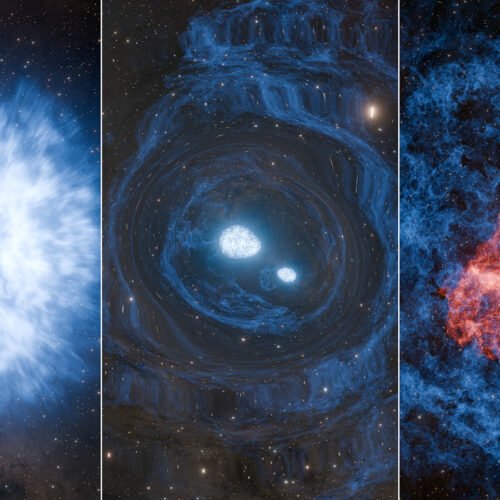
Three stages of a superkilonova: a supernova blast, neutron star merger, and finally kilonova that spews heavy metals.
Credit:
Caltech/K. Miller and R. Hurt (IPAC)
It’s a regrettable reality that there is never enough time to cover all the interesting scientific stories we come across each month. In the past, we’ve featured year-end roundups of cool science stories we (almost) missed. This year, we’ve experimented with a monthly collection. December’s list includes a fossilized bird that choked to death on rocks; a double-detonating “superkilonova”; recovering an ancient seafarer’s fingerprint; the biomechanics of kangaroo movement; and cracking a dark matter puzzle that stumped fictional physicists on The Big Bang Theory, among other tantalizing tidbits
Secrets of kangaroo posture
Kangaroos and wallabies belong to a class of animals called macropods, with unique form and style of movement. Their four limbs and tail all contact the ground at slow speeds, while they use a hopping gait at higher speeds. Typically, high-speed movements are more energy-intensive than slow-speed motion, but the opposite is true for macropods like kangaroos; somehow the hopping speed and energy cost become uncoupled. According to a paper published in the journal eLife, this may be due to changes in a kangaroo’s posture at higher hopping speeds.
To investigate their hypothesis, the authors used 3D motion capture and data from force plates to create a 3D musculoskeletal model to analyze the motions of red and grey kangaroos, focusing on how body mass and speed influence three factors during hopping: hindlimb posture, efficiency of movement and associated tendon stress; and the ankles. This revealed that kangaroos adjust their posture so that the hindlimbs are more crouched while hopping, with the ankle joint doing most of the work per hop. The crouching position increases energy absorption, thus improving efficiency.
DOI: eLife, 2025. 10.7554/eLife.96437.3 (About DOIs).
Fossilized bird choked on rocks
Credit:
Jingmai O’Connor
Some 120 million years ago, a tiny bird choked to death on a bunch of small rocks lodged in its throat. Paleontologists recently discovered the fossil among the many specimens housed at the Shandong Tianyu Museum of Nature in China. Not only does it represent a new species—dubbed Chromeornis funkyi, after techno-funk duo Chromeo—the fossilized bird is the first such specimen to be found with a throat filled with stones, according to a paper published in the journal Palaeontologica Electronica.
Certain bird species, like chickens, swallow small stones and store them in their gizzards to help grind up food. The authors examined prior CT scans of fossilized birds with gizzards and quantified how many gizzard stones were present, then compared that data to a CT scan of the C. funkyi fossil. The scan showed that the more than 800 tiny stones lodged in the throat were not gizzard stones. So the bird didn’t swallow the stones to help grind up food. The authors suggest the bird was sick; sick birds will sometimes eat stones. When it tried to regurgitate the stones, they got stuck in the esophagus and the poor bird choked to death.
DOI: Palaeontologica Electronica, 2025. 10.26879/1589 (About DOIs).
“Superkilonova” exploded twice
Back in 2017, astronomers detected a phenomenon known as a “kilonova”: the merger of two neutron stars accompanied by powerful gamma-ray bursts. Recording this kind of celestial event was unprecedented, and it officially marked the dawn of a new era in so-called “multi-messenger astronomy.” It’s the only unambiguously confirmed kilonova to date, but astrophysicists reported evidence of a possible second such event in a paper published in The Astrophysical Journal Letters. And it’s unusual because this kilonova may have originated from a supernova blast mere hours before, making it a “superkilonova.”
Supernovae are the spectacular explosions that result from dying massive stars, seeding the universe with heavy elements like carbon and iron. Kilonovae occur when two binary neutron stars begin circling into their death spiral, sending out powerful gravitational waves and stripping neutron-rich matter from each other. Then the stars collide and merge, producing a hot cloud of debris that glows with light of multiple wavelengths. It’s the neutron-rich debris that astronomers believe creates a kilonova’s visible and infrared light—the glow is brighter in the infrared than in the visible spectrum, a distinctive signature that results from heavy elements in the ejecta that block visible light but let the infrared through.
This latest kilonova candidate event, dubbed AT2025ulz, initially looked like the 2017 event, but over time, its properties started resembling a supernova, making it less interesting to many astronomers. But it wasn’t a classic supernova either. So some astronomers kept tracking the event and analyzing combined “multimessenger” data from other collaborations and telescopes during the same time frame. They concluded that this was a multi-stage event: specifically, a supernova gave birth to twin baby neutron stars, which then merged to produce a kilonova. That said, the evidence isn’t quite strong enough to claim this is what definitely happened; astronomers need to find more such superkilnova to confirm.
DOI: Astrophysical Journal Letters, 2025. 10.3847/2041-8213/ae2000 (About DOIs).
An ancient seafarer’s fingerprint
Credit:
Photography by Erik Johansson, 3D model by Sahel Ganji
In the 4th century BCE, an invading mini-armada of about four boats attacked an island off the coast of Denmark. The attack failed and the victorious islanders celebrated by sinking one of the boats, filled with their foes’ weapons, into a bog, where it remained until it was discovered by archaeologists in the 1880s. It’s known as the Hjortspring boat, and archaeologists were recently surprised when their analysis uncovered an intact human fingerprint in the tars used to waterproof the vessel. They described their find in a paper published in the journal PLoS ONE.
The fingerprint is significant because it offers a hint into where those would-be raiders from the sea originally hailed from. Prior scholars had suggested they came from somewhere near what is now Hamburg, Germany. But the authors of this latest paper noticed that the waterproofing tars were pine pitch, concluding that the raiders may have originated in the coastal regions of the Baltic Sea, along which pine-rich forests flourished. That would require the raiders to travel over hundreds of kilometers of open sea. The authors hope they can extract some ancient DNA from the tar to learn more about the ancient people who built the boat.
DOI: PLoS ONE, 2025. 10.1371/journal.pone.0336965 (About DOIs).
Roman liquid gypsum burials
Credit:
Seeing the Dead Project/University of York/York Museums Trust
Speaking of ancient fingerprints, archaeologists at the University of York found finger marks and fingerprints preserved in hardened gypsum used by Romans in Britain in their funerary practices in the third and fourth centuries CE. The university is home to the Seeing the Dead project, which studies the bodies preserved by pouring liquid gypsum (plaster of paris) over them in their coffins prior to burial. The gypsum hardened around the decomposing bodies, creating a cavity while preserving clear imprints of the body contours, clothing, and shrouding. It’s similar to the method used to create casts of the victims of Pompeii.
Some 70 gypsum burials have been found in Yorkshire thus far. In this case, researchers were examining a stone sarcophagus excavated in the 1870s that had yet to be analyzed. While cleaning the artifact and subjecting it to 3D scanning, they noticed a handprint with fingers clearly delineated in the hardened gypsum. They also found distinct fingerprints close to the edges of the coffin. The team had previously thought that the gypsum was heated to at least 300 degrees F (150 degrees C) before being poured over the body, but the handprint and fingerprints suggests someone had smoothed the gypsum over the body by hand, suggesting significantly cooler temperatures. While acknowledging it’s a long shot, the team hopes to extract DNA samples from the sarcophagus which might enable them to determine genetic sex.
Playing Super Mario combats burnout
Credit:
Winze Tam et al./Ninetendo
Young adulthood in the 2020s is fraught with a range of interconnected pressures: soaring cost of living, student loan debt, pressure to excel academically, and an “always on” digital culture, to name a few of the most common stressors. This in turn can lead to burnout. Perhaps playing video games can help—the right kind of video games, like Super Mario Bros. or Yoshi., as opposed to dystopian survival horror games or highly competitive multiplayer games. According to a study published in the journal JMIR Serious Games, Super Mario Bros. and Yoshi can help young adults recapture childlike wonder and reduce stress and anxiety that can lead to burnout.
The authors employed a mixed-methods approach for their study. First, they collected qualitative data from 41 college-aged subjects via in-depth interviews; all were experienced players of those two games. They followed this with a cross-sectional survey to collect quantitative data from 336 players. The resulting analysis showed that those who felt greater childlike wonder while playing also reported higher overall happiness; and the happiest players showed significantly lower risk of burnout. “By moving beyond escapism and nostalgia, [this study] offers a new perspective on how well-designed, globally familiar games can function as accessible, resilience-building digital microenvironments,” the authors concluded.
DOI: JMIR Serious Games, 2025. 10.2196/84219 (About DOIs).
Cracking a Big Bang Theory problem
Credit:
CBS
Physicists may have had mixed feelings about The Big Bang Theory‘s depiction of their profession, but one thing the sitcom consistently got right was the equations featured on the ubiquitous white board—clever Easter eggs for physicists, courtesy of science advisor David Saltzberg. In one episode, Sheldon and Leonard are pondering an equation about how axions are generated from the sun—part of the duo’s efforts to estimate the likelihood of detecting axions produced by a fusion reactor. Leonard and Sheldon failed on that point, but real-world physicists think they’ve now cracked the case, according to a paper published in the Journal of High Energy Physics.
Axions are hypothetical particles that could explain dark matter— the mysterious substance that comprises about 23 percent of all the mass in our universe—and represent a theoretical alternative to WIMPs, which thus far have eluded detection by physicists. Particles can exhibit wavelike behavior as well as particle characteristics. So an axion would behave more like a wave (or wave packet) than a particle, and the size of the wave packets is inversely proportional to their mass. That means these very light particles don’t necessarily need to be tiny. The downside is that they interact even more weakly with regular matter than WIMPS, so they cannot be produced in large colliders.
So physicists have been developing all kinds of smaller experiments for detecting axions, from atomic clocks and resonating bars, to shining lasers at walls on the off-chance a bit of dark matter seeps through the other side. Co-author Jure Zupan of the University of Cincinnati and colleagues proposed that axions could be produced by a fusion reactor powered by deuterium and tritium contained in a lithium-lined vessel. Among the fusion byproducts of such a reactor would be a large flux of neutrons which would interact with materials in the walls, or collide with other particles, thereby releasing energy and creating new particles: possibly axions or axion-like particles.
DOI: Journal of High Energy Physics, 2025. 10.1007/JHEP10(2025)215 (About DOIs).
Jennifer is a senior writer at Ars Technica with a particular focus on where science meets culture, covering everything from physics and related interdisciplinary topics to her favorite films and TV series. Jennifer lives in Baltimore with her spouse, physicist Sean M. Carroll, and their two cats, Ariel and Caliban.
