

NASA’s first skywatching tips of 2026 include a very bright planet
Look up for some great views at the start of 2026.
What’s Up: January 2026 Skywatching Tips from NASA
For skywatchers, 2026 kicks off with a great chance to view Jupiter at its biggest and brightest, according to NASA’s latest set of tips on what to look out for in the night sky over the coming month. But there’s more than just Jupiter to enjoy, so read on to find out more.
Jupiter at opposition
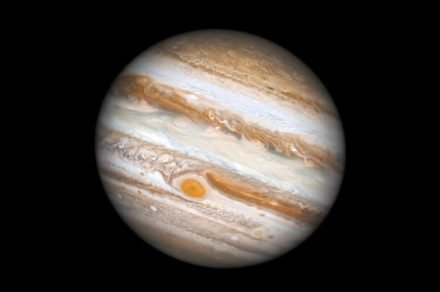
On January 10, the largest planet in our solar system will be at its most brilliant in all of 2026, so it’s definitely one to catch.
“This night, Jupiter will be at what’s called ‘opposition,’ meaning that Earth will be directly between Jupiter and the sun,” NASA explained in a video shared this week (top). “In this alignment, Jupiter will appear bigger and brighter in the night sky than it will all year.”
To find it, look to the east and you’ll see the planet in the constellation Gemini. It’ll also be one of the brightest objects in the night sky, so it should be easy to spot — clear skies permitting, of course. In fact, only the moon and Venus will appear brighter on the evening of January 10.
The moon and Saturn conjunction
Next up, Saturn and the moon will share the sky on January 23 as part of a conjunction.
“A conjunction happens when objects in the night sky look close together even though they’re actually far apart,” NASA says in the video.
You’ll find the moon easily enough. Look a little bit harder and you should also be able to see Saturn just below our nearest neighbor, glinting faintly in the night sky.
The Beehive Cluster
Finally, January offers a chance to view the Beehive Cluster, also known as Messier 44, or even M44. The Beehive Cluster, which was first resolved into individual stars through a telescope by Galileo in 1609, comprises at least 1,000 stars in an open star cluster, meaning it’s a loosely bound group of stars.
To find the Beehive Cluster, look to the east just after sunset and before midnight over the coming weeks, with NASA suggesting the middle of the month as a great opportunity as at that time the cluster won’t be too high or too low in the sky.
If the sky is dark enough with little light pollution around, you might be able to see the Beehive Cluster with the naked eye, but if you have access to binoculars or a telescope, use them for an even better viewing experience.
Not so many moons ago, Trevor moved from one tea-loving island nation that drives on the left (Britain) to another (Japan)…
Watch SpaceX set a new record with its trusty Falcon 9 rocket
It launched from Florida’s Space Coast on Monday night.
A SpaceX Falcon 9 has launched and landed a record 32 times following a successful mission on Monday night.
The Falcon 9 first-stage booster — listed as B1067 — lifted off at 5:26 p.m. ET from Launch Complex 39A (LC-39A) at NASA’s Kennedy Space Center in Florida.
‘We definitely feel the pressure’ — Historic lunar flight could be just around the corner
One of the Artemis II astronauts says they’re starting to feel the pressure as the launch fast approaches.
The days and months roll by, you’re watching a new video from one of the Artemis II crew, and he says something that makes you sit up.
“We’re two-and-a-half months from our first potential launch time,” NASA astronaut Reid Wiseman said in his weekly update from the Johnson Space Center in Texas, where he and fellow NASA astronauts Victor Glover and Christina Koch, along with Canadian Space Agency astronaut Jeremy Hansen, have been in training since when they were announced as part of the crew in 2023.
After the fireworks: The everyday journey of a Falcon 9 space rocket
A rocket’s life away from the limelight.
SpaceX has been landing the first stage of its workhorse Falcon 9 booster since 2015, and the sight of the vehicle coming in for an upright touchdown, engines blazing, never gets old.
Most of the landings take place on a droneship waiting in the ocean, though occasionally SpaceX also lands the booster back near the launch site.
