

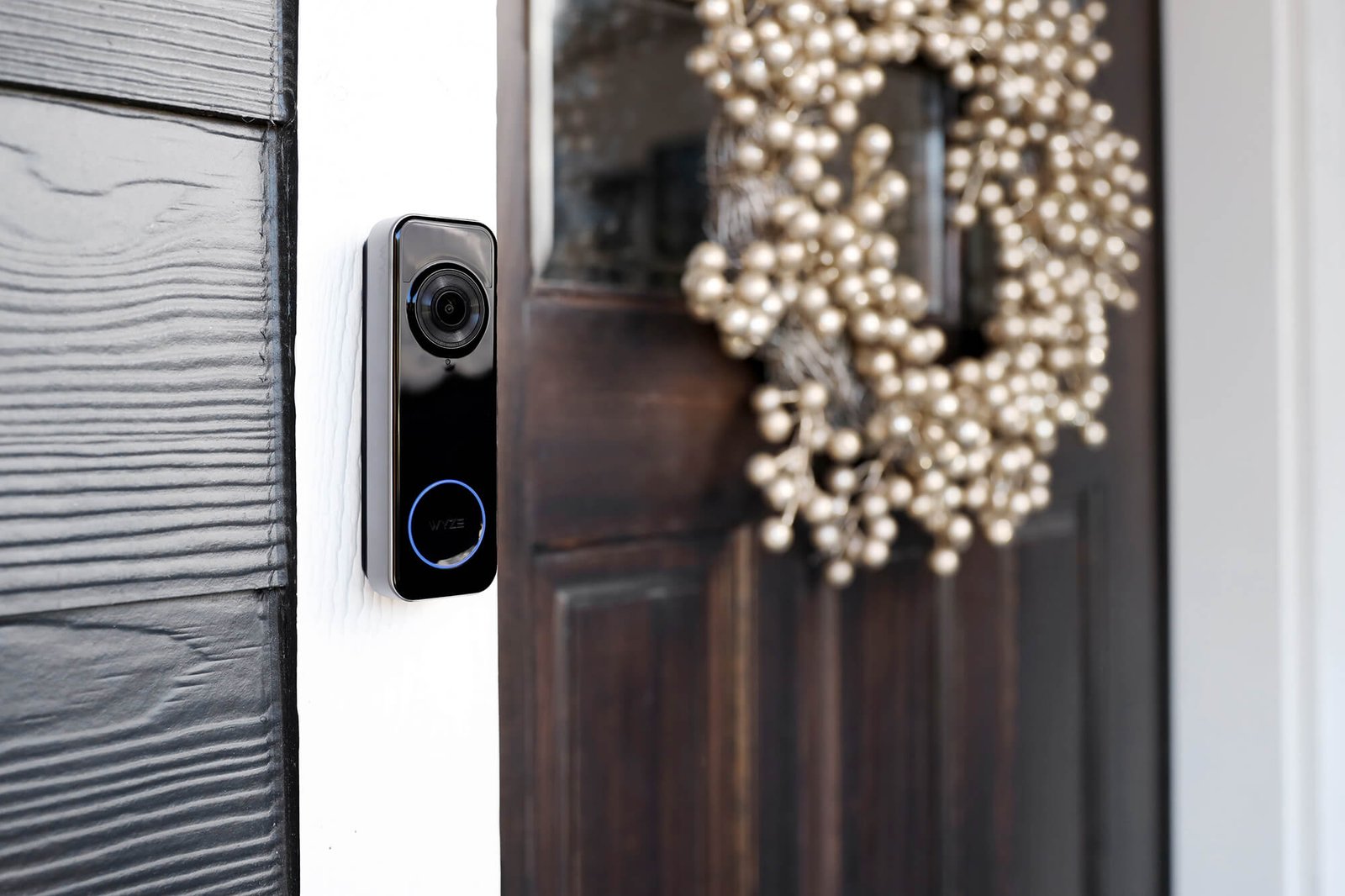
What video doorbells see (and what they don’t): Here’s what you can expect
Image: Wyze
For many people, a video doorbell isn’t just part of their home security system, it is the system. With a camera at the front door and an app on their phone, they jump to the conclusion that they’ll capture faces on the sidewalk, license plates at the curb, and anybody cutting across the lawn.
Most doorbell cameras deliver far more modest real-world performances. They have a tight field of view that sees what’s directly in front of their lens; they’re built to frame a visitor’s face standing in front of the door, not the entire space around the door. That leaves blind spots that can surprise new owners: areas right at the threshold, where packages disappear from view; blurry depictions of passersby on the sidewalk or people walking up the driveway, because they’re outside the camera’s field of view; and side-to-side movement close to the door that slips past the edges of the frame.
Doorbells still provide real awareness. But what they show is shaped by factors such as lens geometry, aspect ratio, motion-detection tech, and other factors–including AI in some cases.
Let’s look at how those design choices define what your doorbell can realistically see–and what it can’t.
Field of view
Michael Brown/Foundry
Field of view–measured in degrees–describes the width of the viewing cone that spreads outward from the camera’s lens. This is the slice of the real world the lens can actually see. But field of view isn’t a single number. It’s split into two parts: horizontal field of view, which determines how much the camera sees from left to right, and vertical field of view, which measures how area it can capture between the ground and the sky.
Most doorbells emphasize horizontal coverage. Specs commonly tout 130- to 160 degrees side-to-side, which helps pick up people moving along sidewalks, walkways, or driveways before they reach the door. That width provides useful context, especially on wide porches or corner lots where activity doesn’t always come straight in.
Vertical coverage is often shortchanged. Many cameras capture much less than 90 degrees top-to-bottom, creating a wide but shallow image. Faces and torsos are centered neatly in frame, but the ground just below the lens is cut off. Packages placed against the wall vanish. Small kids or pets drop out of view as they get closer.
Perspective compounds this. The nearer something is to the lens, the easier it falls outside that narrow vertical cone. So when deliveries disappear from recordings, the culprit is vertical cropping built into the lens design itself.
Aspect ratios
Aspect ratio is simply the proportion between the width and height of the video image. It works alongside field of view to determine the final shape of what you see on screen. A camera can have a wide lens, but if the image format squeezes that view into a short, horizontal rectangle, the result is still an incomplete picture.
Many early doorbells—and plenty of budget models today—use wide, landscape-leaning formats, including true 16:9 or similar ratios. That wide framing is good for seeing activity across sidewalks, driveways, or a front yard, but the tradeoff is vertical space. These formats crop the lower part of the scene, which often means the ground right in front of the door—where delivery packages tend to land—never makes it into the frame.
Newer doorbells have shifted toward taller ratios like 4:3, 3:4, or even square, 1:1 formats, which devote more pixels to vertical coverage instead of the more horizontal spread. This enables true head-to-toe views, letting you see visitors’ faces, what they’re holding, and the area at their feet in a single frame.
Resolution and digital zoom
Resolution is where marketing often overpromises and reality narrows the claim. Entry-level doorbells usually capture video in 1080p (about 2 megapixels). That’s fine when someone is standing right at the door but faces soften quickly past six to eight feet. Step up to 2K (roughly 3 to 4 megapixels) and you get noticeably cleaner facial detail at a distance. 4K (around 8 megapixels) can reveal finer features—sometimes even license plate characters—but only when lighting is good and the subject is already inside the camera’s view.
Because doorbells use fixed lenses, there’s no optical zoom. When you zoom in on a doorbell image, the camera isn’t actually getting closer to the subject. It’s just enlarging a smaller portion of the image by cutting away the surrounding pixels.
This is where the extra pixels in a higher-resolution camera really come into play. Higher resolution means more usable detail after zooming. When you crop into a 1080p image, details break down quickly into visible blocks. With 2K or 4K footage, there are more pixels to work with, so faces and other fine details hold together longer as you zoom.
Motion detection
Michael Brown/Foundry
Early video doorbells relied almost entirely on passive infrared sensors. PIR works by looking for rapid changes in heat combined with movement. It’s simple and power-efficient, but blunt. Wind-whipped bushes, passing cars, or a patch of morning sun warming the driveway can all trip the sensor and fire off an alert.
Newer models layer in video-based detection. The camera feed itself is analyzed, locally on the device or in the cloud, to identify human shapes and movement patterns. Trained recognition models can also flag vehicles and pets instead of labeling everything as generic motion. That technology is what enables alerts like “Person detected,” resulting in fewer nuisance notifications and more meaningful alerts.
But there are tradeoffs. Video analysis takes longer than raw heat sensing, so alerts can be slightly delayed. Detection depends on lighting and clear angles; backlighting or heavy shadows can throw it off. And small or partly hidden figures may simply be missed.
Pre-roll video
When a clip seems to start a few seconds before motion triggers, you’re seeing pre-roll video at work. Most doorbells don’t record continuously. Instead, they run a lightweight recording loop that stores a rolling buffer in small onboard memory—either local flash or a battery cache. Once motion is detected, the system saves that buffered footage along with the full recording, making it appear as though the camera was already rolling.
On many doorbells, that pre-roll footage runs at reduced quality. It may be black and white, lower resolution, and lack audio. That downshift is deliberate. Continuous, full-quality recording would drain a battery doorbell in hours, rather than weeks. Pre-roll is the compromise—brief, low-power snapshots that provide just enough lead-in to show a person stepping into view before the main clip takes over.
Night vision
Night vision is a critical feature for a video doorbell, since you won’t want to keep your porch light on all night.
Martin Williams/Foundry
Most doorbells rely on standard infrared night vision. Small IR LEDs bathe the scene in light–invisible to the human eye–that reflects back to the doorbell’s sensor, producing a black-and-white image. Most IR systems can illuminate roughly 15 to 30 feet from the camera. That’s enough for the porch area, but not down the walkway or into the yard.
IR has quirks, though. Objects close to the lens can wash out into a white glare. Fog, rain, or reflective surfaces scatter the light and create haze or sparkles that degrade clarity. That can result in an image that looks fuzzy or blown out right when you need it to be sharp.
Color night vision tackles after-dark video differently. Video doorbells with this feature use sensors that are more sensitive to ambient light, preserving color. They might also include an LED spotlight that switches on in response to motion, lighting the scene when there isn’t enough ambient light. Spotlights can tip off prowlers–which might prompt them to beat a retreat–but they can also annoy your neighbors if they fire up at 2 a.m.
Camera linking and multi-view triggering
While video doorbell surveillance effectively ends at your porch, some Ring and Eufy systems support camera linking, where motion detected by one camera can triggers other cameras to begin recording at the same time. In this scenario, a doorbell alert might activate a side-yard or driveway camera, picking up an intruder as they move elsewhere on your property.
This can fill gaps left by the doorbell’s narrow coverage and builds better movement timelines. But this isn’t the same as tracking, where you can follow a person’s movement without interruption from point to point. Most systems cap the number of linked devices; Ring, for example, allows up to three of its devices to be linked this way. Eufy and some other security cameras offer a feature that stitches the recordings from several cameras together, so that you get something close to an end-to-end recording of the path they followed around your home.
Set reasonable expectations when you buy a video doorbell
Video doorbells are effective security tools, but only inside the boundaries set by their lenses, sensors, and detection systems. Buying smarter starts with understanding what actually shapes the image. Look beyond headline resolution and focus on aspect ratio and vertical field of view. Think about how much zoom detail you can realistically get. Pay attention to how well alerts filter people from noise.
Good security doesn’t come from expecting one camera to see everything. It comes from matching the right hardware to your space and building coverage around each device’s limits instead of assuming a doorbell alone can handle the whole job.
This story is part of TechHive’s in-depth coverage of the best security cameras and video doorbells.
Author: Michael Ansaldo, Contributor, TechHive
Michael Ansaldo is veteran consumer and business technology journalist. He’s been a contributor to TechHive since 2013, covering robot vacuums, home security cameras, and other smart devices. He previously served as PCWorld’s Small Business Editor, and his tech coverage has appeared in Wired, Macworld, Mac|Life, Mobile Magazine, Enterprise.Nxt, Executive Travel, and other publications.
