

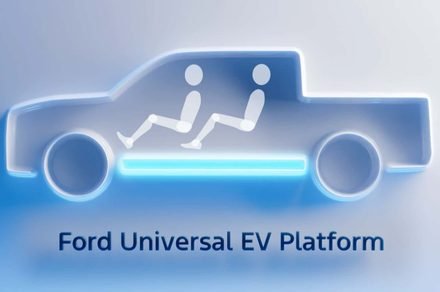
Ford’s new EV platform aims for the Moon, hopefully charging stations are included
Ford’s high-risk UEV platform becomes the centerpiece of its 2027 EV comeback
Ford EV
Ford
It feels like the days of the Detroit Auto Show being a global party are over, but Ford didn’t need confetti to make a statement this year. Instead, they used the stage—and a quieter appearance at CES 2026—to lay out a strategy that feels less like a product roadmap and more like a survival guide.
CEO Jim Farley didn’t mince words when speaking to InsideEVs, comparing Ford’s current situation to the Apollo missions. It sounds dramatic, sure, but when you look at what they are trying to pull off with their Red Bull Formula 1 partnership and the secretive “Universal EV” (UEV) platform, the stakes really are that high.
The UEV project is arguably the one to watch
This isn’t just another electric car; it’s a complete reset of how Ford builds vehicles. Born from a “skunkworks” team in California staffed by former Tesla, Apple, and Rivian engineers, this platform is designed to kill the inefficiencies that have plagued legacy automakers. We are talking about a $30,000 electric pickup coming in 2027 that uses 20% fewer parts and runs on a zonal electrical architecture capable of “eyes-off” driving a year after launch.
Farley confirmed this isn’t just a concept anymore – prototypes are already running
They have even retooled factories and installed massive “megacasting” machines, signaling that they are all-in.
But getting here wasn’t pretty. Ford had to make some brutal calls, including canceling the F-150 Lightning’s direct successor and pivoting big SUVs back to hybrid engines. It was a painful admission that the old way wasn’t working. Now, the UEV platform is their main bet to actually make money on EVs, aiming for a cost structure that can compete with Chinese giants like BYD.
And that is the real ghost haunting this machine. with political winds shifting and competitors like Geely eyeing the U.S. market, Ford knows it has zero breathing room. Whether this new platform ends up underpinning the next Mustang Mach-E or just a family of affordable haulers, one thing is clear: Ford is betting the farm on this “moonshot.” If it lands, they reinvent the company. If it doesn’t, the future looks a lot harder.
Moinak Pal is has been working in the technology sector covering both consumer centric tech and automotive technology for the…
Here’s the problem with plug-in hybrids
EVs aren’t the only cars that plug in. Plug-in hybrids can theoretically serve as stepping stones to all-electric vehicles, providing enough electric range for short trips while still offering the flexibility of a gasoline engine. For those who can’t charge at home, or just don’t want to deal with the uncertainty of public charging infrastructure on road trips, they seem like a decent option. But the news cycle just delivered two reminders of the limits of plug-in hybrids.
Last week, Stellantis abruptly confirmed that it would discontinue three popular plug-in hybrid models. And at the Automotive Press Association conference in Detroit on Monday, General Motors CEO Mary Barra admitted an inconvenient truth — that many plug-in hybrid owners don’t actually plug their cars in. The auto industry as a whole isn’t giving up on plug-in hybrids, but they’re certainly in a rough patch.
Rivian reaches key milestone for its R2 electric SUV, deliveries are coming soon
With manufacturing validation builds now underway, Rivian’s R2 is no longer a promise on a slide deck; it’s a production-ready electric SUV inching steadily toward customer driveways.
Rivian has begun Manufacturing Validation (MV) units of the R2 five-seater electric SUV. The production istaking place at the automaker’s plant in Normal, Illinois, which has been expanded (by another 1.1 million square feet) to accommodate the new assembly lines. This milestone follows the earlier Design Validation (DV) phase, completed in mid-2025.
MV builds are used to test everything from the panel’s fit and finish and paint quality to the electrical systems (including the motors and battery pack) and the software that holds everything together in EVs. They’re near-final vehicles with production-ready specifications.
DDPAI reveals the next-generation of dash cam technology at CES 2026
The Z90 Master is the world’s first dash cam to offer a three channel 4K front + 4K rear + 3K interior camera setup
At CES 2026, DDPAI showed off the next-generation of dash cam with its flagship Z90 Master.
It’s the world’s first dash cam to offer a three channel 4K front + 4K rear + 3K interior camera setup, providing high resolution footage and all-round protection across your vehicle.
