

Give your older car a modern dashboard in one afternoon (and save $100 doing it)
Digital Trends may earn a commission when you buy through links on our site. Why trust us?
Best Buy
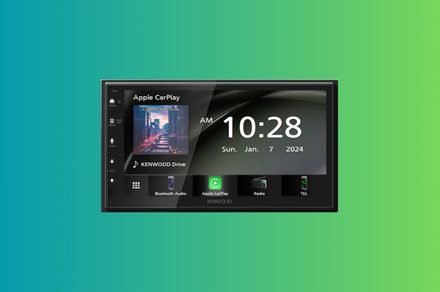
If your car still has the factory stereo that feels stuck in 2014, this is one of the cleanest quality-of-life upgrades you can make. The Kenwood DMX4710S 6.8-inch multimedia receiver is $299.99, which is $100 off the $399.99 compared value. The main draw is simple: wired Apple CarPlay and Android Auto so you can get modern navigation, calls, texts, and music in a way that feels like your phone—but safer and easier to use while driving.
What you’re getting
This is a 6.8-inch touchscreen multimedia receiver designed to replace an older head unit. With wired CarPlay/Android Auto, you plug your phone in and get the familiar interface for maps, podcasts, playlists, and voice control. Wired is also a plus if you prefer a consistent connection and you want your phone to charge while you drive.
It’s a “daily driver” upgrade: clearer interface, easier control of media, and a much better experience for navigation than a phone mount bouncing around on your dashboard.
Why it’s worth it
This deal makes sense because it’s one of the few upgrades that improve every single trip, commute, errand, road trip, everything. CarPlay/Android Auto is especially helpful if you’re relying on your phone for directions and hands-free communication. It reduces the friction and the temptation to mess with your phone while driving.
Also: $100 off matters in this category because you may still need install parts. Depending on your vehicle, you might need a dash kit, wiring harness, antenna adapter, and possibly a steering-wheel-control adapter. If you’re paying for professional installation, that’s another cost. This discount helps offset the “extras” that come with doing it right.
The bottom line
At $299.99, the Kenwood DMX4710S is a solid value if you want to modernize an older car with a clean touchscreen and dependable wired CarPlay/Android Auto. If you’re comfortable handling installation (or you already planned to pay for it), this is a smart time to buy. If you want wireless phone integration specifically, you’ll want a different model—but for a straightforward, reliable upgrade, this deal is easy to justify.
I’m a writer, entrepreneur, and powerlifting coach. I’ve been building computers and fiddling with PC parts since I was a…
Ford’s new EV platform aims for the Moon, hopefully charging stations are included
Ford’s high-risk UEV platform becomes the centerpiece of its 2027 EV comeback
It feels like the days of the Detroit Auto Show being a global party are over, but Ford didn’t need confetti to make a statement this year. Instead, they used the stage—and a quieter appearance at CES 2026—to lay out a strategy that feels less like a product roadmap and more like a survival guide.
CEO Jim Farley didn’t mince words when speaking to InsideEVs, comparing Ford’s current situation to the Apollo missions. It sounds dramatic, sure, but when you look at what they are trying to pull off with their Red Bull Formula 1 partnership and the secretive “Universal EV” (UEV) platform, the stakes really are that high.
Here’s the problem with plug-in hybrids
EVs aren’t the only cars that plug in. Plug-in hybrids can theoretically serve as stepping stones to all-electric vehicles, providing enough electric range for short trips while still offering the flexibility of a gasoline engine. For those who can’t charge at home, or just don’t want to deal with the uncertainty of public charging infrastructure on road trips, they seem like a decent option. But the news cycle just delivered two reminders of the limits of plug-in hybrids.
Last week, Stellantis abruptly confirmed that it would discontinue three popular plug-in hybrid models. And at the Automotive Press Association conference in Detroit on Monday, General Motors CEO Mary Barra admitted an inconvenient truth — that many plug-in hybrid owners don’t actually plug their cars in. The auto industry as a whole isn’t giving up on plug-in hybrids, but they’re certainly in a rough patch.
Rivian reaches key milestone for its R2 electric SUV, deliveries are coming soon
With manufacturing validation builds now underway, Rivian’s R2 is no longer a promise on a slide deck; it’s a production-ready electric SUV inching steadily toward customer driveways.
Rivian has begun Manufacturing Validation (MV) units of the R2 five-seater electric SUV. The production istaking place at the automaker’s plant in Normal, Illinois, which has been expanded (by another 1.1 million square feet) to accommodate the new assembly lines. This milestone follows the earlier Design Validation (DV) phase, completed in mid-2025.
MV builds are used to test everything from the panel’s fit and finish and paint quality to the electrical systems (including the motors and battery pack) and the software that holds everything together in EVs. They’re near-final vehicles with production-ready specifications.
