

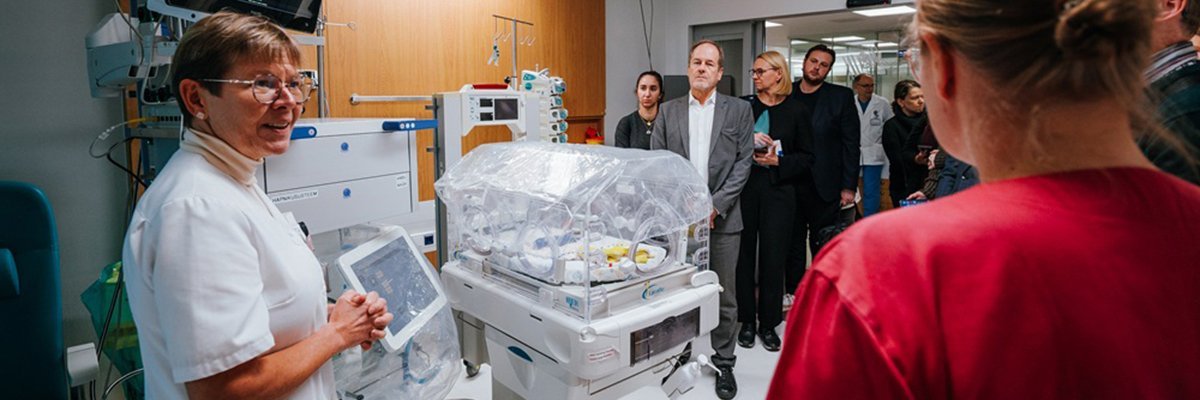
Estonian healthtech a hotbed of innovation for UK and Europe
Tartu University Hospital was founded near the start of the 19th century, but it is focused on the 21st century. It has more than 330 ongoing research and innovation projects, its pharmacy is testing a 3D printer for tablets, and its radiologists are developing the use of artificial intelligence (AI) to analyse medical images taken across the country.
The hospital innovates on soft furnishings as well as software, with rooms for newborns in the 2023 children’s building having beds for parents to support bonding and help tackle neonatal depression. The department is also working on a process that will analyse a baby’s whole genome within 24 hours.
Tuuli Metsvaht (pictured above), professor of paediatric intensive care and pharmacotherapy, says Estonian healthcare has collaborated on research with countries including the UK, and as a small country, it has the agility to adopt the results. “It’s one of the few things where small is beautiful,” she says.
The results in her field have been dramatic. In 1991, 1.75% of children in Estonia died before their fifth birthday, compared with 0.87% in Britain. In 2023, Estonia’s figure had fallen to 0.21%, the third lowest child mortality rate in the world, while the British figure had decreased to 0.45%.
Joel Starkopf, head of department for anaesthesiology and intensive care, describes the changes he has seen in healthcare since the 1990s as equivalent to moving from black and white to colour or from night to day. As for neonatal care, he says: “It’s like medieval times, what we had 30 years ago.”
Estonia as a technology leapfrogger
Estonia, a Baltic country of 1.3 million people, won independence from the collapsing Soviet Union in 1991. While it is still catching up with richer European countries economically, with a gross domestic product per person of just under two-thirds of the UK’s, it has leapfrogged most of the world in terms of its adoption of technology. This includes in healthcare, with a national digital infrastructure based on the country’s identity system supporting paperless prescriptions since 2010, as well as centralised records and administration.
This infrastructure supports healthcare technology (healthtech) innovation. The government is keen to encourage its trade exports, which is why it flies in journalists for articles such as this, while the startups involved want to sell internationally to gain scale.
“For any tech company, but especially for a tech company from Estonia, which is a small country, it has to be the first goal,” says Ain Aaviksoo, managing director of Mentastic. The company provides a “mental health operating system” that, among other things, can pull in data from digital devices on steps, sleep and messaging activity. It uses this to provide intermediate levels of personalised support that can help tackle problems before they require the involvement of mental health professionals.
Aaviksoo sees Britain as a good place to start. “The UK is a friendly, close-by market with a slightly more flexible approach to regulations when it comes to AI and other digital rules,” he says. Along with America’s Food and Drug Administration, which applies post-market surveillance, and the more complex processes required by the European Union (EU), of which Estonia is a member, British medical regulatory clearance can provide a fast track to approval in the Gulf states.
“The UK is a friendly, close-by market with a slightly more flexible approach to regulations when it comes to AI and other digital rules”
Ain Aaviksoo, Mentastic
He says the British regulatory process requires clinical studies, but it is a particularly good place to carry these out: “There is a tradition of pharmaceutical development and universities with skillsets and methods to collaborate in this manner.”
Mentastic is in discussions with University College, London, linked to a collaboration agreement between the British and Estonian governments. It also has connections with the University of Liverpool, with Aaviksoo saying that northern England has a very positive attitude towards collaboration. The company is interested in co-development and is talking to one organisation that could lead to a UK clinical trial involving up to 50,000 people.
Collaboration is helped by the fact that Estonia and the UK take a similar approach to data privacy. Both countries use the EU’s General Data Protection Regulation (GDPR) – in the UK’s case, retained after Brexit, although with a lighter touch than some.
Mentastic asks for consent dynamically, letting people know what will happen next and checking they are happy with this. “GDPR should not be seen as an obstacle to innovation,” says Aaviksoo, who was involved with its implementation in Estonia. The company has trialled the use of generative AI in its services, allowing users to test the capability and then decide whether to continue or delete their data from it. “Understanding this is an asset and something we can bring to the UK,” he adds.
Aaviksoo, who graduated from medical studies in 1998, says Estonia having a well-established digital healthcare system means patients are used to using technology. The system is now struggling with data quality issues, particularly when using information for automation and AI assistance, but he adds that as a country, it is “in a much better position than many others”. Mentastic can integrate with Estonia’s prescribing and healthcare pathway services, but is designed to work independently of other services.
Estonian model seeks to alleviate queues
Estonia and the UK also have common ground in how they administer healthcare, with governments paying for most work in both countries, although Estonian providers operate under private law in a way similar to dentistry in Britain. While so-called single-payer healthcare systems provide access to everyone, they also tend to generate queues. “People’s expectations are, ‘I am paying taxes so I should have free healthcare’,” says Andres Mellik, chief executive of healthtech company Cognuse.
To address queues for speech therapy, Mellik’s company developed SpeakTX.com, a low-cost support service that provides interactive video exercises in a range of languages, including English. It sells this to schools and healthcare providers, including Lincolnshire Community Health Services NHS Trust in the UK for stroke patients, as well as to individuals.
“We’re not trying to replace speech therapists,” says Mellik. “We understand the limitations of a single-payer system and the solidarity that it brings. Technology is the best way, probably the only way, to alleviate those queues by offering something if a full service is not yet available.”
SpeakTX sells to other European countries, including Germany and Ukraine, but Mellik sees the UK as an attractive option. It is easy for Estonians to do business in the UK, given 48% speak English according to the 2022 census, and Britain is a large market which encourages healthtech innovation, including through the National Institute for Health and Care Excellence’s health technology assessment and NHS sandbox test environments for digital services.
“We’re not trying to replace speech therapists [but] technology is the best way, probably the only way, to alleviate queues by offering something if a full service is not yet available”
Andres Mellik, Cognuse
Mellik says Germany and France also have good approval processes for digital health services, but Germans can be reluctant to use them, and German states have differing rules on data sharing. However, the country does provide incentives for new healthtech services to encourage use, and organisations are willing to try new things that can deliver good quality at reasonable prices.
Mellik says the complexity of the UK’s National Health Service can be a challenge, although he adds that this is true in many countries. “Navigating healthcare systems is always a pain,” he says. SpeakTX addresses this by offering anyone free access for seven days, as well as low pricing for organisational trials.
The company is in discussions with UK digital health consultancy 6B Health on providing support with deployment and integration with NHS organisations, after meeting at an event in Liverpool for Estonian healthcare companies.
“Estonia has a really interesting digital health ecosystem,” says 6B Health’s commercial director, Rebecca Willis. However, she adds that selling to NHS organisations has its challenges, including each organisation having its own technology infrastructure, meaning that suppliers often have to do customised integration work even for clients who run the same electronic patient records (EPR) software.
She says NHS procurement is complicated by the fact that it can take place by organisation, region or nationally, while suppliers selling in England currently have to consider the aims of NHS England, the Department for Health and Social Care (although the department is in the process of absorbing NHS England), and the government overall.
Willis believes it may be easier to sell innovative healthtech to secondary care than primary care, but adds: “Whether it is procurement, deployment or integration, there is a whole host of variability across the board.”
DNA database pinpoints Neanderthal genes
The basement of Turku University’s Institute of Genomics holds the DNA of 214,000 Estonians, the primary assets of the Estonian Biobank, stored in steel drum refrigerators that can stay cold for weeks without power until their liquid nitrogen evaporates.
In 2024, the institute opened a portal for those who volunteered these samples using the country’s digital identity system. It provides entertaining information, such as what proportion of someone’s DNA is of Neanderthal origin and how tolerant they are to caffeine. But it also provides warnings on the suitability of medicines based on an individual’s genetic profile – something the institute would like to integrate with prescribing software.
The biobank supports research, with a focus on healthtech startups. It also allows Antegenes, a Tartu-based provider of polygenic (based on multiple genes) risk scores for breast and prostate cancer, to access deposits when someone in the biobank gives permission, saving them from having to provide a saliva sample. The company’s tests are available through Estonia’s public healthcare system, the results enter its records, and based on these, the company can refer women at risk of breast cancer to public mammography screening.
Antegenes’ tests were developed partly with research that used the UK Biobank of 500,000 people, and they are available in Britain, as well as in Germany and Sweden. However, British participants have to pay £299, cannot use samples given to the research-focused UK Biobank and will not be referred to NHS screening. If the test shows susceptibility to breast cancer, the company recommends a private screening.
Peeter Padrik, the company’s chief executive, says Antegenes has focused on exports from the start. “We have developed solutions principally for Europe,” he says. “We see Estonia as a small test country where we can quickly develop and test innovative services and then scale them to offer similar solutions to other countries.”
“We have developed solutions principally for Europe. We see Estonia as a small test country where we can quickly develop and test innovative services and then scale them to offer similar solutions to other countries”
Peeter Padrik, Antegenes
He, too, sees Britain as an obvious place to work, given its research strengths and the readiness of people to use genetic information. “I think the UK is a leading country in healthcare innovations in Europe and invests a lot in this field. It’s very logical,” he says.
The company collaborates with UK charity Prevent Breast Cancer and is contributing to a review of UK guidance on breast cancer, arguing for a more risk-based approach.
Padrik’s medical education at the University of Tartu took place under Soviet rule, and he remains on the staff of Tartu University Hospital’s oncology clinic. He thinks Estonia embraced digital healthcare both for necessity and opportunity.
“The reality was we came from behind, with a much emptier situation due to our history. Then it was easier to take over innovative things and not be fixed to traditional solutions,” he says.
Like other Estonians, Padrik mentions the benefits of the country’s size when implementing innovation. “It is more complicated in big countries,” he says. But among big countries, he and his healthtech peers see the UK as one of the better places to sell and collaborate.
Read more on Big data analytics
Finland and Estonia deepen cross-border digital partnerships
How Estonia’s country-as-a-service scheme has attracted tens of thousands of foreign entrepreneurs
By: Karl Flinders
Estonian government opens its digital heart to tech testers
By: Karl Flinders
Inside Estonia’s tech startup scene
By: Adrian Bridgwater
