

5 Work From Home Gadgets That Solve Everyday Problems
We may receive a commission on purchases made from links.
Working from home is a double-edged sword. On one hand, you retain full access to the creature comforts of home — access to one’s own, private bathroom is arguably better than a 401K, to say nothing of zero commute time. On the other hand, it’s up to you to furnish the experience. Working from your couch feels freeing at first, but once your wrists begin to cramp, a proper workstation is the only solution. From there, it’s one problem after another, and one gadget after another to solve them.
As a freelance writer who often covers tech, my home office is something of a constant work in progress. I’m almost always testing one or more products that claim to make my life easier, though very few of them make good on that promise. Here, I’ve rounded up some of the best gadgets that leveled up my work-from-home setup, taking into account my own experiences with them, as well as those of other users. Beyond sprucing up your home office, these gadgets are a value add day-to-day. From tech that will reduce the strain of work on your body to those meant to protect your gear, here are just a few of my favorite work-from-home gadgets that solve everyday problems
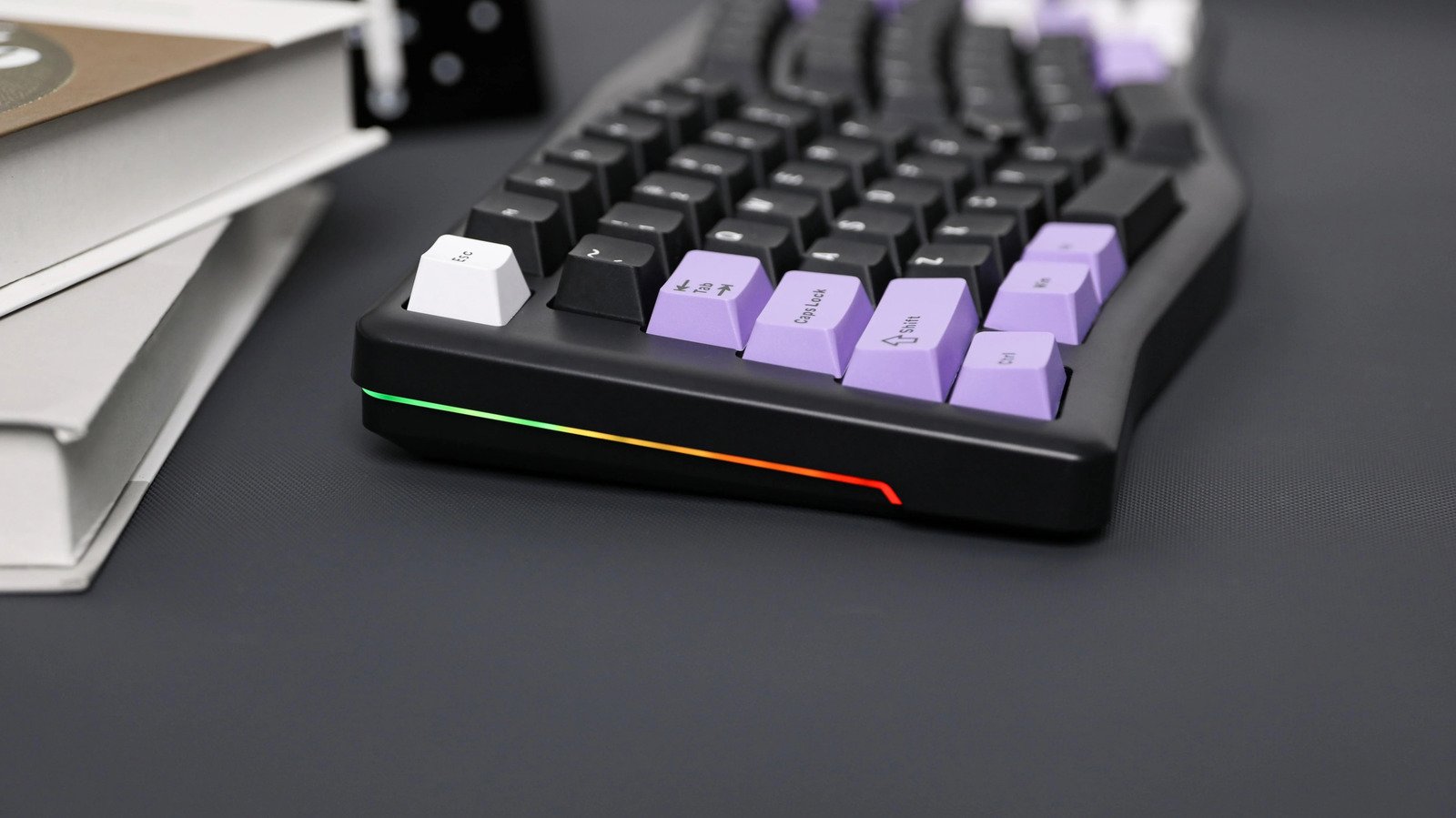
An ergonomic mechanical keyboard will reduce wrist and hand strain
Max Miller/SlashGear
If your job requires a lot of typing, whether it’s writing code or penning articles like this one, you’ll quickly realize that a mechanical keyboard is essential. Even laptop users will benefit from a more professional typing tool. Not only is a keyboard a great productivity-boosting gadget, but long typing stretches are not great for your hands and wrists. Over time, you can develop conditions like carpal tunnel, which are painful. For those reasons, it’s worth trying to adjust to an ergonomic keyboard.
My favorite ergonomic, mechanical keyboard is the LeoBog A75, an Alice-style keyboard with a 75% layout (meaning no number pad). Its hefty, solid build belies its plastic chassis, and the typing experience is confident but not harsh. There’s enough padding and flex that you won’t feel a hard bottom-out on the keys. Enthusiasts would describe it as having “creamy” acoustics, which means that it doesn’t have the traditional, “clacky” sound commonly associated with mechanical keyboards. It supports wired, Bluetooth, and 2.4GHz connections, with separate modes for Windows and macOS. Software is its weakest point, but the LeoBog application does a decent job of customizing keybinds and lighting (oh yeah, there’s RGB, if you’re into that). This is the keyboard I mostly keep on my desk unless I’m testing another one, or want to switch things up for a bit.
When I’m on the go, working from coffee shops or airport lounges, I break out my trusty NuPhy Air75 V2, a low-profile mechanical keyboard with all the same features as the LeoBog A75, but slim enough to fit in a backpack or tote (though it is not a split-layout ergonomic keyboard). The updated Air75 V3 is out now, but I have not tested it.
Get a surge protector, especially if yours is old
If you work from home, it’s unlikely that you’re able to plug everything you need into a single outlet. After your laptop or PC, you might have a standalone monitor, speakers, and more to connect. Moreover, all that gear needs to be protected from power surges and other electrical issues. The solution is a surge protector.
My favorite surge protector (not something I ever thought I’d have an opinion on — age comes for us all) is the Anker 351 Power Strip, a 15-in-1 unit with 12 A/C outlets, two USB-A charging ports, and one USB-C charging port. Personally, I ignore the USB, but the plugs are a lifesaver. The unit is mounted to the underside of my desk, which allows me to route all of my cables through the desk’s channels for a cleaner setup. All in, it routes power to my gaming PC, display, two studio monitors, a lamp, and a docking station for my laptop. It costs $30 on Amazon.
If you already have a surge protector that’s more than three to five years old, you should replace it regardless of how well it seems to work. The parts inside may be stationary, but the constant flow of power does wear them down over time. It’s better to spend a few bucks now than to wind up having your gear zapped — or, even worse, starting an electrical fire. This isn’t solving a problem you have now, but one you’ll have later. Throw away your old surge protectors now, and grab some new ones.
An electric air duster so powerful it feels like an illegal weapon
Not everyone is as dust-averse as I am, but after moving in with my partner and their incredibly sweet and even more incredibly hairy dog, I knew cans of compressed air weren’t going to cut it anymore. But the top-rated electric duster I bought pushed a paltry amount of air and died what seemed like every ten minutes. After redoubling my efforts, I found my new champion: the Yomile Mini Vacuum Cleaner.
This duster is so powerful that, at full tilt, it takes some effort to keep stable. The force of its own fan propels it backward toward the user, so you end up holding it almost like a handgun. Most of the time, turning its power slider about a quarter of the way up is more than enough to get the job done. It comes with several attachments for different scenarios, though I find the standard nozzle to be the best for most situations. It’s made keeping my desk dust-free a literal breeze, and even larger tasks like dusting out my PC case have become much less of a hassle. Best of all, I’ve never once worried about battery life. I use it for about a minute at a time, one to three times daily, and I go months between charges.
The additional vacuum function is also nice to have for those instances when I’d rather not be blowing crumbs or debris from my desk to another part of the room. There’s an included hard travel case, too, though I’ve not made much use of it. Other users appear to love this duster, too, echoing my praises and noting other features like the built-in display to see battery level and power.
The right USB hub or dock will add ports without becoming a bottleneck
If you’ve experienced the frustration of running out of ports on your laptop and being forced to hotswap peripherals, the solution is a USB hub or dock. This probably isn’t rocket science, and it’s likely you’ve already picked one up. But don’t skip this section. The wrong USB hub can actually slow down your work by becoming a bottleneck in your system. For instance, if your laptop supports the newest USB4 standard, or even the slightly older USB 3.2 Gen 2×2, then a dock that only supports the even older USB 3.0 SuperSpeed (also known as USB 3.2 Gen 1) will prevent you from using the full speed of your computer’s USB port. The same goes for a hub that doesn’t support the full resolution and speed of an external monitor over HDMI or DisplayPort, or one that doesn’t have enough Power Delivery passthrough to give you a full-speed charge.
It’s best to future-proof your USB accessories, too, so that you don’t need to upgrade them when you inevitably buy a new computer. Value is important, too, since it’s all too easy to spend hundreds of dollars on a USB hub or dock. My current choice of dongle in terms of balancing bang-for-buck and modern specs is the Anker 565 USB Hub, which comes equipped with two USB 3.2 Gen 2 ports (one Type-A and one Type-C), two USB 2.0 Type-A ports for peripherals, an 85-watt passthrough, a charge-only USB-C port, both an HDMI and DisplayPort port for video output to external displays, an Ethernet jack, a 3.5mm headphone jack, and card slots for SD and microSD formats. At $70, it turns a single USB-C port into a full workstation.
A proper microphone is a must-have for video meetings
Max Miller/SlashGear
Working from home in the 2020s means a steady drip of video conferences, and it’s long past time to stop making your coworkers put up with the hissy audio from your AirPods microphones. Getting a real microphone is one of the easiest ways to add a more professional air to your virtual presence. In meetings, a high-quality microphone can even help your voice come across more clearly and emphatically than that of your colleagues, making your ideas stand out.
As a hobbyist musician, I’ve got a number of the best vocal microphones for home studios. But even with experience using high-end equipment, my choice for home use is the Shure SM58. You know this microphone already, as it’s been the de facto stage microphone for years. Those with unlimited budgets might spring for something like the Shure SM7B, a quintessential podcast mic, but that’s overkill for general use. The SM58 is practically indestructible, sounds great, and mounts on a typical microphone stand. Just be aware that you’ll need a way to convert its XLR signal to USB, whether through a full-sized audio interface or a portable one like the Shure MVX2U.
If you take meetings on the go, a portable clip-on mic may serve your needs better, and I’ve had a solid experience with the Saramonic Air. Built-in noise cancellation and wireless transmission over USB-C mean you’ll sound great even with coffee shop chatter around you, and you’ll never need to fiddle with wires. The kit comes with two microphones (perfect for when another person is with you) and a charging case that keeps them topped up when they’re stowed.
How these work from home gadgets were chosen
All products included in this article were selected based on the writer’s extensive hands-on experience using them, in addition to an assortment of user reviews. They were evaluated in this context for their ability to reduce friction in a work-from-home setup.
