

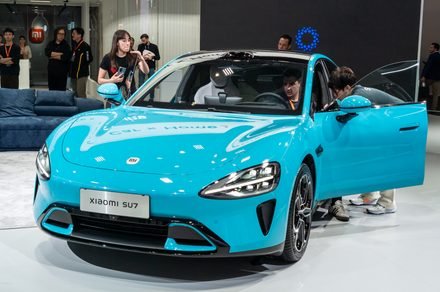
Tesla Model 3 got outsold by an EV from a Chinese smartphone brand
The Xiaomi SU7, built by a company best known for phones, has overtaken Tesla’s Model 3 in China, signaling rising local rivals, shifting consumer tastes, and fresh competition for the global EV leader.
Nirave Gondhia / Digital Trends
In what is one of the most important developments in the Chinese auto industry, Xiaomi’s SU7 has outsold Tesla’s Model 3 in 2025. The information comes from the China Passenger Car Association (via scmp.com).
The Chinese smartphone maker delivered 258,164 units of its first EV. Meanwhile, Tesla sold only 200,361 Model 3s, marking the first time since Tesla’s Chinese launch that another brand has overtaken it in the world’s largest EV market.
Xiaomi’s formula for success
There are quite a few reasons behind this. First, Xiaomi has undercut the Model 3’s pricing by around 9% (CNY 235,500 vs. CNY 215,900 for the baseline variant). The SU7’s baseline variant offers a 700 km CLTC range, which is higher than the Model 3’s 606 km.
Further, the integration of HyperOS, free driver-assistance features, its smartphone ecosystem, and the ability to rapidly scale up production to meet the rising demand among Chinese buyers could be among the few reasons behind the major market shift.
To give you some perspective, Tesla’s Model 3 has been one of the most popular EVs of all time. For years, it has been a benchmark against which other EVs are evaluated; it has also helped kickstart mainstream EV adoption.
In China, the Model 3 has held the premium electric sedan crown since it arrived in 2019, despite attempts by multiple local EV startups to launch models with aggressive pricing, flashy features, and more frequent refreshes than Tesla.
However, Xiaomi seems to have cracked the Chinese EV market. A brand known primarily for budget smartphones and Android flagships has built something that local buyers not only appreciate but also adopt, and all of that has happened after the SU7’s Chinese launch in April 2024.
Xiaomi’s success is a major win for Chinese automakers. It proves that local brands can compete with the American giants on both quality and scale, not just price. For Tesla, it’s a sign to up its EV game in its biggest market. In the future, Xiaomi could launch new EVs to take on other popular Tesla models.
For more than five years, Shikhar has consistently simplified developments in the field of consumer tech and presented them…
Your future BMW electric M3 will still sound like a real M car
Bmw gives its electric M3 fake engine noise, but the fancy kind
The transition to electric vehicles has always had one major stumbling block for car enthusiasts: the sound. Or rather, the lack of it. For decades, the soul of a performance car has been tied to the noise it makes—the intake gasp, the exhaust crackle, the mechanical symphony of pistons and valves. Now, as BMW prepares to launch its first-ever fully electric M3, the company is tackling this problem head-on, and their solution is surprisingly old-school.
Instead of trying to invent a new “sound of the future” filled with abstract spaceship hums and digital warbles, BMW’s Motorsport division is digging into its own history books. New videos from the development team reveal that the upcoming electric M3 will feature a synthetic audio system built from high-fidelity recordings of the brand’s most iconic internal combustion engines. We aren’t talking about generic engine noises here; BMW is literally sampling the legends.
This is the tech that makes Volvo’s latest EV a major step forward
When it comes to EVs, Volvo hasn’t been afraid to experiment. It’s tried repurposing a platform from its internal-combustion cars (for the EX40 and EC40, nee XC40 Recharge and C40 Recharge), a flagship SUV that’s also a technology demonstrator (the EX90) and a radical reinvention of its brand (with the EX30). The Swedish automaker’s latest EV takes yet another approach — one that could make it the most important Volvo EV yet.
The 2027 Volvo EX60 boasts engineering improvements in a package that’s likely to have mass appeal. It’s based on a new architecture that offers improved range and charging performance, backed by software with now-obligatory AI integration. And as a five-seat SUV similar in size to the current Volvo XC60 — the automaker’s bestselling model — it’s exactly the type of car most people are looking for.
Your cheap Chevrolet EV might not be cheap for Long
GM confirms limited Chevy Bolt EV run as Kansas plant repurposes for gas vehicles and Buick production.
General Motors’ effort to bring back the Chevrolet Bolt EV as an affordable electric vehicle is already facing a roadblock. Although the refreshed 2027 Chevy Bolt EV has just started arriving at U.S. dealerships with a sub-$30,000 price tag, Bloomberg reports that GM officials now say the new model will be in production for only about 18 months before the line winds down around mid-2027.
This shift comes as GM continues reshuffling its manufacturing footprint, with its Fairfax Assembly plant in Kansas City, Kansas, set to switch from Bolt EV output to other vehicles, including gas-powered models and a relocated Buick crossover. The decision marks a significant pivot away from making one of the U.S. market’s most affordable electric cars, at least for now.
