

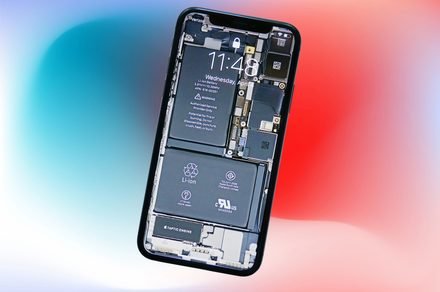
Your phone might stay cool thanks to this new battery breakthrough
Researchers develop a “thermal diode” that could control heat flow and extend battery life.
Phones, electric vehicles, and other devices that run hot might soon have a powerful new tool keeping them cool. Engineers at the University of Houston have developed a novel thermal management technique that works like a “thermal diode,” allowing heat to flow in only one direction. This breakthrough, rooted in a concept called thermal rectification, has been developed by Bo Zhao, an award-winning and internationally recognized engineering professor at the Cullen College of Engineering, and his doctoral student, Sina Jafari Ghalekohneh. The new technology could, in theory, help electronics keep hot spots under control, potentially extending battery life and preventing overheating, as published in Physical Review Research.
Current smartphones and portable electronics often struggle with heat because traditional materials let thermal energy travel freely in all directions. That means internal heat from batteries or processors can linger or even flow back into components, leading to excessive temperatures, reduced performance, and faster battery wear. The new thermal diode design changes that dynamic by pushing heat forward while blocking reverse heat flow, giving engineers a more precise way to regulate temperatures inside devices.
How the Thermal Diode Works
Instead of relying on conventional materials that let heat move freely, the research team created structures using semiconductor materials under a magnetic field, which alters how energy moves at the microscopic level. That setup creates a one-way heat pathway, much like an electrical diode lets current flow one way. All of this steers heat out of sensitive areas and prevents it from creeping back.
By controlling radiative heat flow in this way, the technology offers a new form of thermal management that could reduce the risk of overheating in phones, electric vehicles, satellites, and even high-performance AI systems where heat buildup is a serious design challenge. Before this innovation, overheating often limited battery life and device reliability, and excessive temperatures could even accelerate battery degradation. The thermal diode could keep key components at a comfortable temperature even under heavy use or in hot environments.
Right now, the thermal diode exists mainly in computer models and simulations, but researchers are working to build real-world prototypes to prove it works outside the lab. If it performs as expected, the technology could help devices stay cooler and safer by directing heat away from sensitive parts, improving reliability and battery life. That doesn’t just apply to smartphones, either. It could also benefit electric vehicles, satellites, and other electronics that struggle with overheating. While it may take a few years to reach everyday products, the breakthrough offers a promising new way to tackle one of tech’s most common problems: excess heat.
Varun is an experienced technology journalist and editor with over eight years in consumer tech media. His work spans…
Why your next smartglasses might finally have crisp visuals
A micro-LED revolution could bring near-life-like resolution to AR and VR headsets.
A long-standing obstacle for augmented reality (AR) and mixed-reality smartglasses may finally be on the brink of being solved. A team of researchers led by Professor Sanghyeon Kim at the School of Electrical Engineering, in collaboration with Inha University and industry partners, has developed a micro-LED display technology capable of ultra-high resolution on the order of ~1,700 pixels per inch (PPI). That’s roughly three to four times sharper than most flagship smartphone screens today, with a level of detail that could make immersive wearable visuals far more convincing.
For context, Micro-LEDs are a form of self-emissive display technology that holds key advantages over OLEDs, including higher brightness, longer lifespan, and improved power efficiency, all critical for compact, battery-constrained wearables like smartglasses. Until now, engineering ultra-high-resolution micro-LED displays in such small form factors has been a major technical challenge, especially when it comes to creating tiny red pixels that work efficiently without consuming excessive power.
Super Bowl tactile device lets your hands follow the ball
A OneCourt tablet will give some blind and low-vision fans a touch-first view of the game, with live audio in their headphones so the action stays synced.
A small group of blind and low-vision fans will experience the Super Bowl with a Super Bowl tactile device that renders the ball’s location through touch. The tablet also delivers vibration cues for key moments, so big plays don’t blur into crowd noise.
The NFL is teaming up with OneCourt and Ticketmaster to bring the setup to Levi’s Stadium in Santa Clara, California, when Seattle plays New England on Feb. 8. Around 10 attendees are expected to use the device in their seats, with a live Westwood One broadcast feed running through headphones.
A flexible AI chip thinner than hair promises smart wearables that work without a phone
The chip that could free wearables from phones or cloud-based-computing
Wearables are getting smarter every year, but most of them still lean heavily on a nearby smartphone to do the real thinking. That dependency may not last much longer.
Researchers from Tsinghua University and Peking University have now developed a flexible AI chip that is slimmer than a human hair and can be folded thousands of times.
