

Watch Unitree’s G1 unleash a kung fu robot frenzy
The performance was shown on Chinese TV this week as part of the nation’s Lunar New Year celebrations.
Unitree demostration during the Chinese New Year Gala is incredible!
Chinese robotics leader Unitree took full advantage of the nation’s Lunar New Year celebrations this week to show off the impressive skills of its G1 humanoid robot.
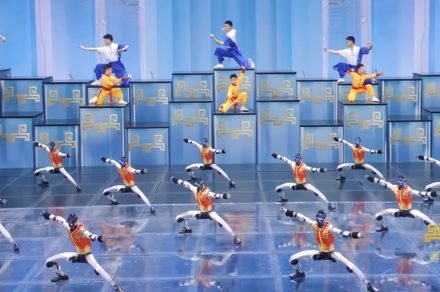
A video (top) of the event shows numerous G1 robots participating in what Unitree described as “the world’s first fully autonomous humanoid kung fu performance.” There’s a spot of breakdancing in there, too.
Performing alongside kids from the Tagou Martial Arts School for the Spring Festival Gala on China Central TV, the robots displayed incredible agility and coordination, moving at around 3 meters per second while performing flips, table vaults, somersaults, and rapid formation changes, blending martial arts with robotics innovation.
The robots were recently upgraded with improved, more dexterous hands, which during this week’s performance supported rapid switching and stable gripping of martial arts props such as nunchaku, Global Times reported.
Unitree founder and CEO Wang Xingxing said the robots executed many of their moves while running at high speed, claiming it as a first for high-dynamic, highly coordinated cluster-control technology.
Wang described the innovations as “very practical” and said they will “facilitate large-scale group deployment of robots in the future.”
The 132-centimeter-tall G1 robot was unveiled in May 2024 and made available three months later for $16,000. The bipedal bot is targeted for research, education, entertainment, and light industrial applications, with researchers, students, and developers encouraged to program and customize the the robot for different tasks.
Unitree also has a full-size humanoid robot called H1, which is about 180 centimeters tall. The H1 is more robust and powerful and is aimed at industrial deployment, while the more compact G1 prioritizes agility and affordability, and is geared more toward research and entertainment.
Unitree is aiming to ship in the region of 20,000 humanoid robots this year, nearly four times last year’s number.
It’s competing with a slew of robotics companies in China, the U.S., and beyond, with all of them racing to find meaningful and manageable roles for their humanoid robots in industrial settings.
The G1 also hit the headlines earlier this month when it took on an autonomous walking challenge in deep snow and brutally cold conditions.
Not so many moons ago, Trevor moved from one tea-loving island nation that drives on the left (Britain) to another (Japan)…
Microsoft develops storage that lets you backup data that lasts 10,000 years
Project Silica packs data into CD-sized glass plates, and it’s built for archives that outlive hard drives.
Microsoft is betting on glass data storage for the kind of files you can’t afford to lose, the records that have to survive hardware refreshes, format changes, and decades of time. Its Project Silica research says laser-etched silica glass can hold data for 10,000 years, with room for longer lifespans in normal storage conditions.
Data gets written inside a small glass plate with ultra-fast lasers, then imaging and decoding software reconstructs it later. Microsoft has also pointed to a peer-reviewed Nature paper as evidence it can reliably write, read, and decode what it stores. This is aimed at archives, not your personal photo drive.
Google Gemini adds Lyria 3, an AI model that can create music with words and photos
Lyria 3 is now available on desktop, and will be rolling out to the Gemini mobile app in the coming days.
Google is expanding the multimodal capabilities of Gemini, once again. Following the success of the viral Nano Banana image generator, the company is releasing Lyria 3, an AI model that can generate music. Google says you can get started with your words and describe what kind of music you want to generate, and the model will comply.
Alternatively, you can feed it a picture or even a video, and Lyria 3 will generate a “high-fidelity track,” with custom lyrics in tow. “From funny jingles to lo-fi beats, you can create custom 30-second soundtracks for any moment,” says the company. Lyria 3 is already rolling out to the desktop version of Gemini, which you can access in a web browser. It will also be expanding to the Gemini mobile app for users in the coming days across the globe.
You can now use NotebookLM as your faster path from notes to slides
New prompt revisions and PPTX export reduce tool switching for presentations.
NotebookLM is leaning harder into presentations, and the latest slide deck update targets the parts that usually slow you down. You can now revise slides with a prompt, and you can hand the finished deck off as a PowerPoint-ready PPTX file.
That combination turns the Google studying tool from a quick generator into something closer to a drafting workspace. Build the structure from your notes, then refine it without rebuilding slides by hand. When you need to share or present, you don’t have to re-create everything in another app.
