

Oh no, Intel is moving customer support to AI
Image: Foundry
Summary created by Smart Answers AI
In summary:
- Intel is launching ‘Ask Intel,’ an AI virtual assistant built on Microsoft Copilot Studio to handle customer support cases and warranty checks.
- PCWorld reports this shift follows Intel’s removal of inbound phone support in December, directing customers to online assistance instead.
- The AI system warns users its answers may be inaccurate, raising concerns about potential hardware damage from incorrect technical advice.
If your Intel processor requires a warranty return or support, the first “person” you’ll probably be dealing with at Intel will be an AI.
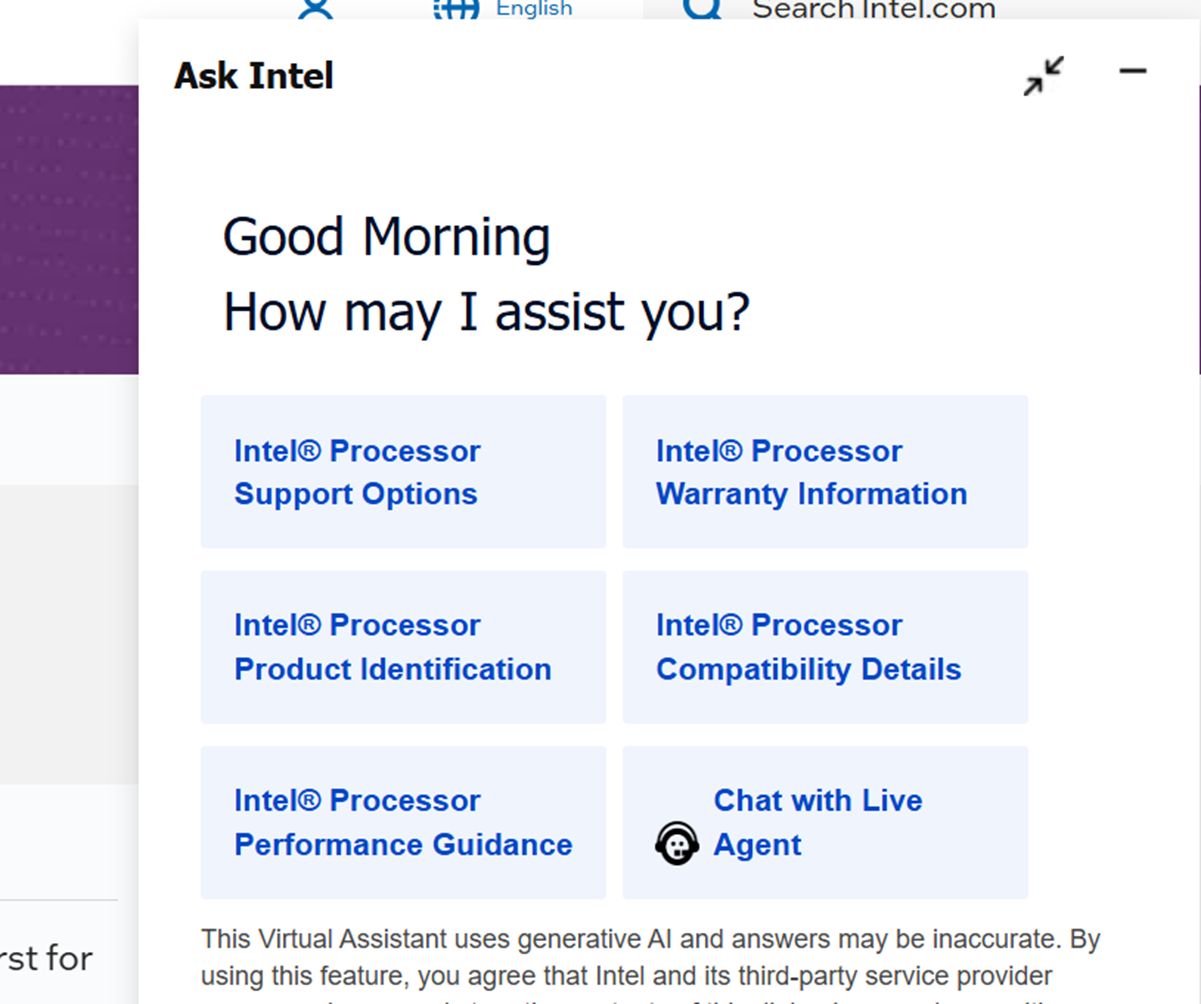
Intel is rolling out “Ask Intel,” an addition to its Intel support site, that runs on Microsoft Copilot rather than on human intervention. Ask Intel will appear as part of support.intel.com, Intel sales executive Boji Tony announced on a LinkedIn post last week. Tony is the vice president and general manager of Intel sales enablement and support.
Ask Intel is built on Microsoft Copilot Studio, and is “a new generative AI–powered virtual assistant for customer and partner support—one of the first of its kind in the semiconductor industry,” Tony said in the post, as reported by CRN.
“With agentic AI capabilities, Ask Intel can open support cases on your behalf, check warranty coverage instantly, and connect you with live support agents when human support is needed,” Tony said.
That Intel should replace at least some of its human customer support staff with AI shouldn’t be surprising. For one thing, Intel and others have been pushing AI solutions to replace humans at drive-through fast-food restaurants for years, such as at KFC. Now, the chipmaker is applying that same strategy to addressing your support questions, too.
Foundry
CRN reported that Intel began removing inbound customer support phone numbers in December, redirecting them to the support site. Naturally, Intel plans to make Ask Intel more central to the support experience over time.
Today, Ask Intel isn’t the first thing you see when you visit Intel’s support site. When I began digging down through support options for Intel’s NUCs and Intel’s processors, the first time I experienced Ask Intel was in the “Live Chat” portion of the site.
“This Virtual Assistant uses generative AI and answers may be inaccurate,” Ask Intel says. It also notes, “By using this feature, you agree that Intel and its third-party service provider may record, use, and store the contents of this dialog in accordance with Intel’s Privacy Notice.”
When I used Ask Intel and asked to speak to a live representative, it first deflected, prompting me to describe the issue. In this case, I asked about crashing desktop CPUs, and Ask Intel first instructed me to download an updated graphics driver. I’m not entirely certain that would have solved my problem. It also suggested that I stress-test my processor, which may have exacerbated the issue.
When I asked if stress-testing a possibly defective CPU was a good idea, Ask Intel then recommended that I update my motherboard’s BIOS instead.
To be fair, we’re seeing AI chat options appear more and more in customer service. I’d be irritated if an AI screwed up my burger, but I’m sure a human manager could quickly fix it. But if I get the wrong advice from an AI and end up torching an expensive CPU, it might be a different story. Proceed carefully.
Author: Mark Hachman, Senior Editor, PCWorld
Mark has written for PCWorld for the last decade, with 30 years of experience covering technology. He has authored over 3,500 articles for PCWorld alone, covering PC microprocessors, peripherals, and Microsoft Windows, among other topics. Mark has written for publications including PC Magazine, Byte, eWEEK, Popular Science and Electronic Buyers’ News, where he shared a Jesse H. Neal Award for breaking news. He recently handed over a collection of several dozen Thunderbolt docks and USB-C hubs because his office simply has no more room.
