

Rocket Report: Chinese launch firm raises big money; Falcon 9 back to the Bahamas
The company that attempted China’s first orbital-class rocket landing says it will soon try again.
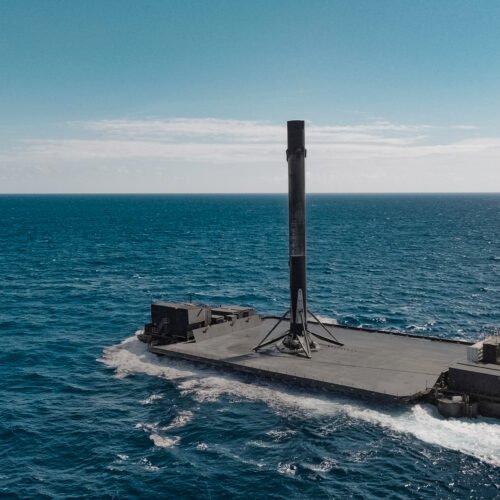
A Falcon 9 booster on its drone ship after landing in Bahamian territorial waters last year.
Credit:
SpaceX
Welcome to Edition 8.30 of the Rocket Report! As I write this week’s edition, NASA’s Space Launch System rocket is undergoing a second countdown rehearsal at Kennedy Space Center, Florida. The outcome of the test will determine whether NASA has a shot at launching the Artemis II mission around the Moon next month, or if the launch will be delayed until April or later. The finicky fueling line for the rocket’s core stage is the center of attention after a hydrogen leak cut short a practice countdown earlier this month.
As always, we welcome reader submissions. If you don’t want to miss an issue, please subscribe using the box below (the form will not appear on AMP-enabled versions of the site). Each report will include information on small-, medium-, and heavy-lift rockets, as well as a quick look ahead at the next three launches on the calendar.
Who is actually investing in sovereign launch? No one will supplant American and Chinese dominance in the space launch arena any time soon, but several longtime US allies now see sovereign access to space as a national security imperative, Ars reports. Taking advantage of private launch initiatives already underway within their own borders, several middle and regional powers have approved substantial government funding for commercial startups to help them reach the launch pad. Australia, Canada, Germany, and Spain are among the nations that currently lack the ability to independently put their own satellites into orbit, but they are now spending money to establish a domestic launch industry. Others talk a big game but haven’t committed the cash to back up their ambitions.
Ranking them... Ars examined how much international governments, specifically those without a present-day orbital launch capability, are investing in sovereign access to space. Germany, Spain, the United Kingdom, Canada, and Australia have committed the most government funding to homegrown launcher development. The fruits of the UK’s investment are in question after the failure of the Scottish rocket company Orbex, which we wrote about in last week’s Rocket Report. Other countries with real, although less credible, orbital launch programs include Brazil, Argentina, and Taiwan.
The easiest way to keep up with Eric Berger’s and Stephen Clark’s reporting on all things space is to sign up for our newsletter. We’ll collect their stories and deliver them straight to your inbox.
An update on one of Germany’s launch startups. German rocket builder Rocket Factory Augsburg (RFA) is making significant progress toward once again attempting an inaugural flight of its RFA One rocket, European Spaceflight reports. The company is moving forward with commissioning its launch pad at SaxaVord Spaceport in Scotland as it works toward a hot fire test of the rocket’s first stage. The RFA One rocket is a 30-meter (98-foot) tall two-stage rocket designed to deliver payloads of up to 1,300 kilograms (2,866 pounds) to low-Earth orbit. The company is also developing an optional kick stage called Redshift that can be configured for a wide range of applications.
They’ve been here before... In August 2024, as the company was preparing for the inaugural flight of its RFA One rocket, an anomaly during a first-stage hot fire test caused the vehicle to burst into flames, resulting in the total loss of the stage. Over the last 18 months, the company has been manufacturing a replacement for the destroyed first stage and upgrading the vehicle’s upper stage to resume preparations for launch from SaxaVord Spaceport. RFA’s chief executive told European Spaceflight that the rocket’s booster is being transported from its German factory to the launch site in Scotland. That will be followed by the upper stage. “We are taking the time to do it properly. We remain aggressive, fast, and flexible, but the wild times before August 2024 are over,” Indulis Kalnins, the company’s CEO, said.
UAE launches hybrid rocket. The first hybrid rocket domestically developed in the United Arab Emirates launched on February 13, marking a significant step in the country’s push to build sovereign space and propulsion capabilities, the Khaleej Times reports. The sounding rocket, developed by the Technology Innovation Institute, reached an altitude of 3 kilometers (1.6 miles) during a test flight over the UAE desert, validating a fully UAE-designed and operated propulsion system for the first time. At the core of the mission was a hybrid propulsion engine combining nitrous oxide with a solid polyethylene-based fuel—a system that blends elements of solid and liquid rocket technologies.
Room to grow... “This achievement is the result of years of disciplined research, engineering, and iteration,” said Elias Tsoutsanis, chief researcher at the institute’s Propulsion and Space Research Center. “That capability is the foundation for everything that follows—higher altitudes, heavier payloads, and more complex missions, all from the UAE.” The UAE has a growing space program, having already sent an orbiter to Mars. The nation has a long-term goal of developing an indigenous orbital launch capability. (submitted by EllPeaTea)
SpaceX restores full crew to ISS. A Crew Dragon spacecraft docked with the International Space Station on Saturday, and astronauts popped open the hatches a few hours later to bring the lab back to a full crew complement of seven astronauts and cosmonauts. The arrival of four new astronauts as part of the Crew-12 mission—Jessica Meir and Jack Hathaway of NASA, Sophie Adenot of the European Space Agency, and Andrey Fedyaev of Roscosmos—came a day after their launch on a Falcon 9 rocket from Cape Canaveral Space Force Station, Florida.
Recovering from something... One of the astronauts on the preceding SpaceX crew mission, Crew-11, experienced a health emergency on the ISS a few days into the new year. NASA made an unprecedented decision to bring them home early. NASA has not named the afflicted Crew-11 astronaut, but the flier is said to be recovering on Earth. The early departure of Crew-11 left just a single NASA astronaut, Chris Williams, aboard the space station. He had reached space on board a Russian Soyuz spacecraft in November, alongside two Russian cosmonauts, Sergey Kud-Sverchkov and Sergei Mikaev. The space station is a big place, and with much of the facility now more than two decades old, Williams had to spend most of his time on maintenance and monitoring activities. Because Crew-11 was brought home more than a month early, NASA and SpaceX scrambled to launch the Crew-12 vehicle a little sooner than expected to minimize the time Williams had to manage the large US segment of the station on his own. (submitted by EllPeaTea)
SpaceX resumes Bahamas landings. For just the second time, a Falcon 9 booster returned to Earth Thursday night on a drone ship stationed among the islands of the Bahamas during a mission to deploy 29 Starlink satellites for SpaceX’s satellite Internet service. The booster landed on the drone ship parked near The Exumas less than 10 minutes after lifting off from Cape Canaveral, Florida. SpaceX landed a Falcon 9 booster in this location for the first time almost exactly one year ago, on February 18, 2025, without incident. But the Bahamian government raised environmental concerns after two Starships broke apart and dropped debris near the Bahamas last year, putting further Falcon 9 landings there on hold. The two entities have since come to an understanding, paving the way for this second booster to land near the island nation.
Back on station… SpaceX’s offshore rocket landings typically occur in international waters. The shift to territorial waters near the Bahamas allows SpaceX to launch into more types of orbits from Cape Canaveral. The Bahamian government hailed the original rocket landing agreement as an opportunity for the island nation to attract visitors and investment, with plans for a regular cadence of Falcon 9 booster returns near the Bahamas over the coming months. (submitted by EllPeaTea)
LandSpace lays out plans for 2026. Chinese commercial launch firm LandSpace is targeting the second quarter of this year for a second orbital launch and booster recovery attempt of its Zhuque-3 rocket, followed by a reuse test in the fourth quarter, Space News reports. A LandSpace official provided the update in a presentation earlier this month before the United Nations Office for Outer Space Affairs. The first launch of the Zhuque-3 rocket in December successfully reached orbit, but the first stage booster crashed near its downrange landing zone instead of descending to a controlled touchdown.
So close… Still, LandSpace got tantalizingly close to nailing an on-target landing. Something went wrong moments after ignition of the rocket’s engines for a final landing burn to slow for touchdown. The stage impacted around 40 meters off the center of a dedicated landing area in Wuwei County, Gansu province, some 390 kilometers (240 miles) downrange from the launch pad at the Jiuquan spaceport in northwestern China. (submitted by EllPeaTea)
Another Chinese launch company rakes in cash. Chinese launch firm iSpace has secured a record D++ funding round to accelerate its reusable rocket development efforts and expand its industrial footprint, Space News reports. The money will support test flights of the company’s Hyperbola-3 rocket, a medium-lift launcher powered by nine main engines. The first launch is scheduled later this year. Public statements suggest the two-stage Hyperbola-3 is 69 meters (226 feet) long with a payload capacity of 8,500 kilograms (18,700 pounds) to low-Earth orbit in reusable mode and 13,400 kilograms (29.500 pounds) to LEO in expendable mode.
A mixed record... iSpace has attracted the massive funding round despite strong competition from other launch startups. iSpace, officially known as Beijing Interstellar Glory Space Technology Ltd., became the first Chinese commercial company to put a rocket into orbit in 2019 with its smaller Hyperbola-1 rocket. But the Hyperbola-1 lacks a reliable track record, with just a 50 percent success rate over eight flights. The Hyperbola-1 is fueled by solid propellants, while the more powerful Hyperbola-3 will use new methane propulsion. iSpace’s latest fundraising round is the largest ever for a Chinese rocket company.
NASA vows to fix those pesky hydrogen leaks, eventually. NASA Administrator Jared Isaacman said Saturday the agency is looking at ways to prevent the fueling problems plaguing the Space Launch System rocket before the Artemis III mission, Ars reports. Artemis III is slated to be the first crew mission to land on the Moon since the Apollo program more than 50 years ago. As for Artemis II, which remains on the launch pad at Kennedy Space Center in Florida after missing a launch window earlier this month, NASA is putting the rocket through a second countdown rehearsal on Thursday to test whether technicians have resolved a hydrogen fuel leak that cut short a practice countdown run on February 2.
Moving the goalposts… Artemis II is the first crew flight for the SLS rocket and Orion spacecraft. The nearly 10-day mission will carry four astronauts around the far side of the Moon and return them to Earth. But none of this can happen until NASA can fix the hydrogen leaks. During the first Wet Dress Rehearsal (WDR) earlier this month, hydrogen gas concentrations in the area around the fueling connection exceeded 16 percent, NASA’s safety limit. This spike was higher than any of the leak rates observed during the Artemis I launch campaign in 2022. Since then, NASA reassessed its safety limit and raised it from 4 percent—a conservative rule NASA held over from the Space Shuttle program—to 16 percent.
Florida community braces for big, new rockets. Before SpaceX’s Starship mega-rockets arrive on Florida’s Space Coast, leaders in Cape Canaveral want to explore state and federal grants to mitigate potential infrastructure damage caused by vibrations and sonic booms, Florida Today reports. The first Florida Starship launch could occur as early as late summer or fall, with US Space Force Col. Brian Chatman calling 2026 “the year of the giants” in Brevard County during a January space conference in Orlando. Blue Origin officials also hope to ramp up launches of their 322-foot New Glenn heavy-lift rockets.
Taking precaution… “We need more data, as well. I think we suspect that we’re going to sustain potential vibration damages. And what does that look like for us? And will there be other sources of revenue available in the event that that happens?” Cape Canaveral City Manager Keith Touchberry asked during the Tuesday City Council meeting. Mayor Pro Tem Kay Jackson, who spearheaded Tuesday’s discussion, said the city should move expeditiously, noting that Blue Origin’s Launch Complex 36 at Cape Canaveral Space Force Station lies closest to the city. That’s where New Glenn rockets launch, 5.7 miles from the closest city condominium and 7.2 miles from City Hall.
Next three launches
Feb. 21: Falcon 9 | Starlink 17-25 | Vandenberg Space Force Base, California | 08:00 UTC
Feb. 22: Falcon 9 | Starlink 6-104 | Cape Canaveral Space Force Station, Florida | 02:04 UTC
Feb. 24: Falcon 9 | Starlink 17-26 | Vandenberg Space Force Base, California | 14:00 UTC
Stephen Clark is a space reporter at Ars Technica, covering private space companies and the world’s space agencies. Stephen writes about the nexus of technology, science, policy, and business on and off the planet.
