

Chevy’s Colorado ZR2 Bison Is Ridiculous (For Better And Worse)
Alex Hevesy/SlashGear
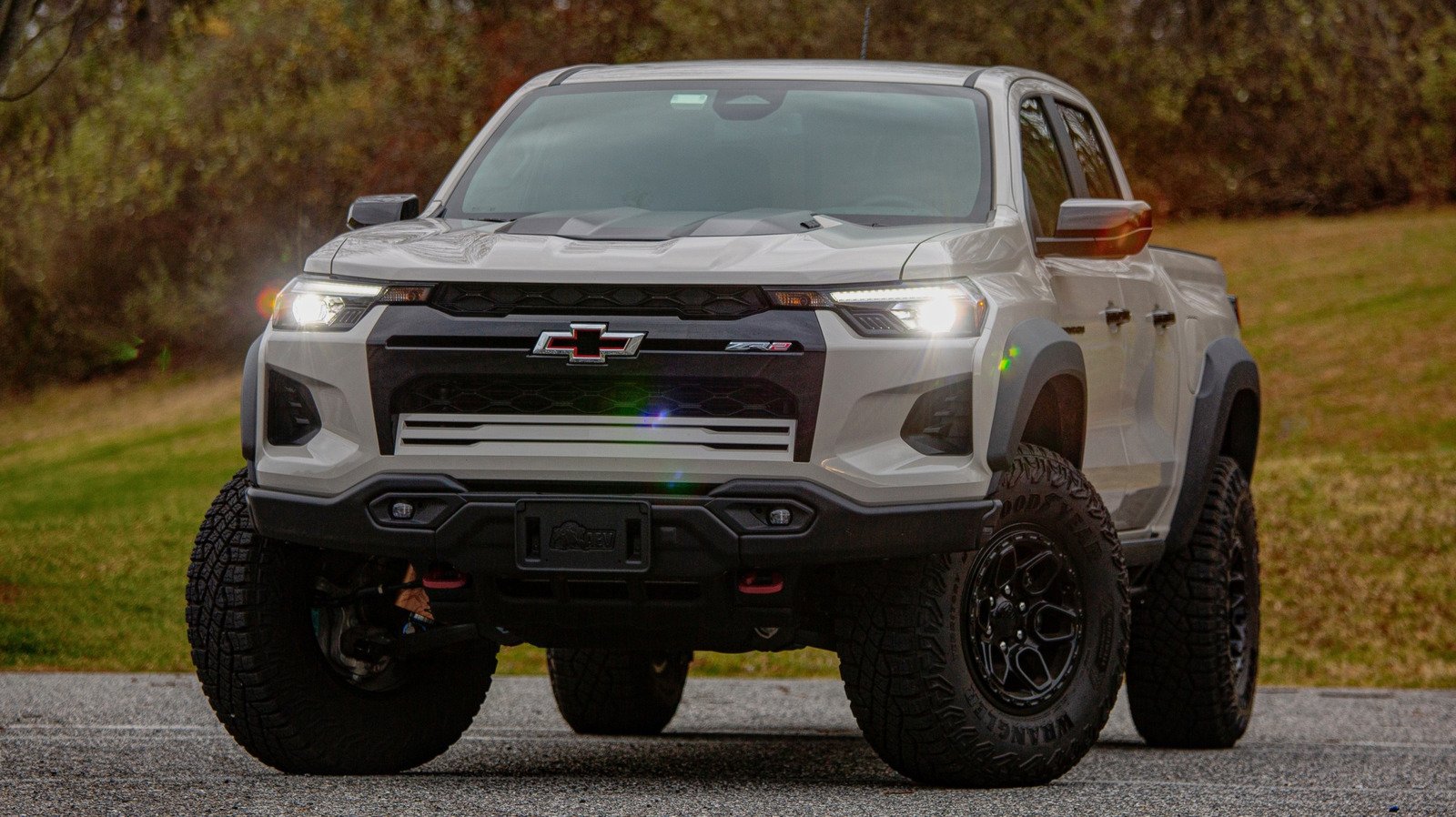
The 2026 Chevrolet Colorado ZR2 Bison is an odd truck. It feels as big as a house, monstrously tall, powerful, expensive, inefficient, definitely capable within its niche of vehicles, and completely impractical for daily life.
The base model Chevy Colorado occupies the smallest truck segment within GM’s body of work, competing directly against the Ford Ranger, Nissan Frontier, and Toyota Tacoma. Give it the ZR2 treatment (not to mention the additional Bison add-ons) and it becomes a different animal entirely. It turns from a work truck into a sport truck that’s contractually obligated to never go near a jobsite.
Even in this specific model’s more subtle “White Sands” finish, it was completely impossible to ignore when it rumbled into my driveway. Despite being an ostensibly “mid-size” truck, it towered over the other vehicles in my apartment building’s parking lot. I like the more ostentatious side of motoring, and after driving a lackluster yet still flashy Ram, I wanted to see what GM was up to in the big goofy truck department.
Chevy’s huge mid-size truck
Alex Hevesy/SlashGear
What does “ZR2” actually mean? That’s a good question. Engine and transmission-wise, it’s a run of the mill Colorado with a “Turbomax” 2.7-liter four-banger that puts out 310 horsepower. As of now, that’s the only engine available for the Colorado. Power goes to all four wheels via an 8-speed automatic transmission; again, the only available transmission for the Colorado. There, however, the similarities to your local electrician’s truck stop.
The ZR1 gets a three-inch lift, 33-inch tires, off-road tuned dampers, and a bodykit for a meaner look. This truck also got the Bison package which gives you skid plates over the all of the important parts underneath, decals (because of course), a big spare tire carrier in the bed, and bumpers from AEV. It’s a scary-looking truck. You also get locking differentials (front and rear), drive modes for every surface on earth, and beadlock tires. It has bark and bite.
The beefy Bison
Alex Hevesy/SlashGear
Driving it is a bit of a different story. I didn’t blast through the mud or crawl up the side of a mountain with the ZR2: while that may be Chevy’s marketing push, I drove it like the sports truck I strongly suspect most owners will treat it as. I went to the grocery store, ran a few errands, and showed it off to some friends while parking as obnoxiously as possible.
In everyday driving, it just feels like any other pickup truck: a little like a tractor and not all that refined, compared to something with a lot more power or a car that’s lower to the ground. Given the height, it’s assaulting the wind rather than gliding through it. When you drive a little more dynamically, however, the ZR2 seems to get a little more spring in its step. It’s not fast, per se, but 310 horsepower is certainly enough to get moving.
Alex Hevesy/SlashGear
The dampers, however, really do make a difference. On winding roads, the ZR2’s bodyroll is minimal and the whole vessel feels a lot more controllable than the apartment building of a vehicle that, say, a Ford Bronco is. It’s odd to say this about a Chevy Colorado, but it was actually sporty. If you’re just using a ZR2 to go to work, those dampers and suspension tunes aren’t going to prove their worth all that much, but if you drive it fast (or dare venture off-road) you will welcome their presence.
Efficient inside, inefficient everywhere else
Alex Hevesy/SlashGear
On the inside, it’s really just a Chevy Colorado. A Colorado with some unique stitching and ZR2 badging all over the place, sure, but otherwise not so special. Being a mid-size truck, it’s a little cramped compared to a proper SUV or full-size truck, but it’s certainly large enough to fit four adults or two plus a bunch of stuff in the rear.
As far as ergonomics go, this truck is one of the unfortunate vehicles where some of the most important features — like the lights — are controlled by a touchscreen that might not always give you what you want. Physical buttons are good, especially in a truck that’s probably going to get very dirty and be driven by someone who might be wearing gloves.
Alex Hevesy/SlashGear
Efficiency is barely even a serious point to consider on the ZR2. It’s laughably bad at an estimated 16 miles per gallon, but easily drops as low as 13 miles per gallon when you’re thrashing around. For a four-cylinder engine made for efficiency, that’s less than ideal, to put it lightly. The huge tires and aerodynamic properties of a brick aren’t helping anything.
Feeling practical or powerful?
Alex Hevesy/SlashGear
As far as traditional truck stuff goes, this ZR2 Bison trim really isn’t all that practical. The three-inch lift means that towing is going to get more complicated, with a lower maximum towing weight at 6,000 pounds compared to the other Colorado trims’ 7,700 pounds. It also has a lower payload of 1,151 pounds, much less than the base model’s 1,684 pound payload.
Plus, the huge spare tire in the bed takes up a lot of room. Work truck the Colorado ZR2 is not. That said, it can actually tow a little more than the similarly ridiculous Ford Ranger Raptor, which tops out at 5,510 pounds, so that’s certainly something to consider if you’re exclusively looking for big, excessive off-road trucks.
Pricing is similarly outsized, compared to the rest of the Colorado family. A base-spec rear-wheel drive 2026 Colorado WT starts at $34,495. The ZR2 immediately rockets up to $50,500. The Bison package throws on another $11,700 (although the window sticker deducts $1,500 for the Bison treatment as to not duplicate features already on the ZR2). Put on a $75 hood emblem that says “TURBOMAX” and the destination charge of $2,095, and you arrive thunderously at the final price of $62,870.
2026 Chevrolet Colorado ZR2 Bison verdict
Alex Hevesy/SlashGear
It doesn’t take much searching to find multiple full-size, V8-powered (and even hybrid) trucks for that kind of money. If you’re looking for value in a sport truck like the ZR2, you are barking up the wrong tree. The Ford Raptor Ranger has no issue eclipsing $60,000, and the biggest and meanest Toyota Tacoma TRD Pro models can even get near $70,000 when all’s said and done. The price is absolutely ridiculous in reality, but the Colorado ZR2 and its rowdy friends don’t seem to exist on the same Earth we inhabit.
Let’s be real here, if you buy a ZR2, are you going to be jumping dunes in the Mojave Desert 100% of the time you own it? Do you want to give up the inherent practicality of a more pedestrian truck to look cool? Looking cool is a valid excuse to buy any car, but you have to come to terms with that end of the bargain when you sign up for the ZR2.
It’s an expensive truck, then, but is it a good truck? Similar to a car like the Nissan Z Nismo, Cadillac Escalade V, or Aston Martin Vantage, it’s hard to qualify a vehicle that has vanishingly little real world justification. As a truck, it’s almost hopelessly outclassed by anything else with a bed. It’s too ridiculous that it infringes on the very nature of a pickup. But I would argue that as a sport truck, it’s phenomenal at its job: it effortlessly tramples over different terrain and looks the part. Really fun to drive, then, even if I wouldn’t ever buy one.
