

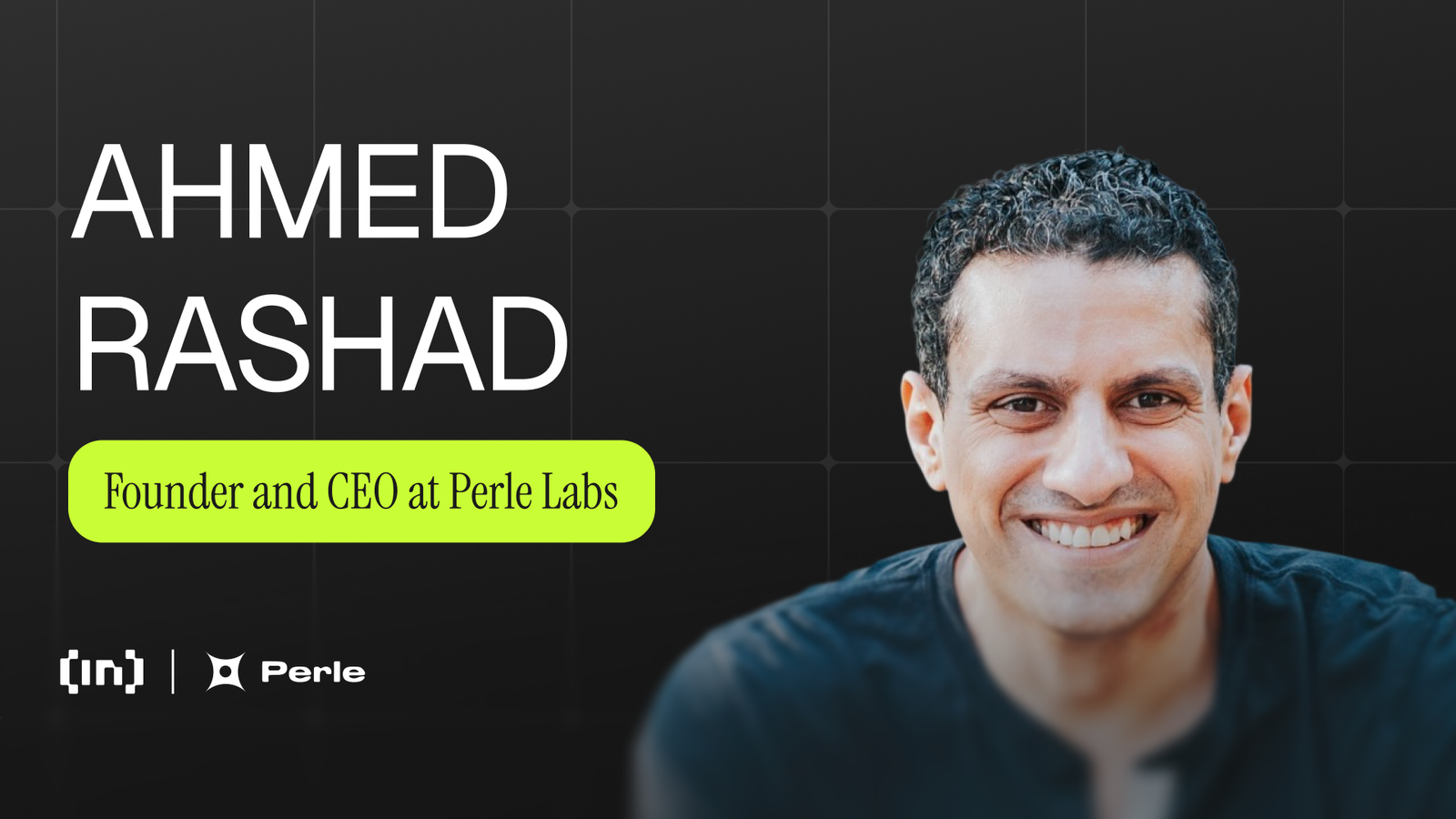
Perle Labs CEO Ahmed Rashad on Why AI Needs Verifiable Data Infrastructure
AI agents dominated ETHDenver 2026, from autonomous finance to on-chain robotics. But as enthusiasm around “agentic economies” builds, a harder question is emerging: can institutions prove what their AI systems were trained on?
Among the startups targeting that problem is Perle Labs, which argues that AI systems require a verifiable chain of custody for their training data, particularly in regulated and high-risk environments. With a focus on building an auditable, credentialed data infrastructure for institutions, Perle has raised $17.5 million to date, with its latest funding round led by Framework Ventures. Other investors include CoinFund, Protagonist, HashKey, and Peer VC. The company reports more than one million annotators contributing over a billion scored data points on its platform.
BeInCrypto spoke with Ahmed Rashad, CEO of Perle Labs, on the sidelines of ETHDenver 2026. Rashad previously held an operational leadership role at Scale AI during its hypergrowth phase. In the conversation, he discussed data provenance, model collapse, adversarial risks and why he believes sovereign intelligence will become a prerequisite for deploying AI in critical systems.
BeInCrypto: You describe Perle Labs as the “sovereign intelligence layer for AI.” For readers who are not inside the data infrastructure debate, what does that actually mean in practical terms?
Ahmed Rashad: “The word sovereign is deliberate, and it carries a few layers.
The most literal meaning is control. If you’re a government, a hospital, a defense contractor, or a large enterprise deploying AI in a high-stakes environment, you need to own the intelligence behind that system, not outsource it to a black box you can’t inspect or audit. Sovereign means you know what your AI was trained on, who validated it, and you can prove it. Most of the industry today cannot say that.
The second meaning is independence. Acting without outside interference. This is exactly what institutions like the DoD, or an enterprise require when they’re deploying AI in sensitive environments. You cannot have your critical AI infrastructure dependent on data pipelines you don’t control, can’t verify, and can’t defend against tampering. That’s not a theoretical risk. NSA and CISA have both issued operational guidance on data supply chain vulnerabilities as a national security issue.
The third meaning is accountability. When AI moves from generating content into making decisions, medical, financial, military, someone has to be able to answer: where did the intelligence come from? Who verified it? Is that record permanent? On Perle, our goal is to have every contribution from every expert annotator is recorded on-chain. It can’t be rewritten. That immutability is what makes the word sovereign accurate rather than just aspirational.
In practical terms, we are building a verification and credentialing layer. If a hospital deploys an AI diagnostic system, it should be able to trace each data point in the training set back to a credentialed professional who validated it. That is sovereign intelligence. That’s what we mean.”
BeInCrypto: You were part of Scale AI during its hypergrowth phase, including major defense contracts and the Meta investment. What did that experience teach you about where traditional AI data pipelines break?
Ahmed Rashad: “Scale was an incredible company. I was there during the period when it went from $90M and now it’s $29B, all of that was taking shape, and I had a front-row seat to where the cracks form.
The fundamental problem is that data quality and scale pull in opposite directions. When you’re growing 100x, the pressure is always to move fast: more data, faster annotation, lower cost per label. And the casualties are precision and accountability. You end up with opaque pipelines: you know roughly what went in, you have some quality metrics on what came out, but the middle is a black box. Who validated this? Were they actually qualified? Was the annotation consistent? Those questions become almost impossible to answer at scale with traditional models.
The second thing I learned is that the human element is almost always treated as a cost to be minimized rather than a capability to be developed. The transactional model: pay per task then optimize for throughput just degrades quality over time. It burns through the best contributors. The people who can give you genuinely high-quality, expert-level annotations are not the same people who will sit through a gamified micro-task system for pennies. You have to build differently if you want that caliber of input.
That realization is what Perle is built on. The data problem isn’t solved by throwing more labor at it. It’s solved by treating contributors as professionals, building verifiable credentialing into the system, and making the entire process auditable end to end.”
BeInCrypto: You’ve reached a million annotators and scored over a billion data points. Most data labeling platforms rely on anonymous crowd labor. What’s structurally different about your reputation model?
Ahmed Rashad: “The core difference is that on Perle, your work history is yours, and it’s permanent. When you complete a task, the record of that contribution, the quality tier it hit, how it compared to expert consensus, is written on-chain. It can’t be edited, can’t be deleted, can’t be reassigned. Over time, that becomes a professional credential that compounds.
Compare that to anonymous crowd labor, where a person is essentially fungible. They have no stake in quality because their reputation doesn’t exist, each task is disconnected from the last. The incentive structure produces exactly what you’d expect: minimum viable effort.
Our model inverts that. Contributors build verifiable track records. The platform recognizes domain expertise. For example, a radiologist who consistently produces high-quality medical image annotations builds a profile that reflects that. That reputation drives access to higher-value tasks, better compensation, and more meaningful work. It’s a flywheel: quality compounds because the incentives reward it.
We’ve crossed a billion points scored across our annotator network. That’s not just a volume number, it’s a billion traceable, attributed data contributions from verified humans. That’s the foundation of trustworthy AI training data, and it’s structurally impossible to replicate with anonymous crowd labor.”
BeInCrypto: Model collapse gets discussed a lot in research circles but rarely makes it into mainstream AI conversations. Why do you think that is, and should more people be worried?
Ahmed Rashad: “It doesn’t make mainstream conversations because it’s a slow-moving crisis, not a dramatic one. Model collapse, where AI systems trained increasingly on AI-generated data start to degrade, lose nuance, and compress toward the mean, doesn’t produce a headline event. It produces a gradual erosion of quality that’s easy to miss until it’s severe.
The mechanism is straightforward: the internet is filling up with AI-generated content. Models trained on that content are learning from their own outputs rather than genuine human knowledge and experience. Each generation of training amplifies the distortions of the last. It’s a feedback loop with no natural correction.
Should more people be worried? Yes, particularly in high-stakes domains. When model collapse affects a content recommendation algorithm, you get worse recommendations. When it affects a medical diagnostic model, a legal reasoning system, or a defense intelligence tool, the consequences are categorically different. The margin for degradation disappears.
This is why the human-verified data layer isn’t optional as AI moves into critical infrastructure. You need a continuous source of genuine, diverse human intelligence to train against; not AI outputs laundered through another model. We have over a million annotators representing genuine domain expertise across dozens of fields. That diversity is the antidote to model collapse. You can’t fix it with synthetic data or more compute.”
BeInCrypto: When AI expands from digital environments into physical systems, what fundamentally changes about risk, responsibility, and the standards applied to its development?
Ahmed Rashad: The irreversibility changes. That’s the core of it. A language model that hallucinates produces a wrong answer. You can correct it, flag it, move on. A robotic surgical system operating on a wrong inference, an autonomous vehicle making a bad classification, a drone acting on a misidentified target, those errors don’t have undo buttons. The cost of failure shifts from embarrassing to catastrophic.
That changes everything about what standards should apply. In digital environments, AI development has largely been allowed to move fast and self-correct. In physical systems, that model is untenable. You need the training data behind these systems to be verified before deployment, not audited after an incident.
It also changes accountability. In a digital context, it’s relatively easy to diffuse responsibility, was it the model? The data? The deployment? In physical systems, particularly where humans are harmed, regulators and courts will demand clear answers. Who trained this? On what data? Who validated that data and under what standards? The companies and governments that can answer those questions will be the ones allowed to operate. The ones that can’t will face liability they didn’t anticipate.
We built Perle for exactly this transition. Human-verified, expert-sourced, on-chain auditable. When AI starts operating in warehouses, operating rooms, and on the battlefield, the intelligence layer underneath it needs to meet a different standard. That standard is what we’re building toward.
BeInCrypto: How real is the threat of data poisoning or adversarial manipulation in AI systems today, particularly at the national level?
Ahmed Rashad: “It’s real, it’s documented, and it’s already being treated as a national security priority by people who have access to classified information about it.
DARPA’s GARD program (Guaranteeing AI Robustness Against Deception) spent years specifically developing defenses against adversarial attacks on AI systems, including data poisoning. The NSA and CISA issued joint guidance in 2025 explicitly warning that data supply chain vulnerabilities and maliciously modified training data represent credible threats to AI system integrity. These aren’t theoretical white papers. They’re operational guidance from agencies that don’t publish warnings about hypothetical risks.
The attack surface is significant. If you can compromise the training data of an AI system used for threat detection, medical diagnosis, or logistics optimization, you don’t need to hack the system itself. You’ve already shaped how it sees the world. That’s a much more elegant and harder-to-detect attack vector than traditional cybersecurity intrusions.
The $300 million contract Scale AI holds with the Department of Defense’s CDAO, to deploy AI on classified networks, exists in part because the government understands it cannot use AI trained on unverified public data in sensitive environments. The data provenance question is not academic at that level. It’s operational.
What’s missing from the mainstream conversation is that this isn’t just a government problem. Any enterprise deploying AI in a competitive environment, financial services, pharmaceuticals, critical infrastructure, has an adversarial data exposure they’ve probably not fully mapped. The threat is real. The defenses are still being built.”
BeInCrypto: Why can’t a government or a large enterprise just build this verification layer themselves? What’s the real answer when someone pushes back on that?
Ahmed Rashad: “Some try. And the ones who try learn quickly what the actual problem is.
Building the technology is the easy part. The hard part is the network. Verified, credentialed domain experts, radiologists, linguists, legal specialists, engineers, scientists, don’t just appear because you built a platform for them. You have to recruit them, credential them, build the incentive structures that keep them engaged, and develop the quality consensus mechanisms that make their contributions meaningful at scale. That takes years and it requires expertise that most government agencies and enterprises simply don’t have in-house.
The second problem is diversity. A government agency building its own verification layer will, by definition, draw from a limited and relatively homogeneous pool. The value of a global expert network isn’t just credentialing; it’s the range of perspective, language, cultural context, and domain specialization that you can only get by operating at real scale across real geographies. We have over a million annotators. That’s not something you replicate internally.
The third problem is incentive design. Keeping high-quality contributors engaged over time requires transparent, fair, programmable compensation. Blockchain infrastructure makes that possible in a way that internal systems typically can’t replicate: immutable contribution records, direct attribution, and verifiable payment. A government procurement system is not built to do that efficiently.
The honest answer to the pushback is: you’re not just buying a tool. You’re accessing a network and a credentialing system that took years to build. The alternative isn’t ‘build it yourself’, it’s ‘use what already exists or accept the data quality risk that comes with not having it.’”
BeInCrypto: If AI becomes core national infrastructure, where does a sovereign intelligence layer sit in that stack five years from now?
Ahmed Rashad: “Five years from now, I think it looks like what the financial audit function looks like today, a non-negotiable layer of verification that sits between data and deployment, with regulatory backing and professional standards attached to it.
Right now, AI development operates without anything equivalent to financial auditing. Companies self-report on their training data. There’s no independent verification, no professional credentialing of the process, no third-party attestation that the intelligence behind a model meets a defined standard. We’re in the early equivalent of pre-Sarbanes-Oxley finance, operating largely on trust and self-certification.
As AI becomes critical infrastructure, running power grids, healthcare systems, financial markets, defense networks, that model becomes untenable. Governments will mandate auditability. Procurement processes will require verified data provenance as a condition of contract. Liability frameworks will attach consequences to failures that could have been prevented by proper verification.
Where Perle sits in that stack is as the verification and credentialing layer, the entity that can produce an immutable, auditable record of what a model was trained on, by whom, under what standards. That’s not a feature of AI development five years from now. It’s a prerequisite.
The broader point is that sovereign intelligence isn’t a niche concern for defense contractors. It’s the foundation that makes AI deployable in any context where failure has real consequences. And as AI expands into more of those contexts, the foundation becomes the most valuable part of the stack.”
Disclaimer
In compliance with the Trust Project guidelines, this opinion article presents the author’s perspective and may not necessarily reflect the views of BeInCrypto. BeInCrypto remains committed to transparent reporting and upholding the highest standards of journalism. Readers are advised to verify information independently and consult with a professional before making decisions based on this content. Please note that our Terms and Conditions, Privacy Policy, and Disclaimers have been updated.
