

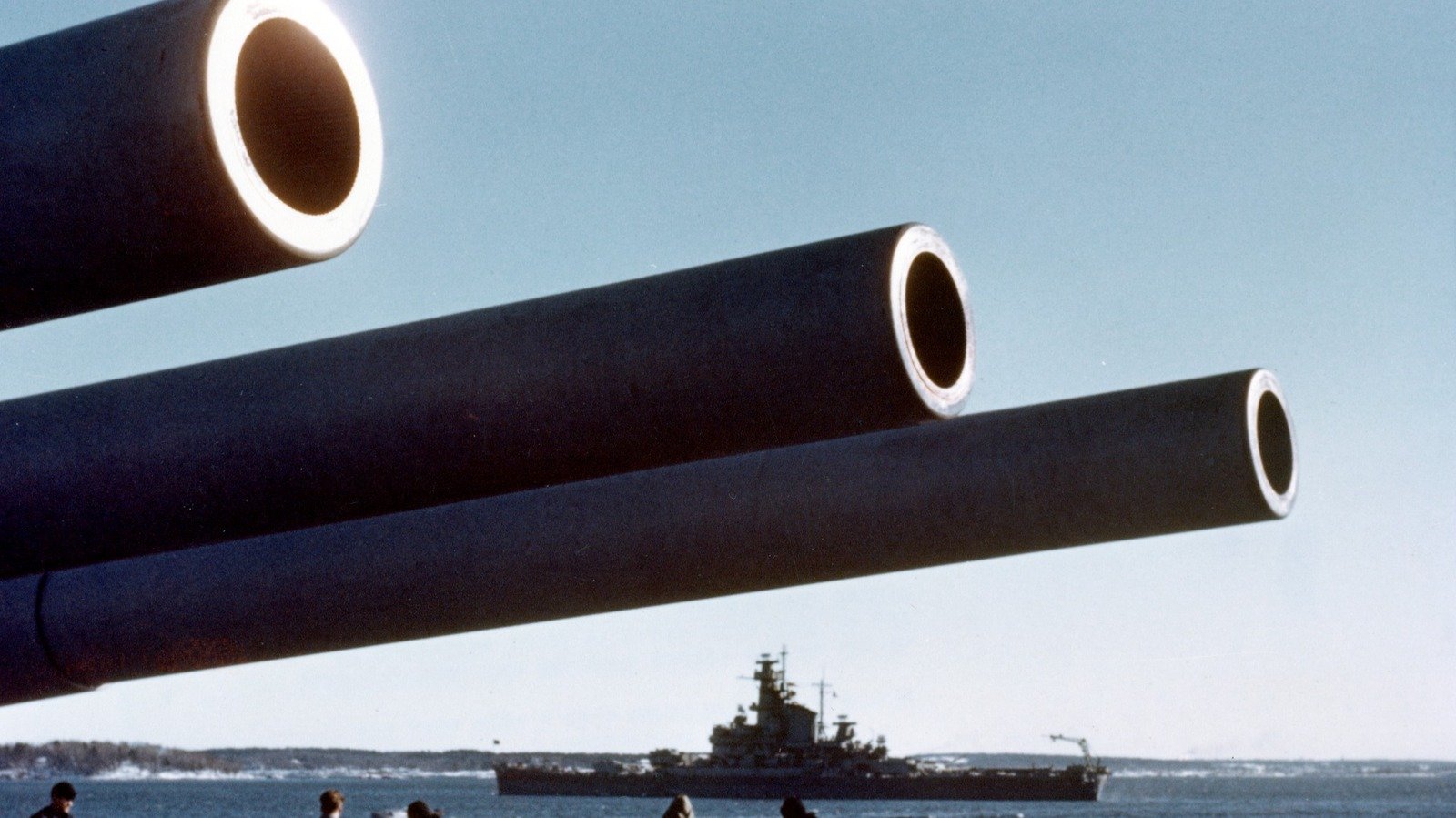
USS Massachusetts: What Happened To The Ship That Fired WWII’s Final Shot
World War II was the largest military conflict in world history, and every side built massive machines of war to try to outdo the other. Japan famously built the largest battleships ever made, the Musashi and Yamato, neither of which was particularly successful, nor did they survive the conflict. The United States was no stranger to battleships either, having utilized 25 of various sizes and classifications throughout WWII. One such class, the South Dakota-class of fast battleships, featured the U.S. Navy vessel that fired the final shot of the war.
The USS Massachusetts (BB-59), aka “Big Mamie,” was commissioned in May 1942, and it took part in numerous operations throughout the war. As a fast battleship, the Massachusetts’ primary role was as a carrier escort, as aircraft carriers had taken a dominant position throughout the Pacific in the aftermath of the sneak attack at Pearl Harbor and the Battle of Midway. While serving in this function, the USS Massachusetts participated in numerous key operations and battles as Fleet Admiral Chester W. Nimitz continued his island-hopping campaign.
These included operations in the Philippines, Gilbert, and the Marshall Islands. In 1945, the USS Massachusetts supported the U.S. Army and Marines during the Battle of Okinawa and continued fighting against Japanese forces as the U.S. moved closer to Honshu, the largest of Japan’s islands. When the war came to an end, the USS Massachusetts was decommissioned until 1962, when it was stricken from the Naval register. Three years later, the USS Massachusetts became a museum ship, where it remains open to the public today.
The USS Massachusetts and the final shots of World War II
One of the more interesting details of any major conflict concerns the first and last shots fired. This fascination covers most of human history, and World War II was no different. In terms of the United States’ direct involvement, the first shots were fired by the USS Ward (DD-139) in defense on December 7, 1941, when the Japanese attacked Pearl Harbor. The attack destroyed or disabled the Pacific Fleet’s battleships while they were sitting in the harbor. The final shots came much later, on August 9, 1945.
That’s also the date that the U.S. dropped “Fat Man,” the second and thus far last nuclear weapon used in combat. The second atomic bomb forced Japan to capitulate to American demands and surrender unconditionally, ending WWII on August 15. While the bomb and its aftermath are some of history’s worst and most well-known moments, other actions were carried out on the same day. The USS Massachusetts fired its 16-inch guns at an industrial complex at Hamamatsu, Japan, on the same day.
It’s believed that the rounds fired on the complex were the last shots of WWII. It was also the final mission for the USS Massachusetts, which remained in active service until its decommissioning in March 1947. It remained in reserve until 1962 and became the museum ship it remains to this day. You can visit the historic battleship the next time you’re in Fall River, Massachusetts, where it is permanently moored at Battleship Cove, home of America’s Fleet Museum.
