

Cash issuing terminals
In the United States, we are losing our fondness for cash. As in many other
countries, cards and other types of electronic payments now dominate everyday
commerce. To some, this is a loss. Cash represented a certain freedom from
intermediation, a comforting simplicity, that you just don’t get from Visa.
It’s funny to consider, then, how cash is in fact quite amenable to automation.
Even Benjamin Franklin’s face on a piece of paper can feel like a mere proxy
for a database transaction. How different from “e-cash” is cash itself, when
it starts and ends its lifecycle through automation?
Increasing automation of cash reflects the changing nature of banking: decades
ago, a consumer might have interacted with banking primarily through a “passbook”
savings account, where transactions were so infrequent that the bank recorded
them directly in the patron’s copy of the passbook. Over the years, nationwide
travel and nationwide communications led to the ubiquitous use of inter-bank
money transfers, mostly in the form of the check. The accounts that checks
typically drew on—checking accounts—were made for convenience and ease of
access. You might deposit your entire paycheck into an account, it might even
be sent there automatically… and then when you needed a little walking around
money, you would withdraw cash by the assistance of a teller. By the time I was
a banked consumer, even the teller was mostly gone. Today, we get our cash from
machines so that it can be deposited into other machines.
Cash handling is fraught with peril. Bills are fairly small and easy to hide,
and yet quite valuable. Automation in the banking world first focused on solving
this problem, of reliable and secure cash handling within the bank branch. The
primary measure against theft by insiders was that the theft would be discovered,
as a result of the careful bookkeeping that typifies banks. But, well, that
bookkeeping was surprisingly labor-intensive in even the bank of the 1950s.
Histories of the ATM usually focus on just that: the ATM. It’s an interesting
story, but one that I haven’t been particularly inclined to cover due to the
lack of a compelling angle. Let’s try IBM. IBM is such an important, famous
player in business automation that it forms something of a synecdoche for the
larger industry. Even so, in the world of bank cash handling, IBM’s efforts
ultimately failed… a surprising outcome, given their dominance in the machines
that actually did the accounting.
In this article, we’ll examine the history of ATMs—by IBM. IBM was just one of
the players in the ATM industry and, by its maturity, not even one of the more
important ones. But the company has a legacy of banking products that put the
ATM in a more interesting context, and despite lackluster adoption of later IBM
models, their efforts were still influential enough that later ATMs inherited
some of IBM’s signature design concepts. I mean that more literally than you
might think. But first, we have to understand where ATMs came from. We’ll start
with branch banking.
When you open a bank account, you typically do so at a “branch,” one of many
physical locations that a national bank maintains. Let us imagine that you are
opening an account at your local branch of a major bank sometime around 1930;
whether before or after that year’s bank run is up to you. Regardless of the
turbulent economic times, the branch became responsible for tracking the balance
of your account. When you deposit money, a teller writes up a slip. When you
come back and withdraw money, a different teller writes up a different slip. At
the end of each business day, all of these slips (which basically constitute
a journal in accounting terminology) have to be rounded up by the back office
and posted to the ledger for your account, which was naturally kept as a card in
a big binder.
A perfectly practicable 1930s technology, but you can already see the downsides.
Imagine that you appear at a different branch to withdraw money from your
account. Fortunately this was not very common at the time, and you would be more
likely to use other means of moving money in most scenarios. Still, the bank
tries to accommodate. The branch at which you have appeared can dispense cash,
write a slip, and then send it to the correct branch for posting… but they
also need to post it to their own ledger that tracks transactions for foreign
accounts, since they need to be able to reconcile where their cash went. And
that ignores the whole issue of who you are, whether or not you even have an
account at another branch, and whether or not you have enough money to cover the
withdrawal. Those are problems that, mercifully, could mostly be sorted out with
a phone call to your home branch.
Bank branches, being branches, do not exist in isolation. The bank also has a
headquarters, which tracks the finances of its various branches—both to know the
bank’s overall financial posture (critical considering how banks fail), and to
provide controls against insider theft. Yes, that means that each of the branch
banks had to produce various reports and ledger copies and then send them by
courier to the bank headquarters, where an army of clerks in yet another back
office did yet another round of arithmetic to produce the bank’s overall
ledgers.
As the United States entered World War II, an expanding economy, rapid
industrial buildup, and a huge increase in national mobility (brought on by
things like the railroads and highways) caused all of these tasks to occur on
larger and larger scales. Major banks expanded into a tiered system, in which
branches reported their transactions to “regional centers” for reconciliation
and further reporting up to headquarters. The largest banks turned to unit
record equipment or “business machines,” arguably the first form of business
computing: punched card machines that did not evaluate programs, but sorted and
summed.
Simple punched card equipment gave way to advanced punched card equipment,
innovations like the “posting machine.” These did exactly what they promised:
given a stack of punched cards encoding transactions, they produced a ledger
with accurately computed sums. Specialized posting machines were made for
industries ranging from hospitality (posting room service and dining charges
to room folios) to every part of finance, and might be built custom to the
business process of a large customer.
If tellers punched transactions into cards, the bank could come much
closer to automation by shipping the cards around for processing at each office.
But then, if transactions are logged in a machine readable format, and then
processed by machines, do we really need to courier them to rooms full of
clerks?
Well, yes, because that was the state of technology in the 1930s. But it would
not stay that way for long.
In 1950, Bank of America approached SRI about the feasibility of an automated
check processing system. Use of checks was rapidly increasing, as were total
account holders, and the resulting increase in inter-branch transactions was
clearly overextending BoA’s workforce—to such an extent that some branches were
curtailing their business hours to make more time for daily closing. By 1950,
computer technology had advanced to such a state that it was obviously possible
to automate this activity, but it still represented one of the most ambitious
efforts in business computing to date.
BoA wanted a system that would not only automate the posting of transactions
prepared by tellers, but actually automate the handling of the checks
themselves. SRI and, later, their chosen manufacturing partner General Electric
ran a multi-year R&D campaign on automated check handling that ultimately lead
to the design of the checks that we use today: preprinted slips with account
holder information, and account number, already in place. And, most importantly,
certain key fields (like account number and check number) represented in a newly
developed machine-readable format called “MICR” for magnetic ink character
recognition. This format remains in use today, to the extent that checks remain
in use, although as a practical matter MICR has given way to the more familiar
OCR (aided greatly by the constrained and standardized MICR character set).
The machine that came out of this initiative was called ERMA, the Electronic
Recording Machine, Accounting. I will no doubt one day devote a full article
to ERMA, as it holds a key position in the history of business computing while
also managing to not have much of a progeny due to General Electric’s failure to
become a serious contender in the computer industry. ERMA did not lead to a
whole line of large-scale “ERM” business systems as GE had hoped, but it did
firmly establish the role of the computer in accounting, automate parts of the
bookkeeping through almost the entirety of what would become the nation’s
largest bank, and inspire generations of products from other computer
manufacturers.
The first ERMA system went into use in 1959. While IBM was the leader in unit
record equipment and very familiar to the banking industry, it took a few years
for Big Blue to bring their own version. Still, IBM had their own legacy to
build on, including complex electromechanical machines that performed some of
the tasks that ERMA was taking over. Since the 1930s, IBM had produced a line of
check processing or “proofing” machines. These didn’t exactly “automate” check
handling, but they did allow a single operator to handle a lot of documents.
The IBM 801, 802, and 803 line of check proofers used what were fundamentally
unit record techniques—keypunch, sorting bins, mechanical totalizers—to present
checks one at a time in front of the operator, who read information like the
amount, account number, and check number off of the paper slip and entered it
on a keypad. The machine then whisked the check away, printing the keyed data
(and reference numbers for auditing) on the back of the check, stamped an
endorsement, added the check’s amounts to the branch’s daily totals (including
subtotals by document type), and deposited the check in an appropriate sorter
bin to be couriered to the drawer’s bank. While all this happened, the machines
also printed the keyed check information and totals onto paper tapes.
By the early 1960s, with ERMA on the scene, IBM’s started to catch up.
Subsequent check processing systems gained support for MICR, eliminating much
(sometimes all!) of the operator’s keying. Since the check proofing machines
could also handle deposit slips, a branch that generated MICR-marked deposit
slips could eliminate most of the human touchpoints involved in routine banking.
A typical branch bank setup might involve an IBM 1210 document
reader/sorter machine connected by serial channel to an IBM 1401 computer.
This system behaved much like the older check proofers, reading documents,
logging them, and calculating totals. But it was now all under computer control,
with the flexibility and complexity that entails.
One of these setups could process almost a thousand checks a minute with a
little help from an operator, and adoption of electronic technology at other
stages made clerk’s lives easier. For example, IBM’s mid-1960s equipment
introduced solid-state memory. The IBM 1260 was used for adding machine-readable
MICR data to documents that didn’t already have it. Through an innovation that
we would now call a trivial buffer, the 1260’s operator could key in the numbers
from the next document while the printer was still working on the previous.
Along with improvements in branch bank equipment came a new line of “high-speed”
systems. In a previous career, I worked at a Federal Reserve bank, where
“high-speed” was used as the name of a department in the basement vault. There,
huge machines processed currency to pick out bad bills. This use of “high-speed”
seems to date to an IBM collaboration with the Federal Reserve to build machines
for central clearinghouses, handling checks by the tens of thousands. By the
time I found myself in central banking, the use of “high-speed” machinery for
checks was a thing of the past—”digital substitute” documents or image-based
clearing having completely replaced physical handling of paper checks. Still,
the “high-speed” staff labored on in their ballistic glass cages, tending to the
green paper slips that the institution still dispenses by the millions.
One of the interesting things about the ATM is when, exactly, it pops up in the
history of computers. We are, right now, in the 1960s. The credit card is in its
nascent stages, MasterCard’s predecessor pops up in 1966 to compete with Bank of
America’s own partially ERMA-powered charge card offering. With computer systems
maintaining account sums, and document processing machines communicating with
bookkeeping computers in real-time, it would seem that we are on the very cusp
of online transaction authorization, which must be the fundamental key to the
ATM. ATMs hand out cash, and one thing we all know about cash is that once you
give yours to someone else you are very unlikely to get it back. ATMs, therefore,
must not dispense cash unless they can confirm that the account holder is “good
for it.” Otherwise the obvious fraud opportunity would easily wipe out the
benefits.
So, what do you do? It seems obvious, right? You connect the ATM to the
bookkeeping computer so it can check account balances before dispensing cash.
Simple enough.
But that’s not actually how the ATM evolved, not at all. There are plenty of
reasons. Computers were very expensive so banks centralized functions and not
all branches had one. Long-distance computer communication links were very
expensive as well, and still, in general, an unproven technology. Besides, the
computer systems used by banks were fundamentally batch-mode machines, and it
was difficult to see how you would shove an ATM’s random interruptions into the
programming model.
Instead, the first ATMs were token-based. Much like an NYC commuter of the era
could convert cash into a subway token, the first ATMs were machines that
converted tokens into cash. You had to have a token—and to get one, you appeared
at a teller during business hours, who essentially dispensed the token as if it
were a routine cash withdrawal.
It seems a little wacky to modern sensibilities, but keep in mind that this was
the era of the traveler’s check. A lot of consumers didn’t want to carry a lot
of cash around with them, but they did want to be able to get cash after hours.
By seeing a teller to get a few ATM tokens (usually worth $10 or £10 and
sometimes available only in that denomination), you had the ability to retrieve
cash, but only carried a bank document that was thought (due to features like
revocability and the presence of ATMs under bank surveillance) to be relatively
secure against theft. Since the tokens were later “cleared” against accounts
much like checks, losing them wasn’t necessarily a big deal, as something
analogous to a “stop payment” was usually possible.
Unlike subway tokens, these were not coin-shaped. The most common scheme was a
paper card, often the same dimensions as a modern credit card, but with punched
holes that encoded the denomination and account holder information. The punched
holes were also viewed as an anti-counterfeiting measure, probably not one that
would hold up today, but still a roadblock to fraudsters who would have a hard
time locating a keypunch and a valid account number. Manufacturers also
explored some other intriguing opportunities, like the very first production
cash dispenser, 1967’s Barclaycash machine. This proto-ATM used punched paper
tokens that were also printed in part with a Carbon-14 ink. Carbon-14 is
unstable and emits beta radiation, which the ATM detected with a simple
electrostatic sensor. For some reason difficult to divine the radioactive
ATM card did not catch on.
For roughly the first decade of the “cash machine,” they were offline devices
that issued cash based on validating a token. The actual decision making, on
the worthiness of a bank customer to withdraw cash, was still deferred to the
teller who issued the tokens. Whether or not you would even consider this an ATM
is debatable, although historical accounts generally do. They are certainly of a
different breed than the modern online ATM, but they also set some of the
patterns we still follow. Consider, for example, the ATMs within my lifespan
that accepted deposits in an envelope. These ATMs did nothing with the envelopes
other than accumulate them into a bin to go to a central processing center later
on—the same way that early token-based ATMs introduced deposit boxes.
In this theory of ATM evolution, the missing link that made
1960s-1970s ATMs so primitive was the lack of computer systems that were
amenable to real-time data processing using networked peripherals. The ’60s and
’70s were a remarkable era in computer history, though, seeing the introduction
of IBM’s System/360 and System/370 line. These machines were more powerful,
more flexible, and more interoperable than any before them. I think it’s fair to
say that, despite earlier dabbling, it was the 360/370 that truly ushered in the
era of business computing. Banks didn’t miss out.
One of the innovations of the System/360 was an improved and standardized
architecture for the connection of peripherals to the machine. While earlier
IBM models had supported all kinds of external devices, there was a lot of
custom integration to make that happen. With the System/360, this took the form
of “Bisync,” which I might grandly call a far ancestor of USB. Bisync allowed a
360 computer to communicate with multiple peripherals connected to a common
multi-drop bus, even using different logical communications protocols. While the
first Bisync peripherals were “remote job entry” terminals for interacting
with the machine via punched cards and teletype, IBM and other manufacturers
found more and more applications in the following years.
IBM had already built document processing machines that interacted with their
computers. In 1971, IBM joined the credit card fray with the 2730, a
“transaction” terminal that we would now recognize as a credit card reader. It
used a Bisync connection to a System/360-class machine to authorize a credit
transaction in real time. The very next year, IBM took the logical next step:
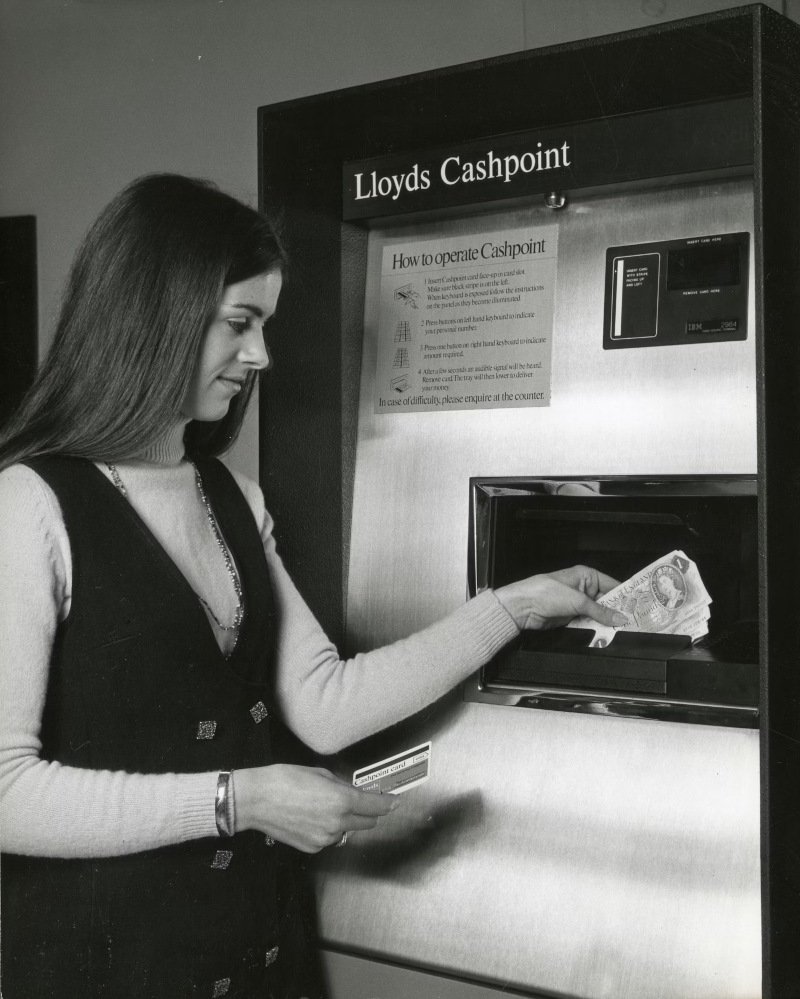
the IBM 2984 Cash Issuing Terminal. Like many other early ATMs, the 2984 had its
debut in the UK as Lloyds Bank’s “Cashpoint.”
The 2984 similarly used Bisync communications with a System/360. While not the
very first implementation of the concept, the 2984 was an important step in ATM
security and the progenitor of an important line of cryptographic algorithms.
To withdraw cash, a user inserted a magnetic card that contained an account
number, and then keyed in a PIN. The 2984 sent this information, over the Bisync
connection, to the computer, which then responded with a command such as
“dispense cash.” In some cases the computer was immediately on the other side of
the wall, but it was already apparent that banks would install ATMs in remote
locations controlled via leased telephone lines—and those telephone lines were
not well-secured. A motivated attacker (and with cash involved, it’s easy to be
motivated!) could probably “tap” the ATM’s network connection and issue it
spurious “dispense cash” commands. To prevent this problem, and assuage the
concerns of bankers who were nervous about dispensing cash so far from the
branch’s many controls, IBM decided to encrypt the network connection.
The concept of an encrypted network connection was not at all new; encrypted
communications were widely used in the military during the second World War and
the concept was well-known in the computer industry. As IBM designed the 2984,
in the late ’60s, encrypted computer links were nonetheless very rare. There
were not yet generally accepted standards, and cryptography as an academic
discipline was immature.
IBM, to secure the 2984’s network connection, turned to an algorithm recently
developed by an IBM researcher named Horst Feistel. Feistel, for silly reasons,
had named his family of experimental block ciphers LUCIFER. For the 2984, a
modified version of one of the LUCIFER implementations called DSD-11. Through
a Bureau of Standards design competition and the twists and turns of industry
politics, DSD-1 later reemerged (with just slight changes) as the Data Encryption
Standard, or DES. We owe the humble ATM honors for its key role in computer
cryptography.
The 2984 was a huge step forward. Unlike the token-based machines of the 1960s,
it was pretty much the same as the ATMs we use today. To use a 2984, you
inserted your ATM card and entered a PIN. You could then choose to check your
balance, and then enter how much cash you wanted. The machine checked your
balance in real time and, if it was high enough, debited your account
immediately before coughing up money.
The 2984 was not as successful as you might expect. The Lloyd’s Bank rollout was
big, but very few were installed by other banks. Collective memory of the 2984
is vague enough that I cannot give a definitive reason for its limited success,
but I think it likely comes down to a common tale about IBM: price and
flexibility. The 2984 was essentially a semi-custom peripheral, designed for
Lloyd’s Bank and the specific System/360 environment already in place there.
Adoption for other banks was quite costly. Besides, despite the ATM’s lead in
the UK, the US industry had quickly caught up. By the time the 2984 would be
considered by other banks, there were several different ATMs available in the US from
other manufacturers (some of them the same names you see on ATMs today). The
2984 is probably the first “modern” ATM, but since IBM spent 4-5 years
developing it, it was not as far ahead of the curve on launch day as you might
expect. Just a year or two later, a now-forgotten company called Docutel was
dominating the US market, leaving IBM little room to fit in.
Because most other ATMs were offered by companies that didn’t control the entire
software stack, they were more flexible, designed to work with simpler host
support. There is something of an inverse vertical integration penalty here:
when introducing a new product, close integration with an existing product
family makes it difficult to sell! Still, it’s interesting that the 2984 used
pretty much the same basic architecture as the many ATMs that followed. It’s
worth reflecting on the 2984’s relationship with its host, a close dependency
that generally holds true for modern ATMs as well.
The 2984 connected to its host via a Bisync channel (possibly over various
carrier or modem systems to accommodate remote ATMs), a communications facility
originally provided for remote job entry, the conceptual ancestor of IBM’s later
block-oriented terminals. That means that the host computer expected the
peripheral to provide some input for a job and then wait to be sent the results.
Remote job entry devices, and block terminals later, can be confusing when
compared to more familiar, Unix-family terminals. In some ways, they were quite
sophisticated, with the host computer able to send configuration information
like validation rules for input. In other ways, they were very primitive,
capable of no real logic other than receiving computer output (which was dumped
to cards, TTY, or screen) and then sending computer input (from much the same
devices). So, the ATM behaved the same way.
In simple terms, the ATM’s small display (called a VDU or Video Display Unit in
typical IBM terminology) showed whatever the computer sent as the body of a
“display” command. It dispensed whatever cash the computer indicated with a
“dispense cash” command. Any user input, such as reading a card or entry of a
PIN number, was sent directly to the computer. The host was responsible for all
of the actual logic, and the ATM was a dumb terminal, just doing exactly what
the computer said. You can think of the Cash Issuing Terminal as, well, just
that: a mainframe terminal with a weird physical interface.
Most modern ATMs follow this same model, although the actual protocol has
become more sophisticated and involves a great deal more XML. You can be
reassured that when the ATM takes a frustratingly long time to advance to the
next screen, it is at least waiting to receive the contents of that screen from
a host computer that is some distance away or, even worse, in The Cloud.
Incidentally, you might wonder about the software that ran on the host computer.
I believe that the IBM 2984 was designed for use with CICS, the Customer
Information Control System. CICS will one day get its own article, but it
launched in 1966, built specifically for the Michigan Bell to manage customer
and billing data. Over the following years, CICS was extensively expanded for
use in the utility and later finance industries. I don’t think it’s inaccurate
to call CICS the first “enterprise customer relationship management system,”
the first voyage in an adventure that took us through Siebel before grounding
on the rocks of Salesforce. Today we wouldn’t think of a CRM as the system of
record for depository finance institutions like banks, but CICS itself was
very finance-oriented from the start (telephone companies sometimes felt like
accounting firms that ran phones on the side) and took naturally to gathering
transactions and posting them against customer accounts. Since CICS was designed
as an online system to serve telephone and in-person customer service reps (in
fact making CICS a very notable early real-time computing system), it was also a
good fit for handling ATM requests throughout the day.
I put a lot of time into writing this, and I hope that you enjoy reading
it. If you can spare a few dollars, consider supporting me on
ko-fi. You’ll receive an occasional extra,
subscribers-only post, and defray the costs of providing artisanal, hand-built
world wide web directly from Albuquerque, New Mexico.
Despite the 2984’s lackluster success, IBM moved on. I don’t think IBM was
particularly surprised by the outcome, the 2984 was always a “request quotation”
(e.g. custom) product. IBM probably regarded it as a prototype or pilot with
their friendly customer Lloyds Bank. More than actual deployment, the 2984’s
achievement was paving the way for the IBM 3614 Consumer Transaction Facility.
In 1970, IBM had replaced the System/360 line with the System/370. The 370 is
directly based on the 360 and uses the same instruction set, but it came with
numerous improvements. Among them was a new approach to peripheral connectivity
that developed into the IBM Systems Network Architecture, or SNA, basically
IBM’s entry into the computer networking wars of the 1970s and 1980s. While SNA
would ultimately cede to IP (with, naturally, an interregnum of SNA-over-IP),
it gave IBM the foundations for networked systems that are almost modern in
their look and feel.
I say almost because SNA was still very much a mainframe-oriented design. An
example SNA network might look like this: An S/370 computer running CICS (or
one of several other IBM software packages with SNA support) is connected via
channel (the high-speed peripheral bus on mainframe computers, analogous to PCI)
to an IBM 3705 Communications Controller running the Network Control Program
(analogous to a network interface controller). The 3705 had one or more
“scanners” installed, which supported simple low-speed serial lines or fast,
high-level protocols like SDLC (synchronous data link control) used by SNA. The
3705 fills a role sometimes called a “front-end processor,” doing the grunt work
of polling (scanning) communications lines and implementing the SDLC protocol
so that the “actual computer” was relieved of these menial tasks.
At the other end of one of the SDLC links might be an IBM 3770 Data
Communications System, which was superficially a large terminal that, depending
on options ordered, could include a teletypewriter, card reader and punch,
diskette drives, and a high speed printer. Yes, the 3770 is basically a grown-up
remote job entry terminal, and the SNA/SDLC stack was a direct evolution from
the Bisync stack used by the 2984. The 3770 had a bit more to offer, though:
in order to handle its multiple devices, like the printer and card punch, it
acted as a sort of network switch—the host computer identified the 3770’s
devices as separate endpoints, and the 3770 interleaved their respective
traffic. It could also perform that interleaving function for additional
peripherals connected to it by serial lines, which depending on customer
requirements often included additional card punches and readers for data entry,
or line printers for things like warehouse picking slips.
In 1973, IBM gave banks the SNA treatment with the 3600 Finance Communication
System 2. A beautifully orange brochure tells us:
The IBM 3600 Finance Communication System is a family of products designed to
provide the Finance Industry with remote on-line teller station operation.
System/370 computers represented an enormous investment, generally around a
million dollars and more often above that point than below. They were also large
and required both infrastructure and staff to support them. Banks were already
not inclined to install an S/370 in each branch, so it became a common pattern
to place a “full-size” computer like an S/370 in a central processing center to
support remote peripherals (over leased telephone line) in branches. The 3600
was a turn-key product line for exactly this use.
An S/370 computer with a 3704 or 3705 running the NCP would connect (usually
over a leased line) to a 3601 System, which IBM describes as a
“programmable communications controller” although they do not seem to have
elevated that phrase to a product name. The 3601 is basically a minicomputer of
its own, with up to 20KB of user-available memory and diskette drive. A 3601
includes, as standard, a 9600 bps SDLC modem for connection to the host, and a
9600 bps “loop” interface for a local multidrop serial bus. For larger
installations, you could expand a 3601 with additional local loop interfaces or
4800 or 9600 bps modems to extend the local loop interface to a remote location
via telephone line.
In total, a 3601 could interface up to five peripheral loops with the host
computer over a single interleaved SDLC link. But what would you put on those
peripheral loops? Well, the 3604 Keyboard Display Unit was the mainstay, with
a vacuum fluorescent display and choice of “numeric” (accounting, similar to a
desk calculator) or “data entry” (alphabetic) keyboard. A bank would put one of
these 3604s in front of each teller, where they could inquire into customer
accounts and enter transactions. In the meantime, 3610 printers provided
general-purpose document printing capability, including back-office journals
(logging all transactions) or filling in pre-printed forms such as receipts
and bank checks. Since the 3610 was often used as a journal printer, it was
available with a take-up roller that stored the printed output under a locked
cover. In fact, basically every part of the 3600 system was available with a
key switch or locking cover, a charming reminder of the state of computer
security at the time.
The 3612 is a similar printer, but with the addition of a
dedicated passbook feature. Remember passbook savings accounts, where the bank
writes every transaction in a little booklet that the customer keeps? They were
still around, although declining in use, in the 1970s. The 3612 had a slot on
the front where an appropriately formatted passbook could be inserted, and like
a check validator or slip printer, it printed the latest transaction onto the
next empty line. Finally, the 3618 was a “medium-speed” printer, meaning 155 lines per minute.
A branch bank would probably have one, in the back office, used for printing
daily closing reports and other longer “administrative” output.
A branch bank could carry out all of its routine business through the 3600
system, including cash withdrawals. In fact, since a customer withdrawing cash
would end up talking to a teller who simply keyed the transaction into a 3604,
it seems like a little more automation could make an ATM part of the system.
Enter the 3614 Consumer Transaction Facility, the first IBM ATM available as a
regular catalog item. The 3614 is actually fairly obscure, and doesn’t seem to
have sold in large numbers. Some sources suggest that it was basically the same
as the 2984, but with a general facelift and adaptations to connect to a 3601 Finance Communication
Controller instead of directly to a front-end processor. Some features which
were optional on the 2984, like a deposit slot, were apparently standard on 3614.
I’m not even quite sure when the 3614 was introduced, but based on manual
copyright dates they must have been around by 1977.
One of the reasons the 3614 is obscure is that its replacement, the IBM 3624
Consumer Transaction Facility, hit the market in 1978—probably very shortly
after the 3614. The 3624 was functionally very similar to the 3614, but with
maintainability improvements like convenient portable cartridges for storing
cash. It also brought a completely redesigned front panel that is more similar
to modern ATMs. I should talk about the front panels—the IBM ATMs won a few
design awards over their years, and they were really very handsome machines.
The backlit logo panel and function-specific keys of the 3624 look more pleasant
to use than most modern ATMs, although they would of course render translation
difficult.
The 3614/3624 series established a number of conventions that are still in use
today. For example, they added an envelope deposit system in which the machine
accepted an envelope (with cash or checks) and printed a transaction identifier
on the outside of the envelope for lookup at the processing center. This
relieved the user of writing up a deposit slip when using the ATM. It was also
capable of not only reading but, optionally, writing to the magnetic strips on
ATM cards. To the modern reader that sounds strange, but we have to discuss one
of the most enduring properties of the 3614/3624: their handling of PIN numbers.
I believe the 2984 did something fairly similar, but the details are now obscure
(and seem to get mixed up with its use of LUCIFER/DSD-1/DES for communications).
The 3614/3624, though, so firmly established a particular approach to PIN
numbers that it is now known as the 3624 algorithm. Here’s how it works: the
ATM reads the card number (called Primary Account Number or PAN) off of the
ATM card, reads a key from memory, and then applies a convoluted cryptographic
algorithm to calculate an “intermediate PIN” from it. The “intermediate pin”
is then summed with a “PIN offset” stored on the card itself, modulo 10, to
produce the PIN that the user is actually expected to enter. This means that
your “true” PIN is a static value calculated from your card number and a key,
but as a matter of convenience, you can “set” a PIN of your choice by using an
ATM that is equipped to rewrite the PIN offset on your card. This same system,
with some tweaks and a lot of terminological drift, is still in use today. You
will sometimes hear IBM’s intermediate PIN called the “natural PIN,” the one
you get with an offset of 0, which is a use of language that I find charming.
Another interesting feature of the 3624 was a receipt printer—I’m not sure if it
was the first ATM to offer a receipt, but it was definitely an early one. The
exact mechanics of the 3624 receipt printer are amusing and the result of some
happenstance at IBM. Besides its mainframes and their peripherals, IBM in the
1970s was was increasingly invested in “midrange computers” or “midcomputers”
that would fill in a space between the mainframe and minicomputer—and, most
importantly, make IBM more competitive with the smaller businesses that could
not afford IBM’s mainframe systems and were starting to turn to competitors like
DEC as a result. These would eventually blossom into the extremely successful
AS/400 and System i, but not easily, and the first few models all suffered from
decidedly soft sales.
For these smaller computers, IBM reasoned that they needed to offer peripherals
like card punches and readers that were also smaller. Apparently following that
line of thought to a misguided extent, IBM also designed a smaller punch card:
the 96-column three-row card, which was nearly square. The only computer ever
to support these cards was the very first of the midrange line, the 1969
System/3. One wonders if the System/3’s limited success lead to excess stock of
96-column card equipment, or perhaps they just wanted to reuse tooling. In any
case, the oddball System/3 card had a second life as the “Transaction Statement
Printer” on the 3614 and 3624. The ATM could print four lines of text, 34
characters each, onto the middle of the card. The machines didn’t actually punch
them, and the printed text ended up over the original punch fields. You could,
if you wanted, actually order a 3624 with two printers: one that presented the
slip to the customer, and another that retained it internally for bank auditing.
A curious detail that would so soon be replaced by thermal receipt printers.
Unlike IBM’s ATMs before it, and, as we will see, unlike those after it as well,
the 3624 was a hit. While IBM never enjoyed the dominance in ATMs that they did
in computers, and companies like NCR and Diebold had substantial market
share, the 3624 was widely installed in the late 1970s and would probably be
recognized by anyone who was withdrawing cash in that era. The machine had
technical leadership as well: NCR built their successful ATM line in part by
duplicating aspects of the 3624 design, allowing interoperability with IBM
backend systems. Ultimately, as so often happens, it may have been IBM’s success
that became its undoing.
In 1983, IBM completely refreshed their branch banking solution with the 4700
Finance Communication System. While architecturally similar, the 4700 was a big
upgrade. For one, the CRT had landed: the 4700 peripherals replaced several-line
VFDs with full-size CRTs typical of other computer terminals, and conventional
computer keyboards to boot. Most radically, though, the 4700 line introduced
distributed communications to IBM’s banking offerings. The 4701 Communications
Controller was optionally available with a hard disk, and could be programmed
in COBOL. Disk-equipped 4701s could operate offline, without a connection to the
host, or in a hybrid mode in which they performed some transactions locally and
only contacted the host system when necessary. Local records kept by the 4701
could be automatically sent to the host computer on a scheduled basis for
reconciliation.
Along with the 4700 series came a new ATM: the IBM 473x Personal Banking
Machines. And with that, IBM’s glory days in ATMs came crashing to the ground.
The 473x series was such a flop that it is hard to even figure out the model
numbers, the 4732 is most often referenced but others clearly existed, including
the 4730, 4731, 4736, 4737, and 4738. These various models were introduced from
1983 to 1988, making up almost a decade of IBM’s efforts and very few sales.
The 4732 had a generally upgraded interface, including a CRT, but a similar
feature set—unsurprising, given that the 3724 had already introduced most of the
features ATMs have today. It also didn’t sell. I haven’t been able to find any
numbers, but the trade press referred to the 4732 with terms like
“debacle,” so they couldn’t have been great.
There were a few faults in the 4732’s stars. First, IBM had made the decision to
handle the 4700 Finance Communication System as a complete rework of the 3600.
The 4700 controllers could support some 3600 peripherals, but 4700 peripherals
could not be used with 3600 controllers. Since 3600 systems were widely
installed in banks, the compatibility choice created a situation where many of
the 4732’s prospective buyers would end up having to replace a significant
amount of their other equipment, and then likely make software changes, in order
to support the new machine. That might not have been so bad on its own had IBM’s
competitors not provided another way out.
NCR made their fame in ATMs in part by equipping their contemporary models with
3624 software emulation, making them a drop-in modernization option for existing
3600 systems. In general, other ATM manufacturers had pursued a path of
interoperability, with multiprotocol ATMs that supported multiple hosts, and
standalone ATM host products that could interoperate with multiple backend
accounting systems. For customers, buying an NCR or Diebold product that would
work with whatever they already used was a more appealing option than buying the
entire IBM suite in one go. It also matched the development cycle of ATMs
better: as a consumer-facing device, ATMs became part of the brand image of the
bank, and were likely to see replacement more often than back-office devices
like teller terminals. NCR offered something like a regular refresh, while IBM
was still in a mode of generational releases that would completely replace the
bank’s computer systems.
The 4732 and its 473x compatriots became the last real IBM ATMs. After a hiatus
of roughly a decade, IBM reentered the ATM market by forming a joint venture
with Diebold called InterBold. The basic terms were that Diebold would sell its
ATMs in the US, and IBM would sell them overseas, where IBM had generally been
the more successful of the two brands. The IBM 478x series ATMs, which you might
encounter in the UK for example, are the same as the Diebold 1000 series in the
US. InterBold was quite successful, becoming the dominant ATM manufacturer in
the US, and in 1998 Diebold bought out IBM’s share.
IBM had won the ATM market, and then lost it. Along the way, they left us with
so much texture: DES’s origins in the ATM, the 3624 PIN format, the dumb
terminal or thin client model… even InterBold, IBM’s protracted exit, gave us
quite a legacy: now you know the reason that so many later ATMs ran OS/2. IBM,
a once great company, provided Diebold with their once great operating system.
Unlike IBM, Diebold made it successful.
