

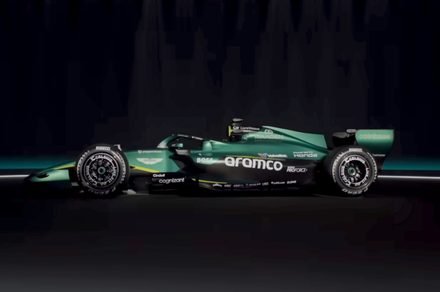
Vibrations from F1 car raise fears of driver nerve damage
The issue is also causing parts of Aston Martin’s car to fall off.
Aston Martin
If you’re driving in an F1 race and hitting speeds of 220 mph (354 kph), you really don’t want parts of the car falling off as you hurtle along, or, more importantly, to suffer nerve damage because of a problem with your vehicle.
But that’s exactly what’s happening with Aston Martin’s car, leaving drivers Fernando Alonso and Lance Stroll unlikely to finish the first race of the new F1 season in Australia on Sunday.
In testing, the car, powered by a Honda engine, has been vibrating so badly that parts of it have been dropping off, with the vibrations reaching the drivers, too.
The issue surfaced as teams adapt to new engine rules designed to boost efficiency and sustainability in a change that forced widespread redesigns in recent months.
While Honda supplies the power units that may be contributing to the vibration problem, Aston Martin’s chassis design and setup affect how the vibrations reach the drivers, making it a problem rooted in both engine performance and car design.
Engineers have been working to reduce the vibrations, but it seems unlikely that Alonso and Stroll will be able to complete Sunday’s race.
“That vibration into the chassis is causing a few reliability problems,” Aston Martin team principal Adrian Newey said in comments to the media on Thursday, adding that the problem includes “mirrors falling off, tail lights falling off.”
Newey said “the much more significant problem is that the vibration is transmitted ultimately into the driver’s fingers. So Fernando [Alonso] is of the feeling that he can’t do more than 25 laps consecutively before he will risk permanent nerve damage to his hands. Lance [Stroll] is of the opinion that he can’t do more than 15 laps before that threshold.”
Commenting on the unusual situation on Thursday, Alonso said, “For us it’s just vibrating everything. But it’s not only for us, I think the car is shrugging a little bit. The vibrations coming from the engine are hurting a little bit the components in the car and the drivers; we feel them, we feel our body with this frequency of the vibrations that you feel after 20 or 25 minutes, a little bit numb.”
It’s certainly a bizarre turn of events. While there have been instances in the past of F1 drivers riding in an uncomfortable condition, this appears to be the first time that a team is facing cutting a race short due to health risks from vibrations.
Not so many moons ago, Trevor moved from one tea-loving island nation that drives on the left (Britain) to another (Japan)…
Tesla’s top rival launches EV battery tech promising full charge in about 10 minutes
BYD’s new battery charges faster than your morning coffee break
Chinese electric vehicle giant BYD has unveiled a major breakthrough in EV battery technology that could dramatically reduce charging times. The company introduced its second-generation Blade Battery alongside new “Flash Charging” technology, claiming compatible electric vehicles could charge from 10% to 70% in about five minutes and up to 97% in roughly nine minutes.
The announcement positions BYD as one of the key challengers to Tesla in the race to make electric vehicles as convenient as gasoline-powered cars.
BYD reveals Tesla Model Y killer with 644-mile range and 10–70% charge in just 5 minutes
BYD just gave its luxury EV a huge range boost, five-minute charging, and a lower price tag. Tesla might want to take notes.
BYD’s luxury brand Denza has launched the upgraded Z9GT, offering something buyers rarely see: a lower price and significantly improved features. If what the company has announced holds true, the Tesla Model Y finally has a challenger that offers a better deal.
A serious price cut with even better specs
Tesla’s biggest rival just claimed the world’s longest-range EV
A new BYD luxury EV promises record-breaking range numbers
Electric vehicles have been steadily pushing past the 300-mile milestone for years, but a new contender has just taken range anxiety to a whole new level. BYD’s luxury brand Denza has unveiled an updated version of its Z9 GT EV, and it now claims the title of the world’s longest-range battery electric vehicle.
According to BYD (via CarNewsChina), the refreshed Denza Z9 GT can travel up to 1,036 km on a single charge under China’s CLTC testing cycle, which translates to roughly 644 miles. That figure puts it ahead of every mainstream production EV currently on sale, including long-range offerings from Tesla and other premium rivals.
