

Best Mid Layer for Hiking, Backpacking, and Travel (2026)
In a layering system, the bulk of the warmth comes from your mid layer—that is, the garment that sit on top of your base layer and traps your body heat to keep you warm. Fleece, merino wool, down, and synthetic fills can all be great mid layers.
In our guide to layering, we suggest a four-layer clothing cake that consists of a base layer, mid layer, puffer jacket, and an outer shell like a rain jacket. This system is versatile and will keep you warm and dry, while remaining as lightweight as possible. Here’s our guide to the best mid layers for every outdoor activity.
Don’t forget to check out the rest of our outdoors coverage, and also read our dedicated guides to the Best Base Layers, Best Puffer Jackets, and Rain Jackets to complete your layering system.
-
The Best Basic Fleece Jacket
The traditional pile fleece is much-maligned these days. In terms of warmth to weight ratio, it does not top the Reddit ultralighter’s spreadsheet, but the price is right and the weight difference compared to a newer grid fleece or alpha fleece is not massive. If you’re just getting started hiking and backpacking, this is my top pick. We used to call this a 100-weight fleece. They last forever, too. I’ve been hiking with some version of a half-zip pullover fleece for 30 years now (I still have and use a Marmot version from about 1995). It just works.
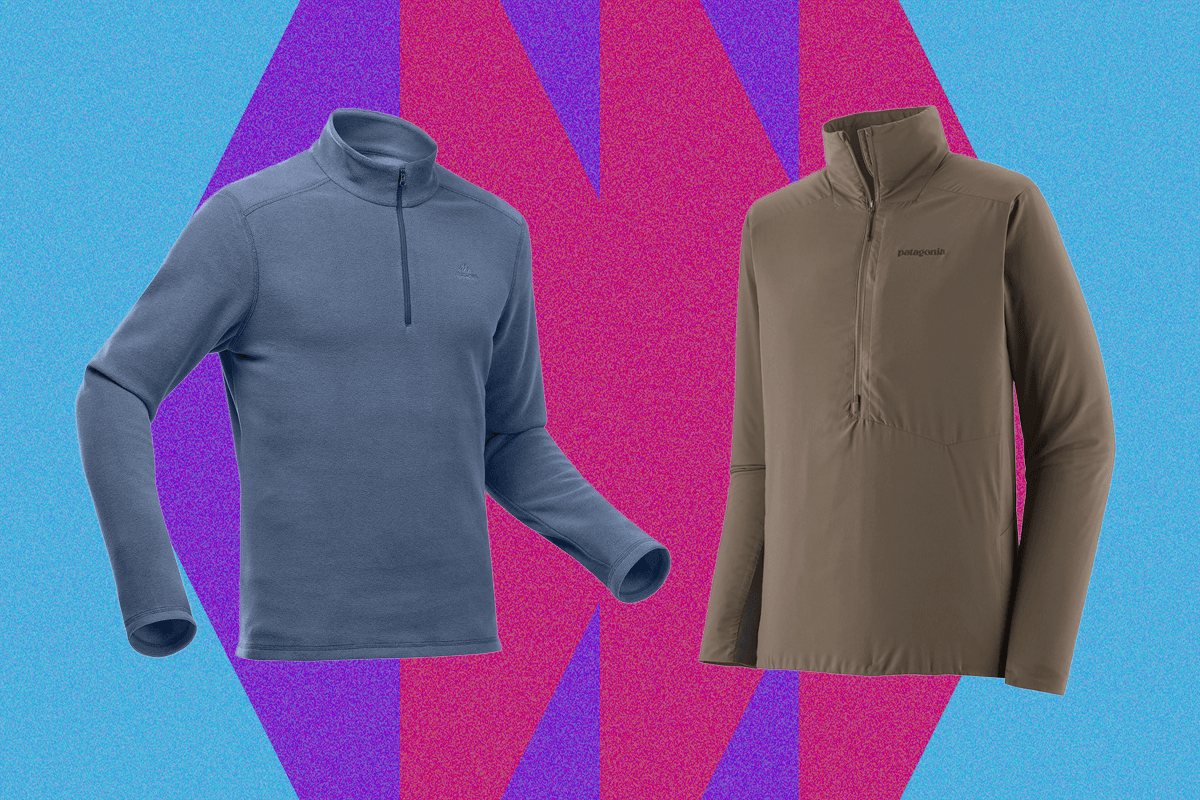
Like all fleece jackets, Decathlon’s HM 100 Hiking Fleece keep you warm by trapping body heat. Unlike down, it stays warm even when damp or downright wet (though wearing wet fleece is an unpleasant experience even if you are warm). It is breathable enough to help move moisture away from your base layer. It will also dry while you’re wearing it. This is a minimalist’s dream jacket, there are no thumb loops, no pockets, and no hood. It doesn’t even have elastic on the cuffs. I find the lack of features to be a feature, but if you really must have more bells and whistles, Decathlon also makes the MH 120 Hiking Jacket which has a full zip and pockets, but weighs in at 12 oz for a men’s medium (vs 7.9 oz for the MH100).
Grab a good base layer, a good puffer jacket, and a good rain jacket to go with this, and you’ll be good to go in most three-season hiking environments.
-
The Best Grid Fleece
The is the most minimal option in Patagonia’s extensive R1 Air line of grid fleece jackets. Like the Decathlon above, it’s a 1/2 zip pullover with no pockets and no hood. I find the minimal cut fine for hiking and backpacking where I’m usually wearing it while moving and don’t need pockets. If you want something more for lounging there’s also the R1 full-zip hoody, which adds pockets and a hood, but weighs 5 oz more in men’s large.
The R1 Air is a grid fleece. Have a look at our guide to understanding the various types of fleece on the market for a complete overview, but the short story is that with grid fleece, a grid pattern with elastane stitching is woven in to create the waffle-like texture. This has two advantages over the traditional fleece, the main being that it’s much more breathable than a standard fleece. The other is that it’s less bulky and packs down smaller. The downside is that grid fleece doesn’t block the wind quite as well and it doesn’t dry as quickly. That said, for hiking in cooler weather, a grid fleece under a wind shell is a hard combo to beat. It keeps you warm but also allows your sweat to wick away, and keeps you much drier and better thermoregulated than a traditional fleece under the same conditions.
-
Most Durable Ultralight
Patagonia
Nano-Air Ultralight Pullover
Finally, the lightest option that I’ve tested is Patagonia’s Nano-Air, which itself comes in three different weight classes per square meter: 20g, 40g, and 60g of insulation. 20g is the lightest possible weight, and Patagonia measures the men’s medium to weigh 7.7 ounces. I’m testing the women’s extra-small and it’s barely even noticeable. This is what you wear when you want just a little more insulation than a base layer under a rain shell.
I have been trail running, hiking, biking, climbing, and camping in the 20g Nano Air pullover for a year now and this is my favorite insulating mid layer. Patagonia has made a proprietary fabric for the shell called FullRange that has been treated for both water and abrasion resistance, so it’s much more durable than the feathery, high-loft alpha direct fleece that I was using before. It’s made from 100 percent recycled polyester synthetic down and cut extremely slim to fit underneath jackets, backpacks, and climbing harnesses. I wore this in multiple 30- to 40-degree trail races underneath my race vest and only noticed it because I did not die of cold at the start or finish lines. This is an extremely minimalist pullover—it only has a small chest pocket to use as a stuff sack—but you can also buy it in heavier weights or configurations, like a hoody.—Adrienne So
-
Best Ultralight Octo Fleece
Arc’teryx’s Delta Jacket is an ultralight fleece made of Octa Fleece, one of the newer, high-tech fleeces to hit the market in the past couple of years. The name comes from the octopus-like weaving which creates air gaps, which help trap warmth while also allowing moisture to escape. It’s very popular with cottage industry ultralight brands, but Arc’teryx adopted it for the 2025 revamp of the company’s popular Delta fleece jacket.
I hesitated to put this jacket in this guide because, while I like it as an ultralight mid layer for summer trips, there is an older, heavier version of the Delta jacket. Judging by the angry reviews on Arc’teryx’s website, it was very popular. This jacket is something else entirely, but disgruntled fans of the older version aside, this is a great mid layer for summer trips, especially when paired with a sun shirt hoodie. At 8.5 oz for this, and 6 oz for a sun hoodie like the one from Kuiu below, you have a combo that allows multiple layering options and still weighs less than many more popular grid fleece options. My only gripe is that fashion was, um, not taken into consideration in the design of this jacket. One user review on the Arc’teryx site likens it to Mr. Roger’s sweater, which is about right. But hey, it’s light, it’s functional—who cares about fashion in the backcountry?
-
The Best Merino Grid Fleece
-
Photograph: Scott Gilbertson
Ridge Merino
Cloudripper Merino Grid Fleece Jacket
Grid fleece is awesome. It’s warm for the weight, and very breathable, making it great for highly aerobic activities. Despite all that, I prefer the comfort of merino, and often bring my merino mid layers backpacking even though there’s a definite weight penalty (see below). Ridge Merino’s Cloudripper jacket combines merino and grid fleece, offering the advantages of both, keeping the merino against your skin, but using grid fleece to improve ventilation and make the jacket much lighter. The men’s large I’ve been testing weighs just 16.1 ounces on my scale. That’s 4 ounces more than our top pick grid fleece, the Patagonia R1 Air hoodie, but I have found the Cloudripper to be considerably warmer than the Air.
The Cloudripper jackets (there’s also a 1/2 zip version and a crew neck version) are made of two fabrics. The first is wool grid fleece (265 gsm) which is 69 percent merino, 15 percent recycled polyester, 13 percent nylon, and 3 percent spandex. The secondary fabric is a grid fleece(180 gsm) that’s 51 percent recycled polyester, 41 percent Merino wool, and 8 percent lycra. The more traditional grid fleece with the higher polyester count is used mainly on the hood and lower back, while everything that would touch your skin (if you don’t have on a base layer) is merino.
The Cloudripper is my go-to mid layer on the cool fall mornings, keeping me warm when I’m first starting out, and venting off the excess heat I’m generating once I get going. It also doesn’t get stinky like my purely polyester grid fleece.
-
-
A Versatile Merino Hoodie
I’ve worn this lightweight merino pullover hoodie from Kuiu as a second base layer when it’s really cold, a mid layer for summer trips, and as a sun shirt on high altitude hikes, which is pretty good for a 7-oz hoodie (men’s large). It’s a good jack-of-all-trades shirt, though it is definitely the lightest mid layer here. I would use it as a base layer in anything but summer (Kuiu classifies it as a base layer, but I often wear it with another layer underneath.)
The Kuiu Ultra 120 is made of Nuyarn, which is a blended weave of 70 percent merino and 30 percent nylon. Nuyarn strikes a good balance between the benefits of wool and the durability of synthetics. Pairing this with the Arc’teryx above makes a more flexible system than a single mid layer like the R1 Air, and weighs just 2 ounces more than that single jacket.
-
The One You’ll Never Own
There are such a huge array of mid layers that each manufacturer has developed its own cult-like following. Probably the most famous of these small-batch home-grown brands is the Colorado-based Melanzana (which famously used to never sell clothes online, oh well), but my local cult brand is Portland, Oregon-based Senchi Designs. During the Covid-19 pandemic, musician, hiker, and nursing student Ryan Windus got his hands on Polartec Alpha Direct, which was invented in 2017. It’s a startlingly warm, fuzzy, lightweight fabric that makes you look like a Muppet. Senchi’s hoodies were an instant hit on r/Ultralight. My Merlin hoody weighs less than 6 ounces.
Senchi’s are cool, oversized, and unisex, and double as fuzzy streetwear. Windus only makes a few items at any given time, and when he does post stock it sells out instantly. I suggest signing up for his email list to be notified. (He also occasionally does garage sales, if you follow him on Instagram or happen to be in Portland.) With all that said, after a year of wearing it constantly, I very rarely wear mine anymore. It’s very fragile and has to be washed in its own special wash bag to prevent the fibers from falling off and getting microplastics all over the Earth. But Senchi is very IYKYK, which matters to some people, and it’s so soft and fuzzy that it doubles as a pillow while traveling, which is nice.—Adrienne So
