

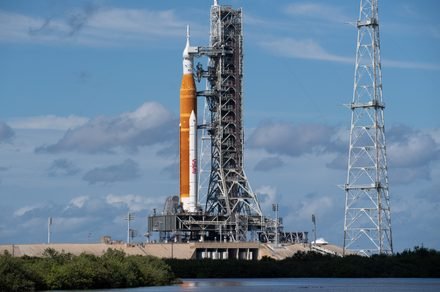
NASA reveals new target date for crewed moon launch — and it’s no joke
The space agency says it’s ‘go’ for launch.
Artemis II to the Moon: Launch to Splashdown (NASA Mission Animation)
NASA has announced a new target date for the highly anticipated Artemis II crewed mission to the moon: April 1.
It may be on April Fools’ Day, but the space agency is deadly serious about finally getting its massive SLS (Space Launch System) rocket, Orion spacecraft, and four astronauts airborne in what will be the first crewed lunar-bound flight since the final Apollo mission in 1972.
The upcoming mission will take the crew around the moon rather than landing on its surface, with the first lunar landing of the Artemis era currently targeted for 2028.
NASA shared the new target launch date at a press conference on Thursday. It said that following the Artemis II Flight Readiness Review, the launch team had “polled ‘go’ to proceed toward launch.”
All being well, the team will roll the SLS rocket and Orion spacecraft to pad 39B at the Kennedy Space Center in Florida on Thursday, March 19, with a launch attempt set for the beginning of the following month at 6:20 p.m. ET on April 1.
NASA had been hoping to launch Artemis II in February, but it was forced to call a halt to proceedings after technical issues with the SLS rocket surfaced during a wet dress rehearsal, a key test that’s essentially a full launch simulation, bar the actual lift-off.
Notably, NASA isn’t planning to conduct another wet dress rehearsal prior to launch, with NASA’s Shawn Quinn telling NASASpaceflight that it has already run the necessary checks and tests following work on the rocket in recent days.
All being well, the SLS rocket and Orion spacecraft carrying astronauts Reid Wiseman, Victor Glover, Christina Koch, and Jeremy Hansen will blast off the launchpad next month.
NASA said that if the two-hour launch window on April 1 doesn’t work out for technical reasons or due to inclement weather, there will be additional launch opportunities on each of the following five days, and a further one on April 30.
After launch, the Orion spacecraft will enter Earth orbit for system checks before performing a burn to put it on a trajectory that loops around the moon. It’ll then use Earth-moon gravity to bring Orion back for a Pacific Ocean splashdown about 10 days after launch.
Not so many moons ago, Trevor moved from one tea-loving island nation that drives on the left (Britain) to another (Japan)…
NASA astronauts to venture into the void on a historic day
The spacewalk is set for March 18 and will be NASA’s first in nearly a year.
NASA is preparing to conduct its first spacewalk at the International Space Station (ISS) in nearly a year, ending an unusually long break for the activity.
Truth be told, NASA had a spacewalk planned for early January but called it off after one of the two participating astronauts experienced a serious health issue that ultimately forced the early return to Earth of a SpaceX crew.
NASA shares stunning Mars images on orbiter’s 20th anniversary
The images were captured from more than 150 miles above the red planet.
NASA launched the Mars Reconnaissance Orbiter in August 2005 and the following year, on March 10, it entered the orbit of the red planet where it continues to operate today.
Data returned to Earth by the MRO has revealed Mars in unprecedented detail and over the years has helped scientists to find out more about the fascinating planet.
NASA’s ‘Moonbound’ is worth a watch as you wait for Artemis II update
NASA recently dropped a trailer reminding folks about the documentary.
NASA had been hoping to launch four astronauts on a voyage around the moon in the Artemis II mission in February, but technical issues with the Space Launch System (SLS) rocket forced the space agency to delay the much-hyped endeavor.
All being well, the SLS rocket and Orion spacecraft carrying NASA’s Reid Wiseman, Victor Glover, and Christina Koch, together with the Canadian Space Agency’s Jeremy Hansen, will roar away from the Kennedy Space Center launchpad in Florida next month.
