

The Best And Worst Motorcycles Made By Major Brands
Me.Karim1983/Shutterstock
Motorcycle manufacturing is a tricky business. Sometimes the next big thing turns out to be the next big flop. But sometimes, a model becomes so successful it transcends a brand’s reputation. These are the kinds of bikes that keep companies afloat. Even as their designs change over years or decades of successive releases, the names remain.
What makes a motorcycle “good” or “bad” is entirely subjective. After all, though there are plenty of examples of bikes that were broken from the jump, a motorcycle that performs well but is marketed to the wrong audience can be a total failure, too.
Today we’re taking a stroll down memory lane to take a look at some of the hits and the misses from your favorite manufacturers. We’re taking a holistic approach, examining the technical prowess, impact, and performance of some of the most famous brands in the biz to suss out which bikes were fantastic and which were failures.
Honda’s worst: DN-01
A curious mishmash of sport, scoot, and touring, the Honda DN-01 debuted in 2008, perhaps with the hope of creating a new motorcycle genre. Just look at the nomenclature: the D and N stand for Dream New, as if to say, “let’s really think outside the box with this one.”
We have to applaud Honda. Trying something new in manufacturing means millions of dollars spent on development and retooling. But while the DN-01 may have been well-intentioned, and even looked good on paper, it just didn’t work out, in part due to an anemic 680cc engine that Motorcycle News dyno tested to the tune of 51 horsepower. That just wasn’t going to cut it against a weight of nearly 600 pounds, especially paired with a (shudder) automatic transmission Honda called the HFT — Human Friendly Transmission.
Pounding nails into the DN-01’s coffin lid was the price. At its debut, this weird-looking tweener bike commanded nearly $15,000, as much or more than the purpose-built competitors it couldn’t keep up with. The DN-01 proved to be one of the worst-selling Honda motorcycles ever made. It enjoyed a two-year production run before being axed in 2010. We appreciate risk-taking as much as anyone, but the DN-01 just didn’t deliver.
Honda’s best: Gold Wing
Maksim Ladouski/Shutterstock
The Honda Super Cub may be the best-selling motorcycle of all time, but we’re turning to something a bit more sophisticated for our pick of Honda’s best. Introduced in 1975, the Gold Wing is Honda’s flagship motorcycle and its second-longest continuously produced nameplate, after the Super Cub.
The Gold Wing’s engine configuration tells you what you need to know about Honda’s aspirations for it. The company developed a brand-new a flat-four engine from the ground up, providing silky-smooth power, ample torque, and a low center of gravity — crucial for maneuvering the weighty bike at low speeds. By developing an engine for its premier tourer, Honda placed function over fiscal responsibility, and it hasn’t looked back since.
The flat-four became a flat-six in 1988, and since then each successive Gold Wing has debuted with improved features. The usual suspects are there, including Apple CarPlay and Android Auto, along with a full-color TFT display for a navigation system with a gyrocompass. A 55-watt stereo system adds entertainment to efficiency, and heated handgrips, hill-hold assist, and cruise control are just some of the amenities Honda throws in.
The Gold Wing may not get the press that the Fireblade does, and it won’t be breaking many performance records, but it remains Honda’s best foot forward. And, considering it’s Honda, that is no small potato.
BMW’S worst: R1200C
Juanhdez/Getty Images
BMW made its bones with sophisticated European designs, so it was a bit of a head scratcher when the German company pivoted to take aim at Harley-Davidson in 1997. There was a method to the madness. A third of all motorcycles sold are cruisers, and with Japan and the United States pumping them out ad nauseam, it only made sense to try to crack the market.
The R1200C wasn’t a bad motorcycle, but BMW had garnered a reputation for building bikes that were a damn sight better than “not bad.” It sported a 1,2000cc boxer twin that made 61 hp. Nothing wrong with that, BMW was known for its boxers after all, but even the Big Four from Japan knew that the Stateside cruising scene tended to be V-twin or bust.
Beemer incorporated art deco styling, which was head-turning, but not in the way that appealed to riders in the cruiser segment. If you were already a BMW fan, you probably loved it. But entering a new market segment isn’t about appealing to your base, and there’s a reason Harley-Davidsons have mostly looked the same for 50 years. All in all, the R1200C was in production until 2004 — not a bad run, but hardly legendary.
BMW’s best: R 1300 GS
John Keeble/Getty Images
Despite recent gains in the superbike world with the S 1000 RR, BMW shines best in the adventure segment, and its crown jewel is the R 1300 GS. Rowdy, ready, and reliable, it eats up dirt and asphalt with equal ease. It is the culmination of nearly 50 years in a market segment the company practically invented with the release of the world’s first big-displacement dual sport motorcycle, the R 80 G/S, in 1980.
The new R 1300 GS is powerful. After years at the 1,250cc displacement, Beemer bumped the boom room to 1,300cc, which turns out 145 hp and 110 lb-ft of torque. The flat engine keeps weight low to the ground — right where you need it on tall motorcycles with sprung suspensions.
The power is well and good, but it’s about much more than the basics with the R 1300 GS. BMW’s box of modern goodies includes its full suite of rider aids, from lean-angle optimized anti-lock brakes to dynamic traction control to multiple riding modes. Despite its rough-and-tumble mission, the R 1300 GS also includes luxury nods like heated grips and a smartphone charging compartment. It’s the middle of a triple Venn diagram of brains, brawn, and brilliance. You may pay a pretty penny to get in the saddle, but when it comes to adventure-touring, few can run with the R 1300 GS.
Harley-Davidson’s worst: AMF Sportster
The story of Harley Davidson’s Sportster is a tale of two (or more) motorcycles. With a history dating back to 1957, the bike was bound to have some rough years as well as some stellar ones. It should come as little surprise to Harley fans that its nadir came during the ill-fated AMF era.
American Machine and Foundry purchased Harley-Davidson in 1969 and has been (fairly or not) maligned as a dark period in the brand’s history. In the early ’80s, Willie G. and company were poised to buy the brand back, and by then the Sportster was extremely long in the tooth. It used a 1,000cc Ironhead engine whose design dated back to the nameplate’s earliest days in the late ’50s. Sending about 60 hp through an uninspiring four-speed transmission, it predated rubber engine mounting.
Vibration was a major problem, causing hardware failure and discomfort for its riders. Oil leaks and electrical issues also plagued the bike, meaning that if it managed to shake, rattle, and roll riders to their destination, it was no guarantee it would start up to make the trip back. A 1973 “Cycle” magazine performance shootout ranked it dead last. AMF didn’t overhaul the design during its 12-year ownership, guaranteeing a bike couldn’t keep up and was horrifically outdated by the time AMF sold in 1981.
Harley-Davidson’s best – FXR series
Harleys are heavy. That’s the cost of chrome-laden cruising. Maybe that’s why so many were delighted at the advent of the FXR series, which sits comfortably among Harley’s best-ever handling motorcycles even decades after production began. By 1982, the AMF years were just winding down, and HD knew that it needed to rebuild its reputation. That’s where the FXR came into play.
Introduced in 1983, the FXR Super Glide II stepped up where the Sportster had failed in the previous year, competing with the best from around the world. For starters, it borrowed rubber mounting from the earlier FLT to smooth out the rider experience. Harley engineers also increased suspension travel for greater lean angle in the twisties, moved the rear shocks back, and designed a new frame from the ground up to accommodate a three-point powertrain mount that isolated the rider from the intense thumping engine.
The result was a handling machine that brought a broad grin to bikers’ faces and pushed imports out of the competition. Superbikes were not yet the candy-coated full-fairing machines they would become by the end of the decade, and the FXR could hang with what was coming from Japan.
While the FXR earned accolades before going out of production in 1994, perhaps its most lasting impact is on Harley itself. It proved to be one of the factors that pulled the company back from the brink. Maybe that’s why Harley launched its Custom Vehicle Operations (CVO) department with the FXR2 and FXR3 in 1999.
Ducati’s Worst: Indiana
Today, Ducati is renowned for outrageous performance and distinctive, elegant design, but things were not always so rosy for the Italian builder. The company was on the verge of shutting down, but was revived when manufacturer Cagiva purchased it in 1984. New ownership promptly set its sights on Harley, and the result was a bizarre and unpopular Ducati cruiser known as the Indiana.
Cagiva wasn’t about to develop a bike from the ground up, so it took the 649cc, air-cooled L-twin (a 90-degree V-twin) from the Ducati Pantah, which made about 53 hp, and settled it into a package that was truly ugly, even for the ’80s. The engine wasn’t as big a problem as positioning — both for the rider and in the market.
The Indiana was notorious for its poorly-located foot pegs and tall 31-inch seat height, which made it uncomfortable on the highway miles where it was supposed to thrive, not to mention a tad difficult to ride. It was a less comfortable version of a Harley-Davidson that covered no new ground and failed to cash in on the name Ducati had built on racetracks through the 1970s. Consequently, the Indiana saw exactly a single year of production, fading into ignominy nearly as quickly as it had arrived.
Ducati’s Best: Panigale V4 R
Allora Empire Art/Shutterstock
Celebrating its 100th anniversary in 2026, Ducati has a wealth of of experience under its belt. Like any manufacturer, it has seen its ups and downs, but the Italian builder is currently on the up, offering beautiful performance bikes that represent the pinnacle of design and performance. And no Ducati represents the sum of that knowledge better than the 2026 Panigale V4 R.
The Panigale nameplate has been around since its unveiling at Abu Dhabi in 2012, and the latest iteration is perhaps the finest race-oriented machine the company has ever produced. A homologation model so that Ducati can hit the racetrack, the 998cc engine makes 208 hp at 13,250 RPM, though that number climbs to 239 hp in racing configuration.
The superlative engine is only the beginning of this bike’s tech. Ducati reduced lateral stiffness by 40% compared to the previous iteration, and introduced corner sidepods and winglets that improve cornering speeds and increase downforce — a tech that so far has only been seen in pure racebikes. The suspension comes in the form of a pro Öhlins setup. The Ducati Racing Gearbox eschews the traditional shift layout for a neutral-down, first-gear-up configuration. In short, the 2026 Panigale V4 R is everything Ducati can muster in a street-legal motorcycle after a long and illustrious history. And it can be all yours for around $49,995.
Suzuki’s Worst: TL1000
In 1997, an international panel of magazine editors named the Suzuki TL 1000 Bike of the Year. So how did it end up as Suzuki’s worst ever effort on this list? First, the good. The water-cooled 90-degree V-twin powerplant used its 996cc displacement, which made 123 hp — more than respectable for the era. All that power was channeled to the rear wheel via a six-speed gearbox. So far so good.
The problems began with how the bike transferred power to the ground. While exciting on paper (and no doubt on the street), the TL 1000 quickly earned a reputation as a killer. The new engine was larger than Suzuki was used to, and it unfortunately precluded installing a conventional rear shock absorber. The company instead used an F1-inspired rotary damper that, to be frank, was not all that good. Rather than planting the bike at speed, it tended to lift the front wheel off the ground. This unfortunate trait resulted in tank-slapping — that horrific moment when a motorcycle’s handlebars alternate slamming uncontrollably against its stops — which caused fatal accidents.
Fatal accidents on motorcycles are hardly uncommon, but when it’s due to a design flaw rather than rider error or traffic, that generally spells doom for a bike. Suzuki tried to salvage the TL with recalls to install steering dampers to steady the bars, and owners often had the rear suspension refitted, but few were going to buy a motorcycle that would extra cost money and time to retrofit in the best-case scenario, and kill them in the worst.
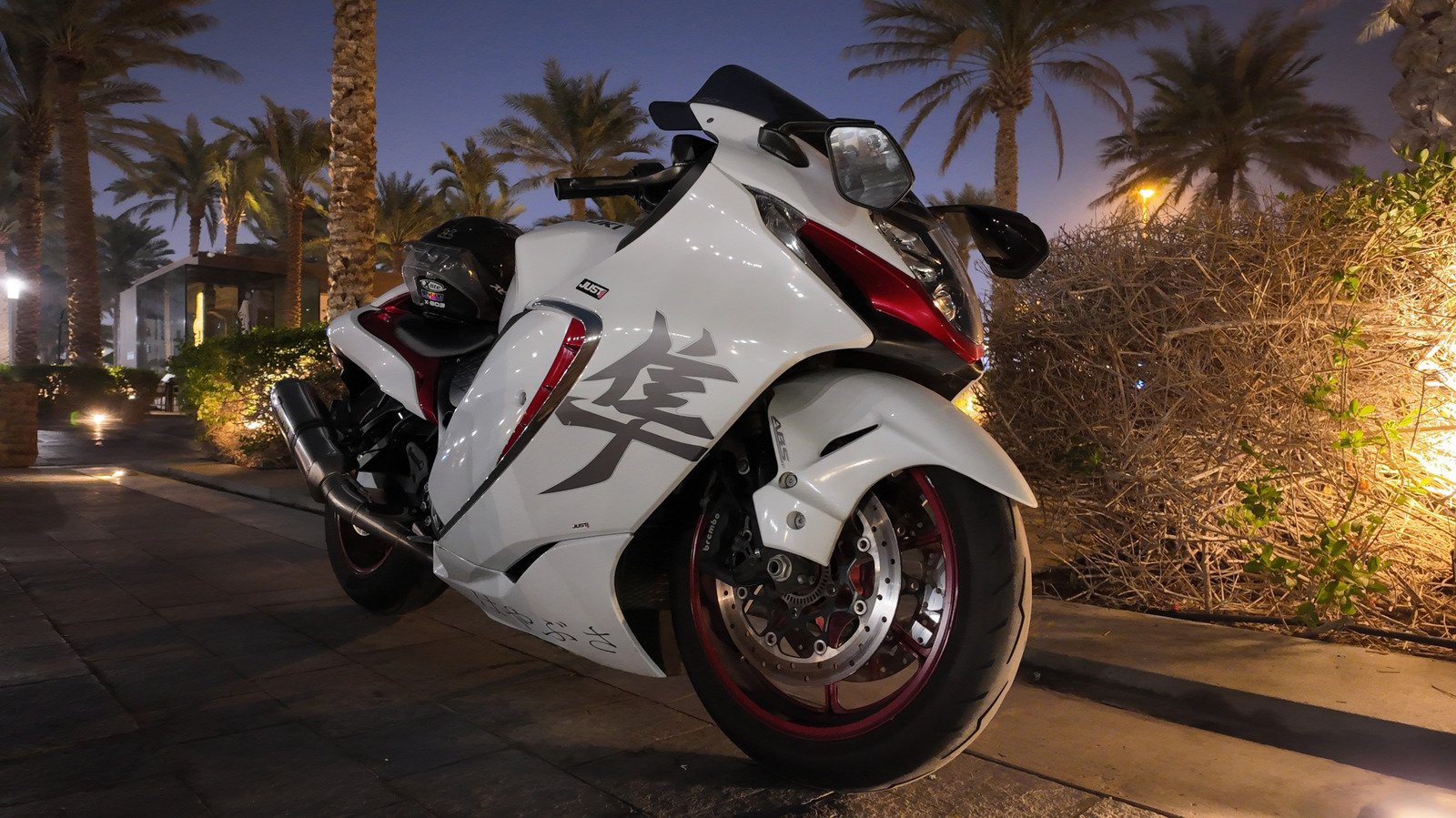
Suzuki’s Best: Hayabusa
Joanna Sokolowska/Getty Images
In the superbike community, handling matters, but speed matters even more, and building the fastest production motorcycle in the world is a boast manufacturers fought over throughout the ’90s. First was the 1990 Kawasaki Ninja ZX-11, with a top speed of 173 mph. Then the Honda Super Blackbird 1100 took over in 1996, edging out the Kawa with a top speed of 177 mph. Then Suzuki dropped the Hayabusa in 1999.
Hayabusa is Japanese for “peregrine falcon” — the world’s fastest animal. The bike lived up to its namesake. Tucked in the frame was a 1,300cc inline four-cylinder engine that made 194 hp against a featherweight 474 pounds. Its distinctive bubble fairings differentiated itself from its competitors visually and manipulated airflow, which helped it reach a 194 mph top speed. The ‘Busa was so out of pocket that shortly after its debut, the major manufacturers agreed to limit top speed to a gentle and sedate 186 mph. That limitation left Suzuki the de facto record holder for years.
However, the Hayabusa was more than a speed record holder. It was a legendary sports bike that shaped Suzuki’s reputation in the years to come. The fact that it has been in production for 25 years and counting, despite ultimately losing the speed crown, is a testament to its enduring appeal and brilliant design.
Kawasaki’s Worst: H2 750 Mach IV
TinoFotografie/Shutterstock
In the 1970s, two-stroke motorcycles still roamed the roads, and the Kawasaki H2 750 was one of them. Two-strokes are twitchy and may not be ideal for novice riders, but that wasn’t the only thing that earned the H2 its “Widowmaker” nickname. It has gone down in history as an impossible-to-control eater of unwary riders, though by today’s standards, its power numbers are somewhat pedestrian. The triple-cylinder made 74 hp and 57 lb-ft of torque. Still, it translated to 12-second quarter-mile times, which blow most streetbikes out of the water.
The real problem lay in the fact that motorcycles need to stop and corner in addition to accelerating, and the Mach IV didn’t. Its brakes were inadequate to the task, it produced intense vibrations and peaky power thanks to its screaming powerplant, and a frame with a reputation for flexing under load. This combination made for a dangerous motorcycle. Kawasaki only made the H2 between 1972 and 1975 – another sign that something was wrong.
Kawasaki’s Best: Ninja H2R
Apollo51x/Shutterstock
The quest for top speed has taken manufacturers many strange places, but few went as far as Kawasaki to achieve it. After the Hayabusa seemed to put an end to the top speed debate, Kawasaki stepped up with one of the most insane and difficult-to-ride motorcycles ever to hit the production line.
The Kawasaki Ninja H2R has been at the top of the speed production bike world since its 2015 debut. Despite sharing a naming nomenclature and lineage with the ’70s H2 that earned a bad rep and a short lifespan, this production bike has been going strong. It’s a pure sport bike. In fact, the top-spec H2R is strictly closed-course only. The reason for that is partially because its 998cc engine makes an absurd 322 hp against a weight of 476 pounds. If that seems a tad heavy compared to the ultralight sport bikes, it’s because Kawasaki tapped its own Heavy Industries division to design a bespoke supercharger that slightly upped the weight while sending power into the stratosphere.
This purpose-built machine is not only the pinnacle of Kawasaki’s decades of manufacturing experience, but it also represents the state of the sport bike art as the reigning speed champion. That’s not to say that the Valkyries and Vulcans and KX450s of the world are not fine motorcycles, but the H2R takes the crown – for now.
