

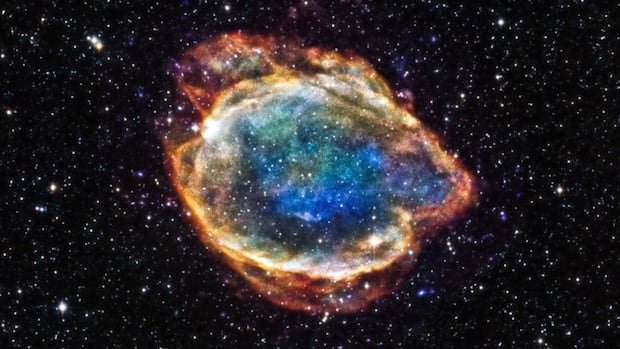
A competing theory to ‘dark energy’ suggests universe has different time zones
New measurements of a certain type of supernova seems to indicate that our expanding universe isn’t accelerating at all, negating any need to invoke a mysterious ‘dark energy’ to explain supernovae observations.
Recent observations from 1,550 supernovae fit the new ‘timescape’ model
Sonya Buyting · CBC Radio
·
Quirks and Quarks19:35Is dark energy dying? A new theory suggests that the universe has different time zones
There’s a cosmic controversy brewing in the universe. It centres around the mysterious force known as “dark energy.”
This concept emerged from observations of distant supernovae that, in the late 1990s, seemed to indicate the universe had been expanding at a faster and faster pace ever since the big bang. Astronomers made these observations from a certain type of supernovae that explode in such a way that allows astronomers to calculate their distance from us.
The picture emerging from that data didn’t fit with previous explanations of the universe that theorized its expansion, driven by the big bang, would eventually slow down as gravity took over. This led scientists to come up with the idea that a force they called “dark energy” pushed against gravity to make the universe expand faster and faster, in keeping with the supernovae data.
But since then, astronomers have measured — with greater precision — many more supernovae, as well as other bright objects in the distant universe. Doing so has revealed cracks in the standard model of cosmology that relies on dark energy to explain the data.
This has led to a new and different theory, dubbed the “timescape model,” that recent research suggests may more accurately describe our universe.
Ryan Ridden, a postdoctoral research fellow at the University of Canterbury in Christchurch, New Zealand, was part of the team behind the recent discovery. Here is part of his conversation with Quirks & Quarks host Bob McDonald.
So here we are 25 years after the original supernovae discoveries. What’s proving to be the problem with the idea of dark energy?
So the idea of dark energy is kind of built on a very big assumption that the universe is a kind of featureless fluid. That it’s the same in all directions, everywhere, on a certain scale. If you go through and do the equations with this fluid, you need this idea of a dark-energy-like substance to fit observations with the data.
There are cracks starting to emerge with a few different things, like we’re starting to see irregularities in the distribution of very distant objects in the universe, which you shouldn’t expect if the universe is uniform and the same in all directions.
We’re also starting to see problems with other measurements, so measurements of distributions of galaxies in the universe. We expect the distribution of galaxies to be kind of controlled by things that happened very early in the beginning of the universe, when the universe was small, hot and dense, and sound waves could propagate through.
And there was a recent result by the Dark Energy Spectroscopic Instrument, which showed that this idea of dark energy doesn’t quite explain their measurements either. They were starting to think that perhaps something like a time-evolving dark energy would be necessary to explain their observations.
So what our telescopes are seeing and measuring doesn’t match the dark energy model, is that the idea?
Yeah. So that’s pretty much what it’s coming down to. The standard model of cosmology is an incredibly good descriptor of the universe. As with every model, they’re only true insofar as they can reproduce the data.
And now that we’ve got all of these enormous and incredible surveys going on in astronomy that are collecting enormous amounts of data that dwarf any dataset that we’ve had before, we’re starting to test the very limits of this model.
We’re starting to see, at least from my perspective, that perhaps the assumptions that we’re making to build the standard model of cosmology don’t quite match up with what we’re seeing in the universe around us.
OK, well, let’s go to the alternative explanation that might fit the universe a little better. Tell me about the timescape model. How does it work?
It’s fundamentally different from the standard model of cosmology because it abandons this assumption that the universe is the same and uniform in every direction.
Instead, the basis of the timescape model is that, in fact, we see in the universe around us today that there are giant cosmic structures, enormous filaments and walls filled with galaxies and galaxy clusters. And in between those filaments and walls we have giant voids of nothing.
You can imagine it like blowing air into water filled with soap. You get all the bubbles forming on the surface. This is kind of what our universe looks like today. We have galaxies forming along the edges of the bubbles and where the bubbles meet. And then in the middle there is pretty much nothing going on.
So the idea with the timescape model is that these structures will play a significant role in the evolution of our universe. And the way they work is that in general relativity, there’s this idea that acceleration or deceleration changes the rate at which time passes for you. So the faster you accelerate, the slower your clock will tick.
So if we go all the way back to the early universe where it was very smooth, hot and dense, there are tiny, tiny differences in that early universe, slightly denser regions and slightly less dense regions.
This [initial] difference in acceleration between the more dense and less dense regions isn’t necessarily a lot, but if you fast forward through the history of the universe and measure the cumulative impact that they have, it has quite a significant change on the time that passes in those regions.
It’s to the point where for us observers sitting inside dense regions of the universe, we would find that the universe is perhaps around 14.2 billion years old. But for the very middle of these giant voids, you might find that they’re 21 billion years old. So time is ticking differently for these different regions.
In the empty spaces, time is passing more quickly than in the dense places where we are…
Yeah, exactly. So it’s to do with the deceleration of the universe giving us this timescape of varying times across the universe. Because quite often, we just assume there’s one fixed time for the entire universe, that it’s around 13.7 billion years old.
But we know from general relativity that these effects must have some kind of impact. So the timescape model goes to the fundamental basics of cosmology, questions the assumptions that were there, and then builds this new model, which incorporates more aspects of general relativity into it.
So how does this add up to what looks like a universe that’s accelerating, that’s speeding up?
Yeah, so as the universe is experiencing these different time frames, you also see these dense regions begin to contract. They’re getting smaller. Whereas the less dense regions are expanding more or less at the same rate they were at the beginning of the universe.
So over time, the total volume of the universe will become dominated by this kind of empty space that’s expanding at the same rate.
For observers like us in dense regions, the effect is that when we look out across these great big void regions, the cumulative effect is that it begins to “appear” that the entire universe is accelerating in its expansion, but that’s just a result of our position in the universe, this kind of mass biased position that we have.
ABOUT THE AUTHOR
Sonya Buyting is an award-winning science journalist whose brain is in its happy place when she’s working on stories from the cutting edge of science. Sonya is a producer for CBC Radio’s weekly science radio show, Quirks & Quarks, who got her start in science journalism on Discovery Channel Canada’s Daily Planet and then at the air crash investigation show, Mayday.
Q&A has been edited for length and clarity.
