

A spectacular explosion shows China is close to obtaining reusable rockets
“China’s first rocket recovery attempt achieved its expected technical objectives.”
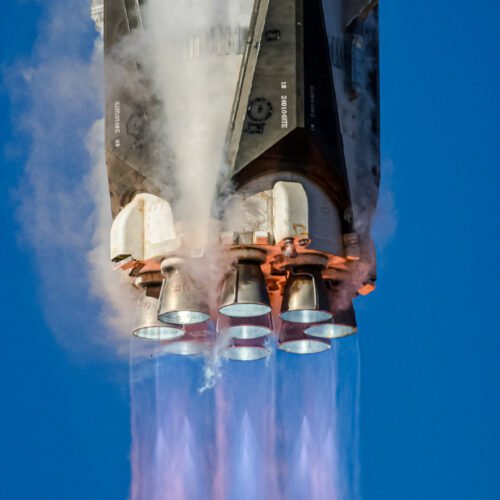
Nine TQ-12A engines, burning methane and liquid oxygen, power the first Zhuque-3 rocket off the launch pad.
Credit:
LandSpace
China’s first attempt to land an orbital-class rocket may have ended in a fiery crash, but the company responsible for the mission had a lot to celebrate with the first flight of its new methane-fueled launcher.
LandSpace, a decade-old company based in Beijing, launched its new Zhuque-3 rocket for the first time at 11 pm EST Tuesday (04:0 UTC Wednesday), or noon local time at the Jiuquan launch site in northwestern China.
Powered by nine methane-fueled engines, the Zhuque-3 (Vermillion Bird-3) rocket climbed away from its launch pad with more than 1.7 million pounds of thrust. The 216-foot-tall (66-meter) launcher headed southeast, soaring through clear skies before releasing its first stage booster about two minutes into the flight.
The rocket’s upper stage fired a single engine to continue accelerating into orbit. LandSpace confirmed the upper stage “achieved the target orbit” and declared success for the rocket’s “orbital launch mission.” This alone is a remarkable accomplishment for a brand new rocket.
Learning on the fly
But LandSpace had other goals for this launch. The Zhuque-3, or ZQ-3, booster stage is architected for recovery and reuse, the first rocket in China with such a design. Made of stainless steel, the first stage arced to the edge of space before gravity pulled it back into the atmosphere. After making it through reentry, the booster was supposed to relight a subset of its engines for a final braking burn before a vertical landing at a prepared location about 240 miles (390 kilometers) downrange from the launch pad.
But something went wrong as the booster approached the landing zone.
“According to telemetry data, an anomaly occurred after the first stage initiated its landing burn, preventing a soft landing on the designated recovery pad,” LandSpace wrote on X. “The stage debris came down near the edge of the recovery pad, and the recovery test was unsuccessful. The specific cause is under further investigation.”
Videos shared on Weibo, a Chinese social media platform, showed the final moments of the booster’s supersonic descent. A fireball enveloped the rocket at the start of the landing burn, and it impacted the recovery pad at high speed. But the rocket appeared to survive the most extreme aerodynamic forces of reentry, and it nearly hit a bullseye at the landing pad, situated in a remote dune field in the Gobi Desert.
“During the first stage recovery system verification test, engines thrust throttling operated normally, attitude control remained stable, and the downrange recovery trajectory was nominal,” LandSpace said, adding that no one was harmed in the accident.
LandSpace’s 216-foot-tall (66-meter) Zhuque-3 rocket lifts off from the Jiuquan Satellite Launch Center in northwestern China.
Credit:
LandSpace
The crash landing may have been disappointing to LandSpace, but it’s actually an auspicious result for a first attempt. The rocket appears to have made it closer to landing than Blue Origin’s first New Glenn booster earlier this year. Blue Origin made a successful landing on its second attempt last month.
It took SpaceX numerous tries before it landed the first Falcon 9 booster 10 years ago this month, pioneering novel guidance algorithms, supersonic retro-propulsion, and experimentation in how to manage the substantial aero-thermal forces of reentry. For example, SpaceX discovered through flight testing that it needed to add grid fins to the Falcon 9 booster. LandSpace’s booster uses grid fins from the start.
Poised for a breakout
China needs reusable rockets to keep up with the US launch industry, which is dominated by SpaceX, a company that flies more often and hauls heavier cargo to orbit than all Chinese rockets combined. There are at least two Chinese megaconstellations now being deployed in low-Earth orbit, each with architectures requiring thousands of satellites to relay data and Internet signals around the world. Without scaling up satellite production and reusing rockets, China will have difficulty matching the capacities of SpaceX, Blue Origin, and other emerging US launch companies.
Just three months ago, US military officials identified China’s advancements in reusable rocketry as a key to unlocking the country’s ability to potentially threaten US assets in space. “I’m concerned about when the Chinese figure out how to do reusable lift that allows them to put more capability on orbit at a quicker cadence than currently exists,” said Brig. Gen. Brian Sidari, the Space Force’s deputy chief of space operations for intelligence, at a conference in September.
Without reusable rockets, China has turned to a wide variety of expendable boosters this year to launch less than half as often as the United States. China has made 78 orbital launch attempts so far this year, but no single rocket type has flown more than 13 times. In contrast, SpaceX’s Falcon 9 is responsible for 153 of 182 launches by US rockets.
LandSpace’s first landing attempt shows China is positioned to close the gap. The company’s engineers will be smarter about landing rockets on the next try.
What’s more, several more Chinese companies are close to debuting their own reusable rockets. The next of these new rockets, the Long March 12A, is awaiting its first liftoff later this month from another launch pad at the Jiuquan spaceport.
The Long March 12A comes from one of China’s established rocket developers, the Shanghai Academy of Spaceflight Technology (SAST), part of the country’s state-owned aerospace enterprise. The Long March 12A has comparable performance to LandSpace’s Zhuque-3 and will also target a landing of its booster stage downrange on its first flight.
A handful of other rocket developers also claim to be weeks or months away from launching their first reusable boosters. One of them, Space Pioneer, might have been first to flight with its new Tianlong-3 rocket if not for the thorny problem of an accidental launch during a booster test-firing last year. Space Pioneer eventually completed a successful static fire in September of this year, and the company recently released a photo showing its rocket on the launch pad.
The Zhuque-3 rocket begins its first flight.
Credit:
LandSpace
These new rockets can each lift medium-class payloads into orbit. In its first iteration, the Zhuque-3 rocket is capable of placing a payload of more than 17,600 pounds (8 metric tons) into low-Earth orbit after accounting for the fuel reserves required for booster recovery. This makes Zhuque-3 the largest and most powerful commercial rocket ever launched from China.
LandSpace eventually plans to debut an upgraded Zhuque-3 carrying more propellant and using more powerful engines, raising its payload capacity to more than 40,000 pounds (18.3 metric tons) in reusable mode or a few tons more with an expendable booster.
LandSpace has raised more than $400 million since its founding in 2015, primarily from venture capital firms and government-backed investment funds. LandSpace initially developed its own liquid-fueled engines and a light-class launcher named Zhuque-2, which became the world’s first methane-burning launcher to reach orbit in 2023. LandSpace’s Zhuque-2 has logged four successful missions in six tries.
The larger Zhuque-3 is a “new-generation, low-cost, high-capacity, high-frequency, reusable LOX/methane launch vehicle,” LandSpace says. The company plans to reuse its Zhuque-3 boosters at least 20 times, “enabling efficient multi-satellite deployment for Internet constellations and China’s future space programs.”
Stephen Clark is a space reporter at Ars Technica, covering private space companies and the world’s space agencies. Stephen writes about the nexus of technology, science, policy, and business on and off the planet.

