

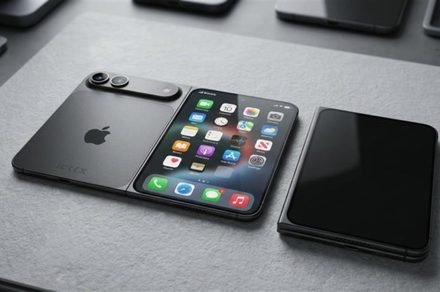
Apple’s upcoming foldable iPhone could serve an iPad-like adaptive iOS experience
Digital Trends may earn a commission when you buy through links on our site. Why trust us?
Apple’s foldable phone will boot iOS, but think of it running an iPad-inspired flavor.
AI Visualization
Apple’s foldable iPhone is eyeing a Fall season debut, and it seems the device will make a splash with a refined software that will make the best of its wide inner flexible screen. According to Bloomberg, the purported “iPhone Fold” will run iOS, but apps will dynamically go from a condensed page-after-page layout on the small outer screen to a side panel format when they run on the bigger foldable screen.
What’s the big change?
“Apple is developing new iOS app layouts and revamping its core iPhone programs to add sidebars along the left edge of the screen, similar to many of its iPad apps,” says the report. The idea is not too different from what Google has been doing with Android lately, making the OS optimize itself across form factors like phones, tablets, and foldables with varied aspect ratios. Google began that journey with Android 12L, and as of 2026, the company is making it mandatory for app developers to opt out of resizing and scaling.
The core objective is to improve scaling and adaptability for larger screens, starting with Android 17. According to Bloomberg, Apple will let developers adapt their apps’ interface to the larger display with a wide aspect ratio, similar to iPads. It would be interesting to see if Apple can also copy a rudimentary version of Stage Manager, which Vivo has already implemented on its foldable Android phone.
What else is there on the table?
“While the foldable iPhone won’t run several windows at once like an iPad mini, it will be able to show two apps side by side,” adds the report. Samsung, Google, and Oppo — among others — aren’t doing things any differently. OnePlus is the sole exception, which offers a unique Open Canvas system that lets you run three apps side-by-side on its Open foldable phone and tablets.
As far as the foldable iPhone goes, it will reportedly ditch the boat-shaped notch, which can still be seen on the iPhone 17e. For the foldable device, Apple has ditched the Face ID module, and has integrated a fingerprint sensor in the side-mounted power button. The foldable’s inner display, meanwhile, is expected to measure around 7.7 inches when fully open — roughly the footprint of an iPad mini, which makes the software story here every bit as important as the hardware.
For more than five years, Shikhar has consistently simplified developments in the field of consumer tech and presented them…
iPhone Fold to ditch Face ID and ugly notch in favor of a camera hole
pple’s foldable iPhone ditches Face ID and the Dynamic Island for a punch-hole camera and Touch ID — because the physics simply wouldn’t cooperate.
The Dynamic Island had a good run. Introduced in 2022 as Apple’s elegant workaround for the Face ID sensor array on the iPhone 14 Pro, it became — depending on who you ask — either a genuinely clever UI trick or a pill-shaped reminder that Apple still hadn’t figured out how to hide a camera.
Either way, it’s gone on the iPhone Fold. Replaced, according to Bloomberg, by a small punch-hole cutout on the outer display.
Google is adjusting the very core of Android OS to speed up your phone
New AutoFDO optimization could make Android phones faster
Your Android phone could soon feel faster without any new chip or hardware upgrade. Google has introduced a new optimization technique called AutoFDO, which squeezes more performance out of Android devices by improving how the operating system’s core code is compiled.
AutoFDO targets the core part of Android, the kernel, that sits between your apps and the phone’s hardware. It handles tasks like memory management, scheduling apps, and talking to hardware, which ends up consuming 40% of CPU time on Android devices.
OnePlus’ next flagship may combine Snapdragon power with a 200MP zoom lens
The OnePlus 16 could go big on zoom and performance.
The next OnePlus flagship is already shaping up to be a big upgrade over its predecessor, the OnePlus 15. A new leak has revealed more information regarding the OnePlus 16, hinting at a powerful Qualcomm Snapdragon flagship chipset along with a big upgrade to zoom photography.
While the phone is still months away from an official release, the leak points to a device with improved hardware.
