Close Menu

    Subscribe to Updates

    Get the latest creative news from FooBar about art, design and business.

    What's Hot

    Xbox unveils first tech details of its next generation console, codenamed Project Helix

    Developer sues publisher after leaving Kickstarter backers waiting over two years for promised physical editions

    Valve responds to NY Attorney General lawsuit: “We have serious concerns with the alterations the NYAG claims are necessary to make to our games”

    Facebook X (Twitter) Instagram
    • Artificial Intelligence
    • Business Technology
    • Cryptocurrency
    • Gadgets
    • Gaming
    • Health
    • Software and Apps
    • Technology
    Facebook X (Twitter) Instagram Pinterest Vimeo
    Tech AI Verse
    • Home
    • Artificial Intelligence

      What the polls say about how Americans are using AI

      February 27, 2026

      Tensions between the Pentagon and AI giant Anthropic reach a boiling point

      February 21, 2026

      Read the extended transcript: President Donald Trump interviewed by ‘NBC Nightly News’ anchor Tom Llamas

      February 6, 2026

      Stocks and bitcoin sink as investors dump software company shares

      February 4, 2026

      AI, crypto and Trump super PACs stash millions to spend on the midterms

      February 2, 2026
    • Business

      Met Office ‘supercomputing as a service’ one year old

      March 12, 2026

      Tech hiring evolves as candidates ask for AI compute alongside pay and perks

      March 11, 2026

      Oracle is spending billions on AI data centers as cash flow turns negative

      March 11, 2026

      Google: Cloud attacks exploit flaws more than weak credentials

      March 10, 2026

      Could this be the key to eternal storage? Experts claim new DNA HDD can be ‘erased and overwritten repeatedly’

      March 9, 2026
    • Crypto

      Banks Respond to Kraken’s Federal Reserve Access as Trump Sides with Crypto

      March 4, 2026

      Hyperliquid and DEXs Break the Top 10 — Is the CEX Era Ending?

      March 4, 2026

      Consensus Hong Kong 2026: The Institutional Turn 

      March 4, 2026

      New Crypto Mutuum Finance (MUTM) Reports V1 Protocol Progress as Roadmap Enters Phase 3

      March 4, 2026

      Bitcoin Short Sellers Caught Off Guard in New White House Move

      March 4, 2026
    • Technology

      Media Briefing: In the AI era, subscribers are the real prize — and the Telegraph proves it

      March 12, 2026

      Furniture.com was built for SEO. Now it’s trying to crack AI search

      March 12, 2026

      How medical creator Nick Norwitz grew his Substack paid subscribers from 900 to 5,200 within 8 months

      March 12, 2026

      Inside Amazon’s effort to shape the AI narrative on sustainability and ethics

      March 12, 2026

      Apple’s upcoming foldable iPhone could serve an iPad-like adaptive iOS experience

      March 12, 2026
    • Others
      • Gadgets
      • Gaming
      • Health
      • Software and Apps
    Check BMI
    Tech AI Verse
    You are at:Home»Technology»Autonomous MIT robot helps discover better materials for solar panels
    Technology

    Autonomous MIT robot helps discover better materials for solar panels

    TechAiVerseBy TechAiVerseJuly 9, 2025No Comments5 Mins Read0 Views
    Facebook Twitter Pinterest Telegram LinkedIn Tumblr Email Reddit
    Autonomous MIT robot helps discover better materials for solar panels
    Share
    Facebook Twitter LinkedIn Pinterest WhatsApp Email

    Autonomous MIT robot helps discover better materials for solar panels

    Serving tech enthusiasts for over 25 years.

    TechSpot means tech analysis and advice you can trust.

    Forward-looking: A new chapter in materials science is unfolding at MIT, where researchers have developed a fully autonomous robotic system designed to accelerate the search for advanced semiconductors. This technology aims to address a long-standing challenge: the slow pace of manually measuring key properties in new materials, which has limited progress in fields such as solar energy.

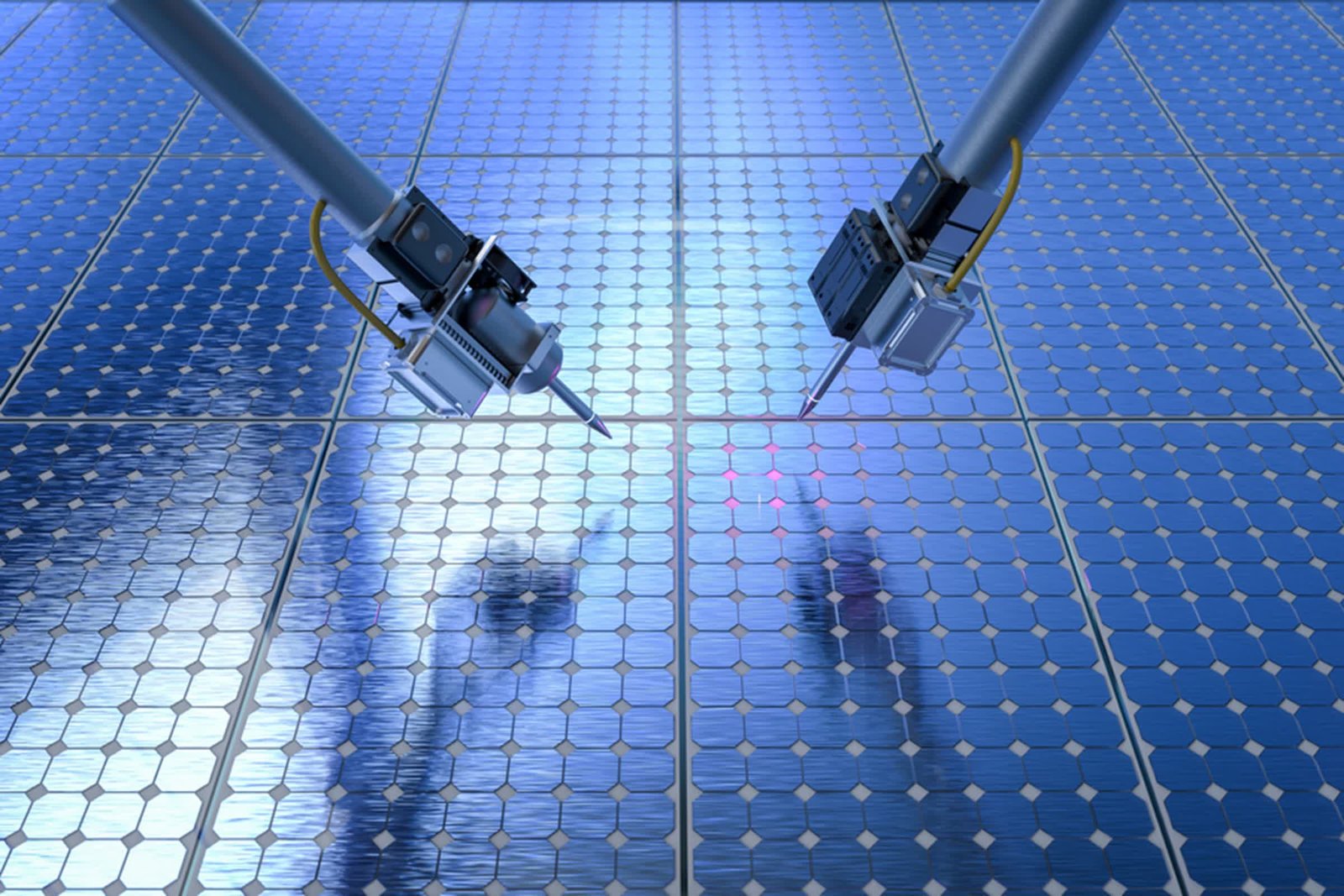
    At the heart of the system is a robotic probe capable of measuring photoconductance, a property that reveals how a material responds to light. By integrating expert knowledge from materials scientists into a machine-learning model, the robot can determine the most informative points to probe on a sample. This approach, paired with a specialized planning algorithm, enables the robot to move quickly and efficiently between contact points.

    In a rigorous 24-hour test, the robot performed more than 125 unique measurements per hour, surpassing the precision and reliability of previous artificial intelligence-based methods. This leap in speed and accuracy could accelerate the development of more efficient solar panels and other electronic devices.

    “I find this paper to be incredibly exciting because it provides a pathway for autonomous, contact-based characterization methods,” said Tonio Buonassisi, a professor of mechanical engineering and senior author of the study. “Not every important property of a material can be measured in a contactless way. If you need to make contact with your sample, you want it to be fast and you want to maximize the amount of information that you gain.”

    The research team, led by graduate student Alexander Siemenn, along with postdoctoral researchers Basita Das and Kangyu Ji, as well as graduate student Fang Sheng, published their findings in Science Advances.

    MIT graduate students Eunice Aissi, left, and Alexander Siemenn

    The journey toward this innovation began in 2018, when Buonassisi’s lab set out to build a fully autonomous materials discovery laboratory. The efforts have recently focused on perovskites, a class of semiconductors used in solar panels. While previous advances allowed for rapid synthesis and imaging-based analysis, accurately measuring photoconductance still required direct contact with the material.

    “To allow our experimental laboratory to operate as quickly and accurately as possible, we had to come up with a solution that would produce the best measurements while minimizing the time it takes to run the whole procedure,” Siemenn explained.

    The system begins by capturing an image of the perovskite sample using its onboard camera. Computer vision then divides the image into segments, which are analyzed by a neural network model that incorporates the expertise of chemists and materials scientists. “These robots can improve the repeatability and precision of our operations, but it is important to still have a human in the loop. If we don’t have a good way to implement the rich knowledge from these chemical experts into our robots, we are not going to be able to discover new materials,” Siemenn added.

    The neural network identifies the best probe contact points based on the sample’s shape and composition. These points are then fed into a path planner that determines the most efficient route for the robot to follow. The adaptability of this approach is crucial, as the samples often have unique shapes. “It is almost like measuring snowflakes – it is difficult to get two that are identical,” Buonassisi said.

    A key innovation is the self-supervised nature of the neural network, which selects optimal contact points directly from sample images without needing labeled training data. The team also improved the path planning algorithm by introducing a small amount of randomness, which helped the robot find shorter paths.

    “As we progress in this age of autonomous labs, you really do need all three of these expertise – hardware building, software, and an understanding of materials science – coming together into the same team to be able to innovate quickly. And that is part of the secret sauce here,” Buonassisi said.

    After building the system, the researchers tested each component. The neural network outperformed seven other AI-based methods in identifying contact points with reduced computation time, and the path planner consistently generated shorter routes than competing algorithms. In a full 24-hour autonomous experiment, the robot completed over 3,000 photoconductance measurements, identifying both high-performing areas and regions of degradation in the materials.

    “Being able to gather such rich data that can be captured at such fast rates, without the need for human guidance, starts to open up doors to be able to discover and develop new high-performance semiconductors, especially for sustainability applications like solar panels,” Siemenn said.

    Looking ahead, the team plans to refine the system further as it works toward establishing a fully autonomous laboratory for materials discovery. The project is supported by organizations including First Solar, Eni through the MIT Energy Initiative, MathWorks, the University of Toronto’s Acceleration Consortium, the US Department of Energy, and the US National Science Foundation.

    Share. Facebook Twitter Pinterest LinkedIn Reddit WhatsApp Telegram Email
    Previous ArticleTrump trade advisor Peter Navarro calls it “inconceivable” that Apple can’t produce iPhones outside China
    Next Article Im Never Splitting AirPods With My Wife Again Thanks to This iPhone Trick
    TechAiVerse
    • Website

    Jonathan is a tech enthusiast and the mind behind Tech AI Verse. With a passion for artificial intelligence, consumer tech, and emerging innovations, he deliver clear, insightful content to keep readers informed. From cutting-edge gadgets to AI advancements and cryptocurrency trends, Jonathan breaks down complex topics to make technology accessible to all.

    Related Posts

    Media Briefing: In the AI era, subscribers are the real prize — and the Telegraph proves it

    March 12, 2026

    Furniture.com was built for SEO. Now it’s trying to crack AI search

    March 12, 2026

    How medical creator Nick Norwitz grew his Substack paid subscribers from 900 to 5,200 within 8 months

    March 12, 2026
    Leave A Reply Cancel Reply

    Top Posts

    Ping, You’ve Got Whale: AI detection system alerts ships of whales in their path

    April 22, 2025714 Views

    Lumo vs. Duck AI: Which AI is Better for Your Privacy?

    July 31, 2025299 Views

    Wired Headphones Are Making A Comeback, And We Have Gen Z To Thank

    July 22, 2025209 Views

    6.7 Cummins Lifter Failure: What Years Are Affected (And Possible Fixes)

    April 14, 2025168 Views
    Don't Miss
    Gaming March 12, 2026

    Xbox unveils first tech details of its next generation console, codenamed Project Helix

    Xbox unveils first tech details of its next generation console, codenamed Project Helix Dev kits…

    Developer sues publisher after leaving Kickstarter backers waiting over two years for promised physical editions

    Valve responds to NY Attorney General lawsuit: “We have serious concerns with the alterations the NYAG claims are necessary to make to our games”

    SAG-AFTRA issues a Do Not Work Order against Capcom for “failing to initiate the signatory process”

    Stay In Touch
    • Facebook
    • Twitter
    • Pinterest
    • Instagram
    • YouTube
    • Vimeo

    Subscribe to Updates

    Get the latest creative news from SmartMag about art & design.

    About Us
    About Us

    Welcome to Tech AI Verse, your go-to destination for everything technology! We bring you the latest news, trends, and insights from the ever-evolving world of tech. Our coverage spans across global technology industry updates, artificial intelligence advancements, machine learning ethics, and automation innovations. Stay connected with us as we explore the limitless possibilities of technology!

    Facebook X (Twitter) Pinterest YouTube WhatsApp
    Our Picks

    Xbox unveils first tech details of its next generation console, codenamed Project Helix

    March 12, 20262 Views

    Developer sues publisher after leaving Kickstarter backers waiting over two years for promised physical editions

    March 12, 20261 Views

    Valve responds to NY Attorney General lawsuit: “We have serious concerns with the alterations the NYAG claims are necessary to make to our games”

    March 12, 20260 Views
    Most Popular

    The Players Championship 2025: TV Schedule Today, How to Watch, Stream All the PGA Tour Golf From Anywhere

    March 13, 20250 Views

    Over half of American adults have used an AI chatbot, survey finds

    March 14, 20250 Views

    UMass disbands its entering biomed graduate class over Trump funding chaos

    March 14, 20250 Views
    © 2026 TechAiVerse. Designed by Divya Tech.
    • Home
    • About Us
    • Contact Us
    • Privacy Policy
    • Terms & Conditions

    Type above and press Enter to search. Press Esc to cancel.