

BigQuery is 5x bigger than Snowflake and Databricks: What Google is doing to make it even better
Join our daily and weekly newsletters for the latest updates and exclusive content on industry-leading AI coverage. Learn More
Google Cloud announced a significant number of new features at its Google Cloud Next event last week, with at least 229 new announcements.
Buried in that mountain of news, which included new AI chips and agentic AI capabilities, as well as database updates, Google Cloud also made some big moves with its BigQuery data warehouse service. Among the new capabilities is BigQuery Unified Governance, which helps organizations discover, understand and trust their data assets. The governance tools help address key barriers to AI adoption by ensuring data quality, accessibility and trustworthiness.
The stakes are enormous for Google as it takes on rivals in the enterprise data space.
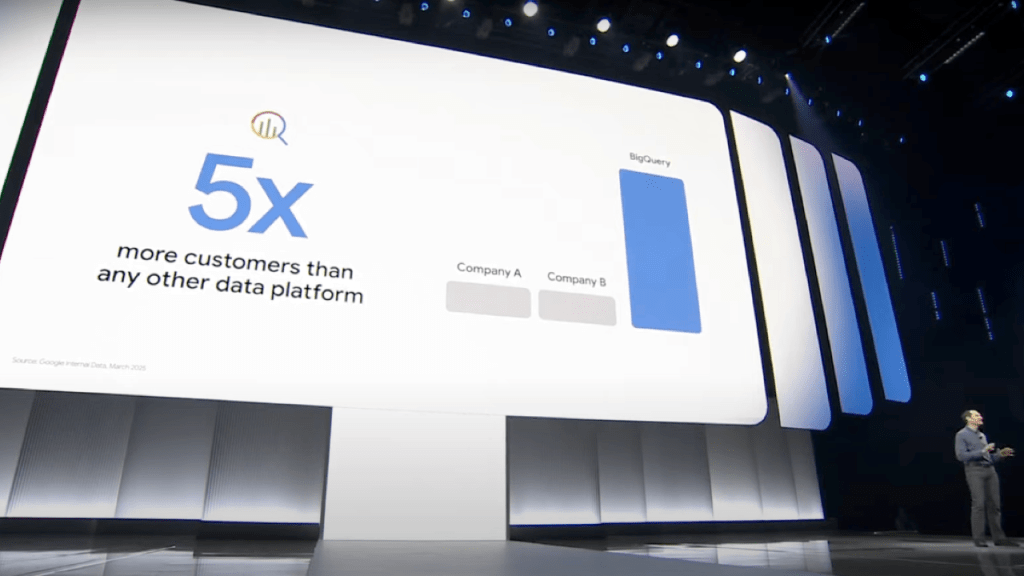
BigQuery has been on the market since 2011 and has grown significantly in recent years, both in terms of capabilities and user base. Apparently, BigQuery is also a big business for Google Cloud. During Google Cloud Next, it was revealed for the first time just how big the business actually is. According to Google, BigQuery had five times the number of customers of both Snowflake and Databricks.
“This is the first year we’ve been given permission to actually post a customer stat, which was delightful for me,” Yasmeen Ahmad, managing director of data analytics at Google Cloud, told VentureBeat. “Databricks and Snowflake, they’re the only other kind of enterprise data warehouse platforms in the market. We have five times more customers than either of them.”
How Google is improving BigQuery to advance enterprise adoption
While Google now claims to have a more extensive user base than its rivals, it’s not taking its foot off the gas either. In recent months, and particularly at Google Cloud Next, the hyperscaler has announced multiple new capabilities to advance enterprise adoption.
A key challenge for enterprise AI is having access to the correct data that meets business service level agreements (SLAs). According to Gartner research cited by Google, organizations that do not enable and support their AI use cases through an AI-ready data practice will see over 60% of AI projects fail to deliver on business SLAs and be abandoned.
This challenge stems from three persistent problems that plague enterprise data management:
- Fragmented data silos
- Rapidly changing requirements
- Inconsistent organizational data cultures where teams don’t share a common language around data.
Google’s BigQuery Unified Governance solution represents a significant departure from traditional approaches by embedding governance capabilities directly within the BigQuery platform rather than requiring separate tools or processes.
BigQuery unified governance: A technical deep dive
At the core of Google’s announcement is BigQuery unified governance, powered by the new BigQuery universal catalog. Unlike traditional catalogs that only contain basic table and column information, the universal catalog integrates three distinct types of metadata:
- Physical/technical metadata: Schema definitions, data types and profiling statistics.
- Business metadata: Business glossary terms, descriptions and semantic context.
- Runtime metadata: Query patterns, usage statistics and format-specific information for technologies like Apache Iceberg.
This unified approach allows BigQuery to maintain a comprehensive understanding of data assets across the enterprise. What makes the system particularly powerful is how Google has integrated Gemini, its advanced AI model, directly into the governance layer through what they call the knowledge engine.
The knowledge engine actively enhances governance by discovering relationships between datasets, enriching metadata with business context and monitoring data quality automatically.
Key capabilities include semantic search with natural language understanding, automated metadata generation, AI-powered relationship discovery, data products for packaging related assets, a business glossary, automatic cataloging of both structured and unstructured data and automated anomaly detection.
Forget about benchmarks, enterprise AI is a bigger issue
Google’s strategy transcends the AI model competition.
“I think there’s too much of the industry just focused on getting on top of that individual leaderboard, and actually Google is thinking holistically about the problem,” Ahmad said.
This comprehensive approach addresses the entire enterprise data lifecycle, answering critical questions such as: How do you deliver on trust? How do you deliver on scale? How do you deliver on governance and security?
By innovating at each layer of the stack and bringing these innovations together, Google has created what Ahmad calls a real-time data activation flywheel, where, as soon as data is captured, regardless of the type or format or where it’s being stored, there is instant metadata generation, lineage and quality.
That said, models do matter. Ahmad explained that with the advent of thinking models like Gemini 2.0, there has been a huge unlock for Google’s data platforms.
“A year ago, when you were asking GenAI to answer a business question, anything that got slightly more complex, you would actually need to break it down into multiple steps,” she said. “Suddenly, with the thinking model it can come up with a plan… you’re not having to hard code a way for it to build a plan. It knows how to build plans.”
As a result, she said that now you can easily have a data engineering agent build a pipeline that’s three steps or 10 steps. The integration with Google’s AI capabilities has transformed what’s possible with enterprise data.
Real-world impact: How enterprises are benefiting
Levi Strauss & Company offers a compelling example of how unified data governance can transform business operations. The 172-year-old company is using Google’s data governance capabilities as it shifts from being primarily a wholesale business to becoming a direct-to-consumer brand. In a session at Google Cloud Next, Vinay Narayana, who runs data and AI platform engineering at Levi’s, detailed his organization’s use case.
“We aspire to empower our business analysts to have access to real-time data that is also accurate,” Narayana said. “Before we embarked on our journey to build a new platform, we discovered various user challenges. Our business users didn’t know where the data lived, and if they knew the data source, they didn’t know who owned it. If they somehow got access, there was no documentation.”
Levi’s built a data platform on Google Cloud that organizes data products by business domain, making them discoverable through Analytics Hub (Google’s data marketplace). Each data product is accompanied by detailed documentation, lineage information and quality metrics.
The results have been impressive: “We are 50x faster than our legacy data platform, and this is on the low end. A significant number of visualizations are 100x faster,” Narayana said. “We have over 700 users already using the platform on a daily basis.”
Another example comes from Verizon, which is using Google’s governance tools as part of its One Verizon Data initiative to unify previously siloed data across business units.
“This is going to be the largest telco data warehouse in North America running on BigQuery,” Arvind Rajagopalan, AVP of data engineering, architecture and products at Verizon, said during a Google Cloud Next session.
The company’s data estate is massive, comprising 3,500 users who run approximately 50 million queries, 35,000 data pipelines, and over 40 petabytes of data.
In a spotlight session at Google Cloud Next, Ahmad also provided numerous other user examples. Radisson Hotel Group personalized their advertising at scale, training Gemini models on BigQuery data. Teams experienced a 50% increase in productivity, while revenue from AI-powered campaigns rose by more than 20%. Gordon Food Service migrated to BigQuery, ensuring their data was ready for AI and increasing adoption of customer-facing apps by 96%
What’s the ‘big’ difference: Exploring the competitive landscape
There are multiple vendors in the enterprise data warehouse space, including Databricks, Snowflake, Microsoft with Synapse and Amazon with Redshift. All of these vendors have been developing various forms of AI integrations in recent years.
Databricks has a comprehensive data lakehouse platform and has been expanding its own AI capabilities, thanks in part to its $1.3 billion acquisition of Mosaic. Amazon Redshift added support for generative AI in 2023, with Amazon Q helping users build queries and obtain better answers. For its part, Snowflake has been busy developing tools and partnering with large language model (LLM) providers, including Anthropic.
When pressed on comparisons specifically to Microsoft’s offerings, Ahmad argued that Synapse is not an enterprise data platform for the types of use cases that customers use BigQuery for.
“I think we’ve leapfrogged the entire industry, because we’ve worked on all of the pieces,” she said. “We’ve got the best model, by the way, it’s the best model integrated in a data stack that understands how agents work.”
This integration has driven rapid adoption of AI capabilities within BigQuery. According to Google, customer use of Google’s AI models in BigQuery for multimodal analysis has increased by 16 times year over year.
What this means for enterprises adopting AI
For enterprises already struggling with AI implementation, Google’s integrated approach to governance may offer a more streamlined path to success than cobbling together separate data management and AI systems.
Ahmad’s claim that Google has “leapfrogged” competitors in this space will face scrutiny as organizations put these new capabilities to work. However, the customer examples and technical details suggest Google has made significant progress in addressing one of the most challenging aspects of enterprise AI adoption.
For technical decision-makers evaluating data platforms, the key questions will be whether this integrated approach delivers sufficient additional value to justify migrating from existing investments in specialized platforms, such as Snowflake or Databricks, and whether Google can maintain its current innovation pace as competitors respond.
Daily insights on business use cases with VB Daily
If you want to impress your boss, VB Daily has you covered. We give you the inside scoop on what companies are doing with generative AI, from regulatory shifts to practical deployments, so you can share insights for maximum ROI.
Read our Privacy Policy
Thanks for subscribing. Check out more VB newsletters here.
An error occured.
