

Boldr Kelvin Review (2026): Heats Your Body, Heats the Wall
Review: Boldr Kelvin
The Boldr Kelvin heater looks cool and promises energy savings and far-infrared heat. Too bad it also heats backward.
Courtesy of Boldr
Cool looking, in an iPhone way. Draws less energy than most heaters. Gentle, even warmth. A smart-home app promises near-infinite customization and energy monitoring.
Doesn’t heat ambient air temp well or quickly. Uses a lot of wall space. Reaches near-boiling temps on its front. Crossbars get hot where they affix to the wall. App is a work in progress.
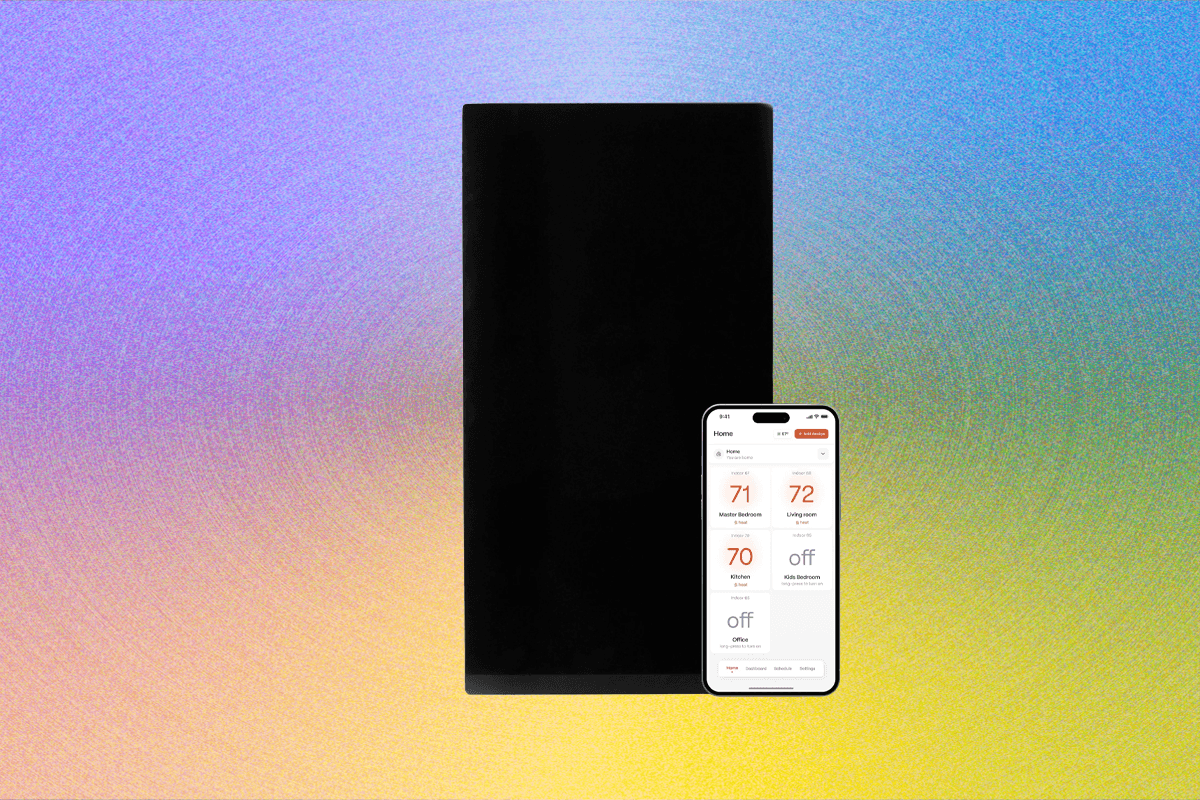
The Boldr Kelvin is unlike other space heaters I’ve tested. It is a blank mirrored panel, 3 feet across on its longest side, meant to hang on a wall. It comes in any color you want, as long as it’s white or black.
The Kelvin looks a bit like a TV without a border, or the monolith in Stanley Kubrick’s 2001: A Space Odyssey. Instead of driving apes crazy, this particular monolith emits far-infrared heat (a type of radiant energy) that its maker promises will make me feel toasty-warm while consuming a fraction of the power of a standard heater. Unlike resistance heaters with fans, it’s blessedly silent. And there’s an app that tracks basically everything, from room temp to energy use.
In the usually hype-free world of space heaters, a trail of influencers and review outlets have hailed the $400 flagship device from Boldr—an international tech startup incorporated in London and with founders in Lithuania and Brazil—as the “smartest heater you’ll ever own,” a piece of “modern wall art” that makes traditional heaters seem obsolete, and a “seriously great” solution to your house’s one cold room.
While it’s certainly the most interesting heater to pass my desk in the past year, I’ve had a much more troubled relationship with the Kelvin. This has been true since I tested the first-generation device last spring. Boldr’s app remains a work in progress, the heater’s use case is narrow, and the panel kicks a surprising amount of heat back to the wall you hang it on.
Red Heat
Photograph: Matthew Korfhage
The Kelvin’s biggest selling point is that it can save you energy by using far-infrared heat, a part of the non-visible spectrum that humans are thought to perceive primarily as warmth. Far-infrared has been a subject of great interest lately as a potential treatment for conditions as diverse as cancer, cardiovascular disorders, diabetes, and arthritis.
A far-infrared heater is not new technology, however. The Kelvin isn’t even the only infrared heating panel on the market. It’s a subclass of radiant heater, a category that also includes oil-filled radiators and the various radiant patio heaters you can find on Amazon. Radiant heaters are usually favored in large or open spaces because they can deliver warmth directly to whoever’s standing near them without needing to heat up the air.
The Kelvin is a low-powered infrared heater, just 450 watts for the standard model, meant for much smaller spaces. By running a current through a resistive element, the Kelvin heats the broad glass pane at the front of the device. The infrared heat radiates from the hot glass directly to you, the cold person. The idea is that direct heat is more cost-effective than trying to heat the whole room. The Kelvin gives off a genial warmth, a bit like bright sun on a cool day.
It nonetheless takes maybe an hour to fully heat up the Kelvin’s glass pane—much longer than the 30 seconds or so it takes to heat up a ceramic heater. In a very small room, radiant heat from the Kelvin will also slowly warm the walls and other objects, which will, in turn, slowly raise the air temp a few degrees over multiple hours. This is much the same way the sun bakes black asphalt and concrete, making cities hotter than the countryside.
Heat Splash
But while the Kelvin doesn’t use much power, it has no claim to greater heat efficiency than resistance heaters. All non-heat-pump heaters are 100 percent efficient, where the laws of thermodynamics are concerned. All energy waste—the motion of a fan, friction, power devoted to electronics—is eventually turned into heat.
When you’re talking about a heater’s effectiveness, you’re really talking about its ability to reliably and quickly deliver heat where you want it. This is where the Kelvin can run aground a bit.
Like basically all radiant heaters, the Kelvin gets quite hot on its surface. The center of the glass pane can reach 200 degrees Fahrenheit, hot enough that you’ll want to keep it out of reach of young children.
Photograph: Matthew Korfhage
That ceramic glass pane doesn’t impart its thermal energy as aggressively as metal or water, so incidental touches won’t likely burn you. But you shouldn’t press against the Kelvin’s front pane carelessly, as I did while taking temperature readings behind the device. (A lightly burnt belly button is a weird feeling I don’t recommend.)
What troubles me more is that the device also radiates and conducts a lot of heat backward, into the wall you hang it on. I first raised this issue with Boldr’s founders last spring, while looking at the first-generation Kelvin. Its makers said an update, with better rear insulation, was coming by the time the next cold season rolled around.
That Gen 2 device, released last fall, nonetheless still heats the wall behind it to above 80 degrees Fahrenheit. The metal mounting bars, meant to be affixed directly to the wall, heat up even more, up to 120 degrees.
This isn’t likely a safety issue: If 120-degree heat were a problem for walls, much of Arizona couldn’t have walls. But this is a temperature at which paint loses its pigment more quickly and wallpaper adhesive may start to degrade if the device heats and cools repeatedly. It also just means there’s energy and heat being directed where you don’t want them.
Optimal placement may also be difficult. You’ll need sufficient wall space, 2 feet by 3 feet, within 5 feet of a power outlet, where you can anchor a 20-pound device. To take advantage of direct radiant warmth, you’ll need the panel to face a spot where you spend a lot of time. Maybe you have just the right space in your office or bedroom. If so, it’ll be a cool-looking solution to your chilly office that you rave about to your friends.
Or maybe, like me, you don’t.
Gotta Get Yourself Connected
Photograph: Matthew Korfhage
Note that before you can even turn the Kelvin on, you’ll also need 2.4-GHz Wi-Fi and an app that will ask for your location and other information and connect your device to an external thermostat.
Company cofounder and CEO Madi Ablyazov told WIRED in a video interview last April that he views the heater as just one part of an energy management platform that would allow homeowners to track energy usage and costs across devices as diverse as heat pumps and solar panels. Boldr is, at heart, a tech startup that happens to have a space heater.
The Wi-Fi– and Bluetooth-connected Boldr app tracks energy usage over time, potentially on multiple devices and in multiple rooms. Temperature and humidity are measured by one of multiple external thermostats, including a Klima smart controller ($165) that could ideally sync with your home’s other heat pumps or AC units.
Boldr app via Matthew Korfhage
The app is still a work in progress, however, and has changed dramatically over the past year. As with most smart-home devices I’ve tested, there’s a bit of trial and error before Boldr’s devices decided to play nice with my router. This is a known difficulty with all 2.4-GHz smart-home devices, whether meat probes or security cameras. Still, the Boldr app required more work than some.
Some of Boldr’s tools are glitchy, including an AI-guided feature designed to track and estimate energy costs. Boldr’s app quoted a downright nostalgic 10 cents per kilowatt-hour for my Portland, Oregon, residence—a rate my city hasn’t seen since 2020. Adjusting Boldr’s app to the current rate was also not as easy as simply typing in the rate that appears on my energy bill. I had to jury-rig a solution that involved math instead. Booooooo, math.
Other tools work more felicitously. I can set Boldr’s thermostat to drop its temperature at local sunset each day and raise it at sunrise—or at specific times of my choosing. I can also set the Kelvin to turn on when the temperature in a given room drops below a specific temperature or when the humidity reaches a prescribed level. Alexa and Siri can likewise be integrated for those who prefer to chat with their devices.
If I want to give the device (and Boldr) access to my location, I can also set the desired temperature based on whether I’m home or not. I verified that this worked, then turned location tracking off. Trust what you trust, I guess.
I do expect Boldr’s energy management system to continue to evolve. And there’s reason for optimism: It’ll be a useful tool with other heating devices. But the caveats do add up. And I doubt I’ll be using it with the Kelvin.
Power up with unlimited access to WIRED. Get best-in-class reporting that’s too important to ignore. Includes unlimited digital access and exclusive subscriber-only content. Subscribe Today.
