Close Menu

    Subscribe to Updates

    Get the latest creative news from FooBar about art, design and business.

    What's Hot

    Need Your Mac Screen to Stay On? Simple Ways to Stop Sleep Mode

    What’s So Different About a Smart Outdoor TV?

    How to Connect AirPods to a MacBook Air and Fix Common Pairing Problems

    Facebook X (Twitter) Instagram
    • Artificial Intelligence
    • Business Technology
    • Cryptocurrency
    • Gadgets
    • Gaming
    • Health
    • Software and Apps
    • Technology
    Facebook X (Twitter) Instagram Pinterest Vimeo
    Tech AI Verse
    • Home
    • Artificial Intelligence

      What the polls say about how Americans are using AI

      February 27, 2026

      Tensions between the Pentagon and AI giant Anthropic reach a boiling point

      February 21, 2026

      Read the extended transcript: President Donald Trump interviewed by ‘NBC Nightly News’ anchor Tom Llamas

      February 6, 2026

      Stocks and bitcoin sink as investors dump software company shares

      February 4, 2026

      AI, crypto and Trump super PACs stash millions to spend on the midterms

      February 2, 2026
    • Business

      These ultra-budget laptops “include” 1.2TB storage, but most of it is OneDrive trial space

      March 1, 2026

      FCC approves the merger of cable giants Cox and Charter

      February 28, 2026

      Finding value with AI and Industry 5.0 transformation

      February 28, 2026

      How Smarsh built an AI front door for regulated industries — and drove 59% self-service adoption

      February 24, 2026

      Where MENA CIOs draw the line on AI sovereignty

      February 24, 2026
    • Crypto

      Bitcoin Bear Market Could Get Worse Despite the Latest Relief Rally

      March 1, 2026

      Crypto Scammers Have Been Quiet in February, Hacks Fall by 90%

      March 1, 2026

      Vitalik Buterin Signals Major Ethereum Wallet Overhaul

      March 1, 2026

      Why is Hyperliquid Price Rallying Amid the US-Iran War

      March 1, 2026

      Arbitrum Price Under Pressure: 60 Million ARB Whale Sale Sparks ATL Fear

      March 1, 2026
    • Technology

      Need Your Mac Screen to Stay On? Simple Ways to Stop Sleep Mode

      March 3, 2026

      What’s So Different About a Smart Outdoor TV?

      March 3, 2026

      How to Connect AirPods to a MacBook Air and Fix Common Pairing Problems

      March 3, 2026

      Oppo Find N6 shown globally with ‘least noticeable foldable crease’

      March 2, 2026

      Motorola to deliver privacy-focused phones by offering GrapheneOS as alternative to Android

      March 2, 2026
    • Others
      • Gadgets
      • Gaming
      • Health
      • Software and Apps
    Check BMI
    Tech AI Verse
    You are at:Home»Technology»C++26 Reflections adventures and compile-time UML
    Technology

    C++26 Reflections adventures and compile-time UML

    TechAiVerseBy TechAiVerseAugust 3, 2025No Comments2 Mins Read4 Views
    Facebook Twitter Pinterest Telegram LinkedIn Tumblr Email Reddit
    C++26 Reflections adventures and compile-time UML
    Share
    Facebook Twitter LinkedIn Pinterest WhatsApp Email

    C++26 Reflections adventures and compile-time UML

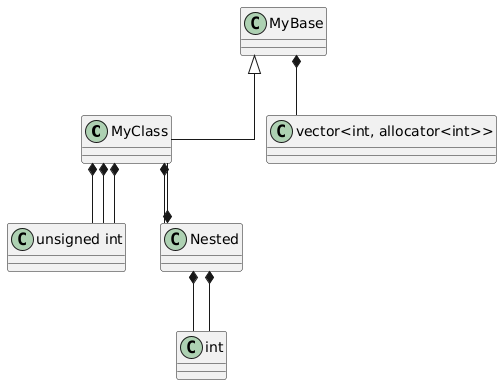
    The first thing I do every time I need to learn a new codebase is to start drawing the UML diagram of its classes, and usually give up soon after I started. The process of doing it manually is certainly useful, but now with reflections I figure it would be fun to try generate it instead.

    With C++26 reflections[1] the general consensus is that the magnitude of language change is comparable to what happened with C++11. After my little experiment with it, I would cautiously agree. So how does one go about creating a (Plant)UML diagram at compile time? With something like this.

    With the spoilers out of the way let’s dig in the details.

    P2996[1] introduces a couple of operators, namely lift ^^ and splice [: :]. The first one “lifts” a type or variable into a “meta” space, and the “splice” one (which imho should have been called “grounding operator”) does the opposite.

    The first thing to understand is that regardless of what we apply the lift operator (^^) to, it creates a std::meta::info type. This means that some info objects will be reflections of types, and some will be reflections of values. This creates confusion in my head, as at times one needs to check which kind of info something is, but there are good reasons for this and are well explained in section 2.2 of the paper. With that in mind let’s start coding.

    int main() {
      MyClass s;
      constexpr const char* const dot_graph_uml = make_class_graph();
    
      std::cout << dot_graph_uml << std::endl;
    }

    You’ll notice right away there is an ugly, and seemingly avoidable char pointer. Let’s get back to that later. Not much happens in main() besides us calling function template that is just a wrapper for what we actually care about:

    template
    consteval const char* make_class_graph() { 
      std::string graph = "@startuml nskinparam linetype ortho n";
    
      std::vector already_drawn;
      graph += make_class_graph_impl(^^U, already_drawn);
      graph += "@enduml";
    
      return std::define_static_string(graph);
    }

    Here we see the first interesting thing, something called std::define_static_string[2]. What this does is take what is a compile time std::string and create a string literal, which we can return from a consteval function. If we were to try to return the std::string we would be greeted with the compiler error

    :116:24: note: pointer to subobject of heap-allocated object is not a constant expression
    /opt/compiler-explorer/clang-bb-p2996-trunk-20250703/bin/../include/c++/v1/__memory/allocator.h:117:13: note: heap allocation performed here
      117 |     return {allocate(__n), __n};

    Which makes sense as we cannot expect to create an object we allocate on the heap at compile time, then have this object exist in the heap also at runtime. This is why we end up with a big fat literal string that holds our final UML diagram, which we can do whatever we want with in main(). Looking at the assembly you’ll see the end result:

     .asciz  "@startuml nskinparam linetype ortho ntogether {n class "MyClass"n  "MyClass"*--"unsigned int"n  "MyClass"*--"unsigned int"n  "MyClass"*--"unsigned int"n  "MyClass"*--"Nested"n  "MyClass"-up-|>"MyBase"n}ntogether {n class "Nested"n  "Nested"*--"int"n  "Nested"*--"int"n  "Nested"*--"MyClass"n}ntogether {n class "MyBase"n  "MyBase"*--"vector>"n}ntogether {n class "vector>"n}n@enduml"
    

    Now that we have a magic function that “defines a static string” for us, let’s dig into the actual reflection bits. The first thing to note is what we pass to make_class_graph_impl, which shows the use of the lift operator, ^^U. This creates a std::meta::info object that in this case is a reflection of a type. The Impl function itself, as you may have guessed, is meant to be recursive and takes a second argument that we’ll explain later:

    consteval std::string make_class_graph_impl(std::meta::info head, std::vector& already_drawn)
    {
      [...]
    
      constexpr auto ctx = std::meta::access_context::current();
      std::string uml_diagram;
        
      uml_diagram += "together {n class " + add_quotes(display_string_of(head)) + "n";
      
      const std::string indent = "  ";
    
      // members
      for (std::meta::info field_info : std::meta::nonstatic_data_members_of(head, ctx))
      {
        uml_diagram += indent +  add_quotes(display_string_of(head)) + composition_arrow + add_quotes(display_string_of(remove_ptr_cv_type_of(field_info))) + "n";
      }
    [...]

    First let’s talk about the new “context” object: the main paper[1] describes it as “a class that represents a namespace, class, or function from which queries pertaining to access rules may be performed[…]“, and it was introduced in [3] as a mean to resolve the “encapsulation” issue. This context comes in 3 flavours:

    • std::meta::access_context::current(): for accessing the public stuff in the current scope
    • std::meta::access_context::unprivileged(): for accessing public stuff in the global scope
    • std::meta::access_context::unchecked(): for accessing anything in the global scope

    After that the interesting things are std::meta::nonstatic_data_members_of(head, ctx), and std::meta::info::display_string_of(head). Those are pretty self explanatory, and they do make “metaprogramming” as easy as “programming”!

    It gets a bit trickier later, when we have to recurse

    uml_diagram += make_class_graph_impl(remove_ptr_cv_type_of(field_info), already_drawn);

    Besides the very convenient fact that we can keep track of what we iterate over already simply using an std::vector, we do define a custom function with the terrible name of remove_ptr_cv_type_of.

    consteval auto remove_ptr_cv_type_of(std::meta::info r) -> std::meta::info {
      return decay(remove_pointer(is_type(r) ? r : type_of(r)));
    }

    This does what it says on the box, as in our UML we don’t want to distinguish between const/volatile/pointers whathaveyou. The important and interesting bit however is std::meta::is_type(..). This function tells us what kind of info object we have, as they can be reflections of anything, and therefore we need to test whether or not we have a reflection of a type or a value and apply std::meta::type_of only when necessary. This is a bit of a pain, but imho it’s a small price to pay for Reflections.

    That is basically it, we just need to try it out plotting our PlantUML result, which gets printed out at runtime in this case.

    References

    [1] https://www.open-std.org/jtc1/sc22/wg21/docs/papers/2025/p2996r12.html

    [2] https://www.open-std.org/jtc1/sc22/wg21/docs/papers/2025/p3491r3.html

    [3] https://www.open-std.org/jtc1/sc22/wg21/docs/papers/2025/p3547r0.html

    Share. Facebook Twitter Pinterest LinkedIn Reddit WhatsApp Telegram Email
    Previous ArticleToday’s NYT Mini Crossword Answers for Sunday, Aug. 3
    Next Article Parsing without ASTs and Optimizing with Sea of Nodes [video]
    TechAiVerse
    • Website

    Jonathan is a tech enthusiast and the mind behind Tech AI Verse. With a passion for artificial intelligence, consumer tech, and emerging innovations, he deliver clear, insightful content to keep readers informed. From cutting-edge gadgets to AI advancements and cryptocurrency trends, Jonathan breaks down complex topics to make technology accessible to all.

    Related Posts

    Need Your Mac Screen to Stay On? Simple Ways to Stop Sleep Mode

    March 3, 2026

    What’s So Different About a Smart Outdoor TV?

    March 3, 2026

    How to Connect AirPods to a MacBook Air and Fix Common Pairing Problems

    March 3, 2026
    Leave A Reply Cancel Reply

    Top Posts

    Ping, You’ve Got Whale: AI detection system alerts ships of whales in their path

    April 22, 2025702 Views

    Lumo vs. Duck AI: Which AI is Better for Your Privacy?

    July 31, 2025285 Views

    6.7 Cummins Lifter Failure: What Years Are Affected (And Possible Fixes)

    April 14, 2025164 Views

    6 Best MagSafe Phone Grips (2025), Tested and Reviewed

    April 6, 2025124 Views
    Don't Miss
    Technology March 3, 2026

    Need Your Mac Screen to Stay On? Simple Ways to Stop Sleep Mode

    Need Your Mac Screen to Stay On? Simple Ways to Stop Sleep Mode If you…

    What’s So Different About a Smart Outdoor TV?

    How to Connect AirPods to a MacBook Air and Fix Common Pairing Problems

    Oppo Find N6 shown globally with ‘least noticeable foldable crease’

    Stay In Touch
    • Facebook
    • Twitter
    • Pinterest
    • Instagram
    • YouTube
    • Vimeo

    Subscribe to Updates

    Get the latest creative news from SmartMag about art & design.

    About Us
    About Us

    Welcome to Tech AI Verse, your go-to destination for everything technology! We bring you the latest news, trends, and insights from the ever-evolving world of tech. Our coverage spans across global technology industry updates, artificial intelligence advancements, machine learning ethics, and automation innovations. Stay connected with us as we explore the limitless possibilities of technology!

    Facebook X (Twitter) Pinterest YouTube WhatsApp
    Our Picks

    Need Your Mac Screen to Stay On? Simple Ways to Stop Sleep Mode

    March 3, 20262 Views

    What’s So Different About a Smart Outdoor TV?

    March 3, 20262 Views

    How to Connect AirPods to a MacBook Air and Fix Common Pairing Problems

    March 3, 20262 Views
    Most Popular

    7 Best Kids Bikes (2025): Mountain, Balance, Pedal, Coaster

    March 13, 20250 Views

    VTOMAN FlashSpeed 1500: Plenty Of Power For All Your Gear

    March 13, 20250 Views

    Best TV Antenna of 2025

    March 13, 20250 Views
    © 2026 TechAiVerse. Designed by Divya Tech.
    • Home
    • About Us
    • Contact Us
    • Privacy Policy
    • Terms & Conditions

    Type above and press Enter to search. Press Esc to cancel.