

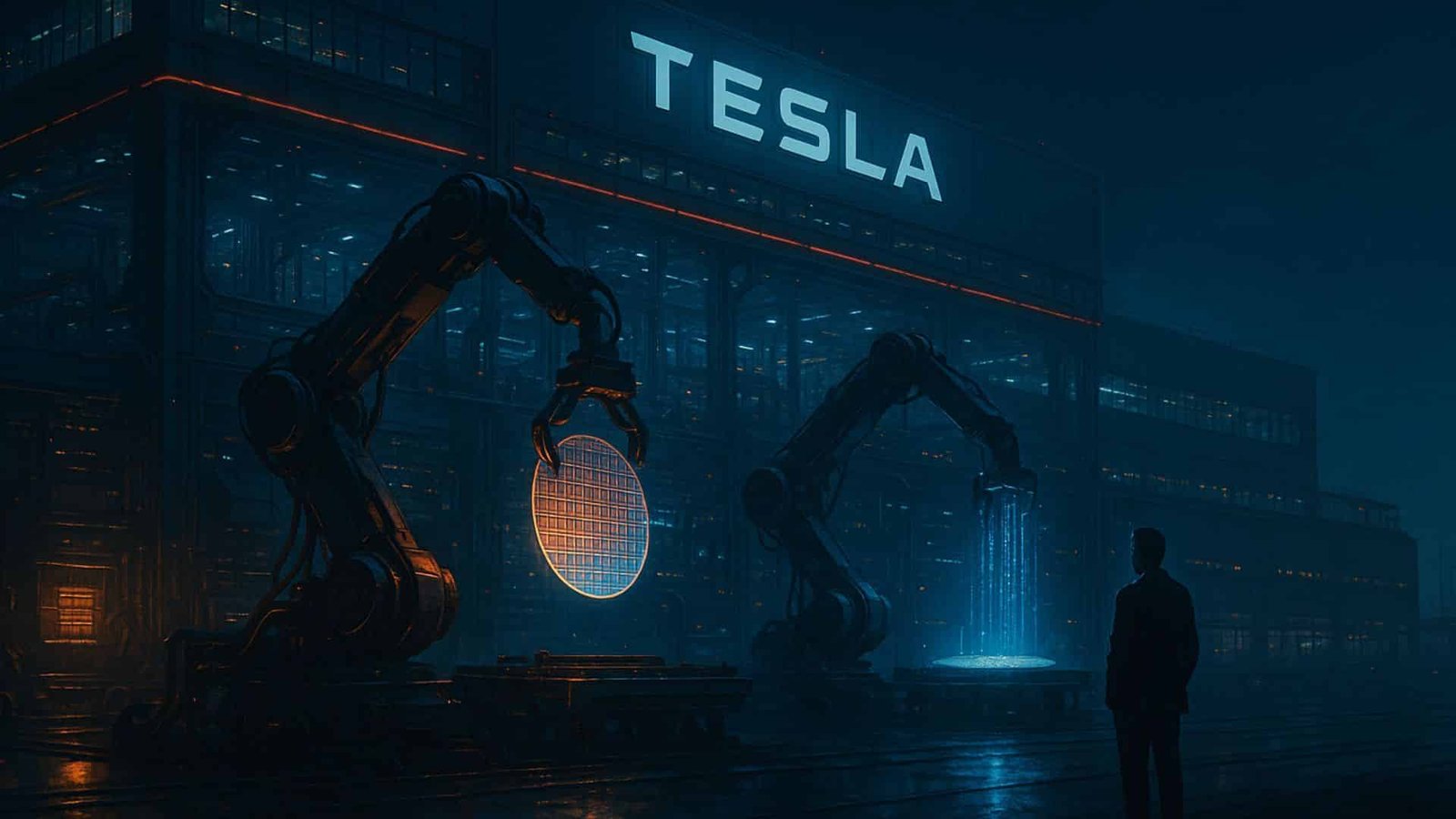
Elon Musk Plans Tesla ‘Terafab’ for AI Chips, Hints at Intel Deal to Shake Up Global Chip Industry
Key Takeaways
- Tesla goes all-in on chips: Musk plans a massive ‘Terafab’ producing over 100K wafer starts monthly to power Tesla’s self-driving, robotics, and AI systems while reducing dependence on Nvidia and TSMC.
- Intel sees a comeback chance: A potential Tesla partnership boosted Intel’s stock and could revive its foundry ambitions as it seeks a bigger role in the AI chip race.
- Vertical control is back: With its in-house AI5 and AI6 chips, Tesla is bringing manufacturing and design under one roof, echoing the old Intel-style integration.
- Global shockwaves ahead: A working Terafab could disrupt the chip hierarchy, shift supply chains toward the U.S., and leave Europe lagging in advanced manufacturing.
When Elon Musk told shareholders at Tesla’s annual meeting that the company might need to build a ‘gigantic chip fab,’ even his most die-hard fans blinked.
The man who redefined electric cars and rockets now wants to rewrite the global semiconductor playbook.
Speaking at Tesla’s annual shareholders’ meeting, Musk described his vision for Tesla’s future, transforming it into an AI and robotics powerhouse, and hinted at potential talks with Intel.
You know, maybe we’ll do something with Intel. We haven’t signed any deal, but it’s probably worth having discussions.
Tesla’s new plan could mark one of the boldest pivots in the company’s history.
If successful, it wouldn’t just change how cars are made – it could shake up the global chip-foundry business and alter the balance of power between the U.S., Asia, and Europe.
From Gigafactory to Terafab
Tesla’s battery Gigafactories were already massive by industrial standards. Now Musk wants to go bigger – ‘tera’ bigger.
His idea is to create a semiconductor manufacturing complex capable of producing more AI chips than any of his existing partners can deliver.
The motivation is simple: Tesla requires an almost unimaginable number of chips to power its growing artificial intelligence empire, from self-driving cars and humanoid robots to the AI models running on Tesla’s Dojo supercomputer.
That’s why he says Tesla may need to ‘do a terafab’, just as NVIDIA recently announced that one of the most advanced AI-chip wafers was manufactured in the US, hinting at a broader shift in who owns the infrastructure for generative AI.
Musk admitted that even with suppliers like TSMC and Samsung working at full throttle, the company won’t get enough chips for its long-term vision.
That’s why he says Tesla may need to ‘do a terafab.’
The goal? A factory capable of producing at least 100K wafer starts per month – a number that puts it in the same league as some of the world’s biggest chip plants.
For comparison, Intel’s largest fabs handle tens of thousands of wafer starts per month, while the largest complexes, such as TSMC’s Fab 18, can exceed 100K.
Musk wants something even bigger.
The AI5 and Beyond
The chip at the heart of this plan is Tesla’s fifth-generation AI processor, known as the AI5. It’s designed to power Tesla’s Full Self-Driving software and future robotics applications.
A small batch of AI5 chips is expected to roll off the line in 2026, with full-scale production targeted for 2027.
But Musk is already thinking ahead. The next generation (AI6) is expected to double performance using the same fabs, with mass production around mid-2028.
In other words, Tesla isn’t dabbling in chip design anymore. It’s preparing for a multi-year roadmap that rivals what Nvidia, AMD, and Intel do for a living.
The ambition doesn’t stop at performance. Musk claims the chip will consume roughly one-third the power of Nvidia’s top-tier Blackwell chip, and it’ll cost just 10% as much to make.
If those numbers prove real, Tesla’s chip could reset expectations for efficiency across the entire industry.
Why Musk’s Plan Could Shake the Industry
The global chip industry is dominated by a few giants, including TSMC, Samsung, and Intel. They fabricate nearly all advanced processors on the planet.
Most of the world’s top chip designers (think Apple, AMD, and NVIDIA) rely on external foundries like TSMC and Samsung to actually do the manufacturing for their processors.
If Tesla goes ahead with its terafab, it breaks that mold. It becomes both designer and manufacturer. That’s a big deal.
The last company to truly pull off that combo at scale was Intel – decades ago. Everyone else has gone fabless because running a foundry is incredibly expensive and complex.
Tesla, of course, has a habit of ignoring what’s normal.
If it succeeds, it would demonstrate that vertical integration can still be effective in a post-fabless world. It would also mean that one of the biggest consumers of AI chips no longer depends on Nvidia, TSMC, or Samsung.
For those companies, that’s a scary thought.
The Intel Twist
Intel, meanwhile, might have just been thrown a lifeline. Musk mentioned that Tesla could ‘do something’ with Intel, hinting at early-stage talks.
That single sentence sent Intel’s stock up 4% overnight – a rare bit of good news for a company that’s been losing ground to Nvidia and AMD in the AI arms race.
Intel desperately needs high-profile customers for its newest manufacturing technologies. Its foundry business has struggled to attract clients, even as it pours billions into new US fabs.
The US government recently acquired a 10% stake in Intel, aiming to bolster domestic chipmaking capacity and reduce its reliance on Asia. A Tesla partnership could validate that entire effort.
But Musk is famously unpredictable. His idea of ‘working with Intel’ could range from co-developing manufacturing processes to simply renting fab time before Tesla builds its own terafab.
Intel might be flattered today, but whether it ends up as a partner or a stepping stone remains to be seen.
The Bigger Picture: Foundry Earthquake
If Tesla actually builds its own chip fab, the shockwaves won’t be limited to the U.S. The global semiconductor ecosystem could be in for a serious realignment.
Recent US export restrictions on AIF chips have already reshaped trade flows and strategy, prompting China to accelerate domestic innovation and U.S. firms to rethink supply dependencies. Tesla’s move could amplify those disruptions, putting more pressure on Asia’s manufacturing dominance.
TSMC, which currently dominates advanced chip manufacturing, might lose one of its most forward-looking clients. Samsung could see its share of Tesla contracts shrink.
And every other company designing AI chips, from startups to major cloud players, will suddenly face a competitor that controls its entire hardware stack.
This vertical integration could set off a new industrial trend. If Tesla can do it, why not Apple, Amazon, or OpenAI?
Once one company proves that owning the fab gives a competitive edge in performance and cost, others might follow. That could slowly erode the dominance of today’s contract foundries.
What It Means for Startups and Creators
Tesla’s ambition isn’t just a corporate chess move. It could ripple across the broader tech landscape, especially for smaller players.
On one hand, a giant new fab could increase global chip supply, which might lower costs in the long term.
Power-efficient, lower-cost Tesla chips could inspire new generations of AI hardware, robotics, and creative tools that were previously too expensive to build.
But in the short term, it might tighten the market. Tesla could hoard manufacturing capacity for its own use, pushing smaller companies further down the queue at foundries.
For AI startups already struggling to get GPUs for training, that could be another roadblock, especially as companies like OpenAI push toward a $1T IPO, highlighting how scale and capital are increasingly defining who controls access to compute.
There’s also the talent question. Building a terafab means Tesla will need to poach engineers, technicians, and scientists from existing chipmakers.
That could drain expertise from other players and concentrate it under one roof – good for Tesla, but challenging for an industry already short on skilled labor.
Europe’s Chip Dreams Look Smaller Now
While the U.S. and Asia move at breakneck speed, Europe is still drafting policy papers about semiconductor independence.
The EU has ambitious goals under its Chips Act, but actual large-scale fabs have been slow to materialize.
Most European efforts are focused on mid-range nodes and specialty chips, not the cutting-edge AI processors that Tesla or Nvidia build.
If Tesla’s terafab becomes reality, it may further sideline Europe in the race for chip sovereignty. The biggest factories and most advanced nodes will sit in the U.S. and Asia once again.
Europe might find itself playing catch-up, even as it pours billions into subsidies.
The irony is that Europe’s automakers – companies like Mercedes, Volkswagen, and BMW – could end up dependent on AI chips made by an American rival. That’s a bitter pill for a region that once led in automotive innovation.
Can Tesla Actually Pull It Off?
Building a chip fab isn’t like building cars – it’s far harder, cleaner, and costlier. A single particle of dust can kill a multimillion-dollar batch, and the machines inside such a fab can cost more than an entire Gigafactory.
Musk’s terafab idea will test Tesla’s discipline more than any rocket or robot ever has.
Yet betting against him has rarely worked. Musk thrives on deadlines that sound like dares, and his obsession with vertical integration is what made SpaceX unstoppable.
If Tesla really brings this fab online by 2027, it could feed every part of its AI empire and make the company one of the most powerful chipmakers in history.
Whether Tesla succeeds or not, the message is clear: the chip world’s old guard should buckle up. Musk isn’t just entering their territory. He’s planning to terraform it.
And you know he’ll broadcast every step on X.
Anya Zhukova is an in-house tech and crypto writer at Techreport with 10 years of hands-on experience covering cybersecurity, consumer tech, digital privacy, and blockchain. She’s known for turning complex topics into clear, useful advice that regular people can actually understand and use. Her work has been featured in top-tier digital publications including MakeUseOf, Online Tech Tips, Help Desk Geek, Switching to Mac, and Make Tech Easier.
Whether she’s writing about the latest privacy tools or reviewing a new laptop, her goal is always the same: help readers feel confident and in control of the tech they use every day. Anya holds a BA in English Philology and Translation from Tula State Pedagogical University and also studied Mass Media and Journalism at Minnesota State University, Mankato. That mix of language, media, and tech has given her a unique lens to look at how technology shapes our daily lives. Over the years, she’s also taken courses and done research in data privacy, digital security, and ethical writing – skills she uses when tackling sensitive topics like PC hardware, system vulnerabilities, and crypto security. Anya worked directly with brands like Framework, Insta360, Redmagic, Inmotion, Secretlab, Kodak, and Anker, reviewing their products in real-life scenarios.
Her testing process involves real-world use cases – whether it’s stress-testing laptops for creative workloads, reviewing the battery performance of mobile gaming phones, or evaluating the long-term ergonomics of furniture designed for hybrid workspaces. In the world of crypto, Anya covers everything from beginner guides to deep dives into hardware wallets, DeFi protocols, and Web3 tools. She helps readers understand how to use multisig wallets, keep their assets safe, and choose the right platforms for their needs. Her writing often touches on financial freedom and privacy – two things she strongly believes should be in everyone’s hands.
Outside of writing, Anya contributes to editorial style guides focused on privacy and inclusivity, and she mentors newer tech writers on how to build subject matter expertise and write responsibly.
She sticks to high editorial standards, only recommends products she’s personally tested, and always aims to give readers the full picture. You can find her on LinkedIn, where she shares more about her work and projects.
Key Areas of Expertise: Consumer Tech (laptops, phones, wearables, etc.) Cybersecurity and Digital Privacy PC/PC Hardware Blockchain, Crypto Wallets, and DeFi In-Depth Product Reviews and Buying Guides Whether she’s reviewing a new wallet or benchmarking a PC build, Anya brings curiosity, care, and a strong sense of responsibility to everything she writes. Her mission? To make the digital world a little easier – and safer – for everyone.
The Tech Report editorial policy is centered on providing helpful, accurate content that offers real value to our readers. We only work with experienced writers who have specific knowledge in the topics they cover, including latest developments in technology, software, hardware, and more. Our editorial policy ensures that each topic is researched and curated by our in-house editors. We maintain rigorous journalistic standards, and every article is 100% written by real authors.
