

Erdős Problem #1026
Problem 1026 on the Erdős problem web site recently got solved through an interesting combination of existing literature, online collaboration, and AI tools. The purpose of this blog post is to try to tell the story of this collaboration, and also to supply a complete proof.
The original problem of Erdős, posed in 1975, is rather ambiguous. Erdős starts by recalling his famous theorem with Szekeres that says that given a sequence of distinct real numbers, one can find a subsequence of length which is either increasing or decreasing; and that one cannot improve the to , by considering for instance a sequence of blocks of length , with the numbers in each block decreasing, but the blocks themselves increasing. He also noted a result of Hanani that every sequence of length can be decomposed into the union of monotone sequences. He then wrote “As far as I know the following question is not yet settled. Let be a sequence of distinct numbers, determine
where the maximum is to be taken over all monotonic sequences “.
This problem was added to the Erdős problem site on September 12, 2025, with a note that the problem was rather ambiguous. For any fixed , this is an explicit piecewise linear function of the variables that could be computed by a simple brute force algorithm, but Erdős was presumably seeking optimal bounds for this quantity under some natural constraint on the . The day the problem was posted, Desmond Weisenberg proposed studying the quantity , defined as the largest constant such that
for all choices of (distinct) real numbers . Desmond noted that for this formulation one could assume without loss of generality that the were positive, since deleting negative or vanishing does not decrease the left-hand side and does not increase the right-hand side. By a limiting argument one could also allow collisions between the , so long as one interpreted monotonicity in the weak sense.
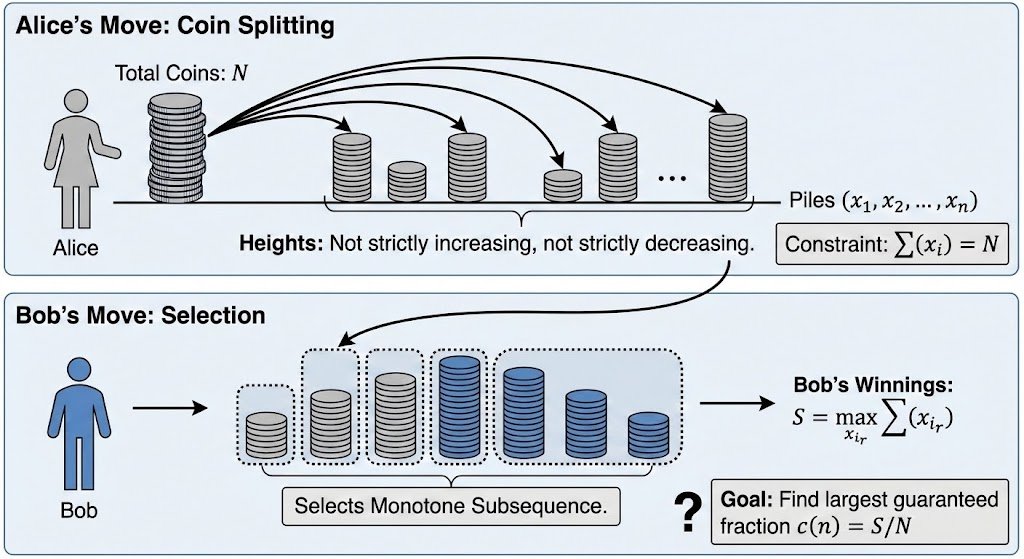
Though not stated on the web site, one can formulate this problem in game theoretic terms. Suppose that Alice has a stack of coins for some large . She divides the coins into piles of consisting of coins each, so that . She then passes the piles to Bob, who is allowed to select a monotone subsequence of the piles (in the weak sense) and keep all the coins in those piles. What is the largest fraction of the coins that Bob can guarantee to keep, regardless of how Alice divides up the coins? (One can work with either a discrete version of this problem where the are integers, or a continuous one where the coins can be split fractionally, but in the limit the problems can easily be seen to be equivalent.)
AI-generated images continue to be problematic for a number of reasons, but here is one such image that somewhat manages at least to convey the idea of the game:
For small , one can work out by hand. For , clearly : Alice has to put all the coins into one pile, which Bob simply takes. Similarly : regardless of how Alice divides the coins into two piles, the piles will either be increasing or decreasing, so in either case Bob can take both. The first interesting case is . Bob can again always take the two largest piles, guaranteeing himself of the coins. On the other hand, if Alice almost divides the coins evenly, for instance into piles for some small 0}”>, then Bob cannot take all three piles as they are non-monotone, and so can only take two of them, allowing Alice to limit the payout fraction to be arbitrarily close to . So we conclude that .
An hour after Desmond’s comment, Stijn Cambie noted (though not in the language I used above) that a similar construction to the one above, in which Alice divides the coins into pairs that are almost even, in such a way that the longest monotone sequence is of length , gives the upper bound . It is also easy to see that is a non-increasing function of , so this gives a general bound . Less than an hour after that, Wouter van Doorn noted that the Hanani result mentioned above gives the lower bound , and posed the problem of determining the asymptotic limit of as , given that this was now known to range between and . This version was accepted by Thomas Bloom, the moderator of the Erdős problem site, as a valid interpretation of the original problem.
The next day, Stijn computed the first few values of exactly:
While the general pattern was not yet clear, this was enough data for Stijn to conjecture that , which would also imply that as . (EDIT: as later located by an AI deep research tool, this conjecture was also made in Section 12 of this 1980 article of Steele.) Stijn also described the extremizing sequences for this range of , but did not continue the calculation further (a naive computation would take runtime exponential in , due to the large number of possible subsequences to consider).
The problem then lay dormant for almost two months, until December 7, 2025, in which Boris Alexeev, as part of a systematic sweep of the Erdős problems using the AI tool Aristotle, was able to get this tool to autonomously solve this conjecture in the proof assistant language Lean. The proof converted the problem to a rectangle-packing problem.
This was one further addition to a recent sequence of examples where an Erdős problem had been automatically solved in one fashion or another by an AI tool. Like the previous cases, the proof turned out to not be particularly novel. Within an hour, Koishi Chan gave an alternate proof deriving the required bound from the original Erdős-Szekeres theorem by a standard “blow-up” argument which we can give here in the Alice-Bob formulation. Take a large , and replace each pile of coins with new piles, each of size , chosen so that the longest monotone subsequence in this collection is . Among all the new piles, the longest monotone subsequence has length . Applying Erdős-Szekeres, one concludes the bound
and on canceling the ‘s, sending , and applying Cauchy-Schwarz, one obtains (in fact the argument gives for all ).
Once this proof was found, it was natural to try to see if it had already appeared in the literature. AI deep research tools have successfully located such prior literature in the past, but in this case they did not succeed, and a more “old-fashioned” Google Scholar job turned up some relevant references: a 2016 paper by Tidor, Wang and Yang contained this precise result, citing an earlier paper of Wagner as inspiration for applying “blowup” to the Erdős-Szekeres theorem.
But the story does not end there! Upon reading the above story the next day, I realized that the problem of estimating was a suitable task for AlphaEvolve, which I have used recently as mentioned in this previous post. Specifically, one could task to obtain upper bounds on by directing it to produce real numbers (or integers) summing up to a fixed sum (I chose ) with a small a value of as possible. After an hour of run time, AlphaEvolve produced the following upper bounds on for , with some intriguingly structured potential extremizing solutions:
The numerical scores (divided by ) were pretty obviously trying to approximate simple rational numbers. There were a variety of ways (including modern AI) to extract the actual rational numbers they were close to, but I searched for a dedicated tool and found this useful little web page of John Cook that did the job:
I could not immediately see the pattern here, but after some trial and error in which I tried to align numerators and denominators, I eventually organized this sequence into a more suggestive form:
This gave a somewhat complicated but predictable conjecture for the values of the sequence . On posting this, Boris found a clean formulation of the conjecture, namely that
whenever and . After a bit of effort, he also produced an explicit upper bound construction:
Proposition 1 If and , then .
Proof: Consider a sequence of numbers clustered around the “red number” and “blue number” , consisting of blocks of “blue” numbers, followed by blocks of “red” numbers, and then further blocks of “blue” numbers. When , one should take all blocks to be slightly decreasing within each block, but the blue blocks should be are increasing between each other, and the red blocks should also be increasing between each other. When , all of these orderings should be reversed. The total number of elements is indeed
and the total sum is close to
With this setup, one can check that any monotone sequence consists either of at most red elements and at most blue elements, or no red elements and at most blue elements, in either case giving a monotone sum that is bounded by either
or
giving the claim.
Here is a figure illustrating the above construction in the case (obtained after starting with a ChatGPT-provided file and then manually fixing a number of placement issues):
Here is a plot of (produced by ChatGPT Pro), showing that it is basically a piecewise linear approximation to the square root function:
Shortly afterwards, Lawrence Wu clarified the connection between this problem and a square packing problem, which was also due to Erdős (Problem 106). Let be the least number such that, whenever one packs squares of sidelength into a square of sidelength , with all sides parallel to the coordinate axes, one has
Proposition 2 For any , one has
Proof: Given and , let be the maximal sum over all increasing subsequences ending in , and be the maximal sum over all decreasing subsequences ending in . For , we have either (if ) or (if ). In particular, the squares and are disjoint. These squares pack into the square , so by definition of , we have
and the claim follows.
This idea of using packing to prove Erdős-Szekeres type results goes back to a 1959 paper of Seidenberg, although it was a discrete rectangle-packing argument that was not phrased in such an elegantly geometric form. It is possible that Aristotle was “aware” of the Seidenberg argument via its training data, as it had incorporated a version of this argument in its proof.
Here is an illustration of the above argument using the AlphaEvolve-provided example
for to convert it to a square packing (image produced by ChatGPT Pro):
At this point, Lawrence performed another AI deep research search, this time successfully locating a paper from just last year by Baek, Koizumi, and Ueoro, where they show that
which, when combined with a previous argument of Praton, implies
This proves the conjecture!
There just remained the issue of putting everything together. I did feed all of the above information into a large language model, which was able to produce a coherent proof of (1) assuming the results of Baek-Koizumi-Ueoro and Praton. Of course, LLM outputs are prone to hallucination, so it would be preferable to formalize that argument in Lean, but this looks quite doable with current tools, and I expect this to be accomplished shortly. But I was also able to reproduce the arguments of Baek-Koizumi-Ueoro and Praton, which I include below for completeness.
Proof: (Proof of Theorem 3, adapted from Baek-Koizumi-Ueoro) We can normalize . It then suffices to show that if we pack the length torus by axis-parallel squares of sidelength , then
Pick . Then we have a grid
inside the torus. The square, when restricted to this grid, becomes a discrete rectangle for some finite sets with
By the packing condition, we have
From (2) we have
hence
Inserting this bound and rearranging, we conclude that
Taking the supremum over we conclude that
so by the pigeonhole principle one of the summands is at most . Let’s say it is the former, thus
In particular, the average value of is at most . But this can be computed to be , giving the claim. Similarly if it is the other sum.
UPDATE: Actually, the above argument also proves Theorem 4 with only minor modifications. Nevertheless, we give the original derivation of Theorem 4 using the embedding argument of Praton below for sake of completeness.
Proof: (Proof of Theorem 4, adapted from Praton) We write with . We can rescale so that the square one is packing into is . Thus, we pack squares of sidelength into , and our task is to show that
We pick a large natural number (in particular, larger than ), and consider the three nested squares
We can pack by unit squares. We can similarly pack
into squares of sidelength . All in all, this produces
squares, of total length
Applying Theorem 3, we conclude that
The right-hand side is
and the left-hand side similarly evaluates to
and so we simplify to
Sending , we obtain the claim.
One striking feature of this story for me is how important it was to have a diverse set of people, literature, and tools to attack this problem. To be able to state and prove the precise formula for required multiple observations, including some version of the following:
- The sequence can be numerically computed as a sequence of rational numbers.
- When appropriately normalized and arranged, visible patterns in this sequence appear that allow one to conjecture the form of the sequence.
- This problem is a weighted version of the Erdős-Szekeres theorem.
- Among the many proofs of the Erdős-Szekeres theorem is the proof of Seidenberg in 1959, which can be interpreted as a discrete rectangle packing argument.
- This problem can be reinterpreted as a continuous square packing problem, and in fact is closely related to (a generalized axis-parallel form of) Erdős problem 106, which concerns such packings.
- The axis-parallel form of Erdős problem 106 was recently solved by Baek-Koizumi-Ueoro.
- The paper of Praton shows that Erdős Problem 106 implies the generalized version needed for this problem. This implication specializes to the axis-parallel case.
It was only through the combined efforts of all the contributors and their tools that all these key inputs were able to be assembled within 48 hours. It seems plausible that a more traditional effort involving just one or two mathematicians and simpler programming and literature search tools may eventually have been able to put all these pieces together, but I believe this process would have taken much longer (on the order of weeks or even months).
Another key ingredient was the balanced AI policy on the Erdős problem website, which encourages disclosed AI usage while strongly discouraging undisclosed use. To quote from that policy: “Comments prepared with the assistance of AI are permitted, provided (a) this is disclosed, (b) the contents (including mathematics, code, numerical data, and the existence of relevant sources) have been carefully checked and verified by the user themselves without the assistance of AI, and (c) the comment is not unreasonably long.”
