

Everything You Need to Know About Fiber Internet (but Were Too Afraid to Ask)
You’ve probably heard about fiber internet by now; it’s often touted as the “gold standard” of broadband by policymakers, experts and internet users alike. Plus, the Fiber Broadband Association estimates that a little over 76 million homes have made the switch to a fiber internet connection, representing a growth of 13% in the past year.
If you’ve ever struggled with slow speeds or outages while using cable, 5G, satellite or (God forbid) DSL internet, you’ve probably considered switching internet providers for a faster, more cost-efficient setup. So, should you jump on the bandwagon and make the switch to fiber?
The answer is complicated and depends primarily on what internet providers you can get at your address. Of all the ways to get online, a fiber internet connection is the fastest, by far, and has significantly raised the bar for other internet connection types in terms of speed and reliability. But speeds alone won’t automatically make fiber the best option for every household. While fiber may be the fastest internet connection type, it’s one of the least available nationwide, and it’s rarely deployed in rural or hard-to-reach areas.
Plus, according to the latest data from OpenVault, most households don’t exceed an average of 569 megabits per second in download speeds. So, while you could be due for a speed tier update, especially if you have remote workers or gamers in the house, you may not need the 1,000Mbps speeds heavily promoted by some fiber providers. Other considerations like prices, availability and fees will ultimately determine fiber’s efficiency for your home internet needs and budget.
Still, fiber internet is marvelous. A fiber-optic internet connection relies on the speed of light to transmit data, making it incredibly efficient and able to deliver symmetrical download and upload speeds — a luxury other internet connection types have yet to offer.
We’re still getting acquainted with all the possibilities of the technology, but it’s already had a tremendous impact on the way we communicate and use the internet.
Fiber internet is a connection that you’ll find CNET recommending again and again, provided it’s available to you at a competitive price. Let’s explore what makes this internet connection such a reliable method of getting online.
What is fiber internet exactly?
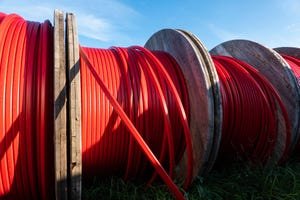
Fiber internet gets its name from the delicate fiber cables it relies on to get you online. The cables are made up of thin, long strands of glass or plastic, encased in layers of cladding and coating, that transmit data through light signals across hundreds of miles.
Technically, the speed of light used to transmit this data is reduced by around 30% because of the refraction that occurs within the cables, but the speeds are still very, very fast. All that may seem baffling — and it was to me, too, when I first learned about fiber internet — but fiber cables have long been used to get us online.
In fact, you’re reading this right now because of the lightning-fast fiber cables under the ocean, powering your home internet connection — whether it’s fiber or not.
What does all that mean for you? The speeds at which fiber-optic cables can relay data means you can get symmetrical download and upload speeds on any speed tier, even up to a 50-gigabit (or 50,000Mbps) plan. Compared with the upload speeds of most cable internet providers, which usually range between 20 to 50Mbps, that’s a vast improvement.
Additionally, fiber-optic cables are less susceptible to interference than coaxial cables or fixed wireless technology. That means your latency will likely be much lower with a fiber internet connection.
You should also know that fiber cables are very expensive, as is the installation process for a fiber network. Laying down fiber-optic cables requires extensive planning and funding. That means it may be difficult for some providers to extend a fiber network to your neighborhood, especially if you’re in a rural.
How does fiber internet get installed?
Because fiber internet requires an existing infrastructure or fiber network to work, the speeds you get depend on which fiber internet provider has already been active in your area. Occasionally, fiber providers will share each other’s networks to mitigate costs.
There are a few different ways an internet provider will connect a fiber network to your home, depending on the existing infrastructure. Note that the only true fiber internet connection is a direct one or a fiber-to-the-home (FTTH) connection.
- Fiber to the home: Fiber-optic cables run directly from the network to your house. This is the fastest option.
- Fiber to the curb: If your household can’t be wired for fiber directly, the fiber cables connect with a coaxial cable from a utility pole or cabinet, which will inevitably slow the connection down but is still plenty fast.
- Fiber to the neighborhood: This fiber internet connection, also known as fiber to the node, runs from a connection hub or node utility pole. Your house is then connected to the network through coaxial cables, meaning it travels the furthest of the three options and is the slowest connection type of the three.
Despite which fiber connection may be available to you, fiber internet is installed using a small utility box or an optical network terminal, or ONT, that a technician installs either inside or outside your home. The ONT is wired to the fiber network and converts light signals into electric signals, giving you the fastest internet connection on the block.
Most big fiber internet providers waive your installation fee, as is the case with AT&T Fiber, Quantum Fiber, Ziply Fiber, Kinetic and Verizon Fios if you opt for the 1Gbps plan.
Is fiber internet the best internet connection?
There’s plenty to consider before calling fiber “the best” internet connection type. Let’s discuss availability, pricing and customer satisfaction to see how fiber internet measures up.
How available is fiber internet?
Fiber is definitely the fastest, but it’s also the most limited internet connection type in terms of availability.
According to the most recent data from the US Federal Communications Commission, less than half the population is wired for a fiber internet connection. Compared with cable internet availability, which covers 82% of the population, fiber deployment has some catching up to do.
The FCC’s broadband map shows the availability of a fiber internet connection nationwide, with speeds at least 100Mbps down and 20Mbps up.
FCCDo fiber internet providers offer competitive pricing?
The costs of fiber internet also determine whether it’s a good option for your home. There’s no doubt that fiber internet has higher starting prices than cable, with many starting prices averaging around $50 per month. There are a few cheap fiber internet providers, like Frontier Fiber and Ziply Fiber, with service starting at $30 for 200Mbps and $20 for 100Mbps a month, respectively.
If you look at the cost per Mbps, fiber is often the most cost-efficient internet connection type despite the higher average price tags. Also, prices don’t typically increase year after year as they do with some cable providers.
For example, Spectrum and AT&T Fiber offer 1,000Mbps for $70 and $80 a month, respectively. In this case, Spectrum offers a better deal, at least in terms of introductory pricing. After yearly price increases with Spectrum, however, that $70 will jump to around $100 monthly in a year or two, averaging 10 cents per Mbps. AT&T Fiber won’t do that. Your price will stay at $80 a month or a cost per Mbps of 8 cents. Also note that AT&T Fiber offers 1,000Mbps in upload speeds (compared with Spectrum’s 35Mbps upload speeds for that tier), lower latency and more overall reliability.
Google Fiber, a more expensive fiber provider, starts at $70 a month for 1,000Mbps and only goes up from there; but the cost per Mbps reveals you’re getting pretty good value for the offered speeds. Paying $125 a month for 5,000Mbps may seem like a lot, but that price comes down to around 3 cents per Mbps.
Again, consider first how much internet speed you actually need, so you can make the best use of your money. Not all of us require 5,000Mbps, but for those who work at home, are avid gamers and have multiple busy internet users in the house, a multigig internet connection may be the way to go.
Data from the latest ACSI survey shows that the average satisfaction rating is higher for fiber internet service providers than the average for internet service as a whole.
ACSIHow does customer satisfaction compare to other internet types?
Customer satisfaction is one of the metrics we use to rate and review internet providers. The bottom line is that even if an ISP hypothetically offers a great service, if customers are repeatedly dissatisfied with it, it’s probably not worth it to stick with that ISP if you have other options.
That said, fiber internet has the best customer service track record compared with other internet service types, though 5G internet providers have started getting much more positive reviews.
Data from J.D. Power, a customer satisfaction surveyor we often rely on, notes that customers were happier with wireless internet overall during 2023, although the survey did not separate the fixed wireless offerings from the fiber offerings from one provider. For instance, Verizon offers 5G home internet as well as fiber through Verizon Fios, but there are no separate categories in the data. Not separating internet connection types skews the data slightly, but either way, fiber internet providers like AT&T, Frontier Fiber, Verizon and Google Fiber scored at the top of all regional surveys.
The American Customer Satisfaction Index also points to positive trends for fiber internet providers in the past few years. AT&T Fiber scored at the top of the ACSI’s 2024 satisfaction benchmark with a score of 80, while the lowest score came from Optimum Fiber at 66. For context, the scores for nonfiber internet providers (DSL, fixed wireless and cable) ranged from a low of 56 to a high of 76, held by T-Mobile Home Internet.
What internet providers offer fiber?
There are upwards of 1,400 fiber internet providers in the country, according to the latest report from the FCC. Most of those providers are local. Only around seven providers serve more than 1% to 2% of the population, with Verizon Fios and AT&T Fiber covering the most ground with 9% and 12% coverage, respectively.
- Altafiber
- AT&T Fiber
- Brightspeed
- Frontier Fiber
- GoNetSpeed
- Google Fiber
- Kinetic by Windstream
- Metronet
- Optimum
- Point Broadband
- Quantum Fiber
- Verizon Fios
- Ziply Fiber
Bottom line: Is fiber internet worth it?
The answer to this question will depend on several factors, but perhaps most important is whether fiber is available in your area. In my opinion, if you can get fiber, it’s absolutely worth it and it’s a necessary step toward future-proofing your home.
You may not need multi-gigabit tiers for over $100 a month, but even the lower tiers of 300Mbps download/300Mbps upload outpace the speeds offered by cable, fixed wireless providers and especially DSL. Plus, fiber usually features unlimited data as well as no contracts, monthly equipment fees or installation costs, although this varies by provider.
Despite its reliability and appeal, fiber internet isn’t the only solution to our broadband needs. Working out the expansion of fiber networks and improving the affordability of multi-gig tiers are essential to making fiber internet more accessible. While we wait for those improvements, you’d be hard-pressed to find an internet connection that’s as lightning-fast as the speeds you get from fiber.
What is fiber internet FAQs
How fast is fiber internet?
The fastest known residential internet connection (at the moment) is Ziply Fiber’s 50,000Mbps tier, which raises the bar for all internet providers. Some fiber providers, like Google Fiber, start at 1,000Mbps and max out around 8,000Mbps or 10,000Mbps. Others have lower starting speeds, like Frontier Fiber or Verizon Fios, which start at 200Mbps and 300Mbps, respectively.
Is fiber internet expensive?
It definitely can be, depending on your internet provider and how fast you want your internet to be. Some of the cheapest fiber providers have plans starting at $20 a month for 100Mbps (Ziply Fiber) or $30 a month for 200Mbps (Frontier Fiber), but most starting prices average around $50.
What’s the difference between fiber internet and “fiber-rich” internet?
Cable providers often use the term “fiber-rich” to describe their services, but that doesn’t mean you’ll get true fiber internet. It usually means fiber-optic cables are somewhere along the network but not fiber to your home. You can usually tell if an internet provider offers true fiber service by the download and upload speeds. If they’re symmetrical, it should be fiber.
Where can I get fiber internet?
If you live in or near a big city, your chances of getting fiber internet are much higher. You can plug your address into the availability checkers on most provider websites or use data from the FCC to determine if your address is eligible for fiber.
