

Ferrari’s New Jony Ive–Designed EV Is Swathed in Glass and Aluminum
Despite Ferrari dramatically scaling back its EV plans at the end of 2025, it’s no exaggeration to say that the reveal of the Italian automaker’s first full electric car is going to be the automotive event of 2026.
While the exterior is still under wraps, Ferrari has unveiled the interior of its upcoming electric vehicle designed by LoveFrom, the creative firm of Apple’s former chief designer, Jony Ive. It may not turn out quite like the Project Titan car Apple worked on for a decade then killed in 2024, but it sure does look like it has similar DNA.
“We are entering a new era in Ferrari,” the company’s CEO Benedetto Vigna said at the unveiling, which took place last week at San Francisco’s pyramid-shaped Transamerica building. Vigna also revealed that Ferrari has changed the EV’s name. It is now officially called the Ferrari Luce—the Italian word for “light,” pronounced loo-chay.
“This is a project that will enlighten our future, our road ahead,” Vigna said.
The car previously had the nickname of Elettrica, and the change is apparently an effort to downplay the electrified elements in favor of focusing on more Ferrari-esque features. “There are many other things that are at the core of Ferrari Luce,” Vigna said. “Elettrica would have been a wrong name for our car.”
Auto Parts
This interior uncloaking is the second of a three-part reveal process of the Luce. Ferrari shared details about its EV powertrain in October. Ferrari says a full disclosure of the exterior will come in May, but this latest showing was the first look at what Ive and his team at LoveFrom have created for those who sit inside the Luce.
At the event, Ive immediately contrasted the experience of designing the Luce with the 27 years he spent at Apple before leaving in 2019.
“Cars are very complicated,” Ive said. “But I hope that it will be obvious and clear the amount of care that has gone into every little piece.”
Utilizing an office space on an upper floor of the Transamerica pyramid, Ferrari and LoveFrom showed off several of the internal components that will be in the Luce. The team is certainly not ready to show us everything. We didn’t see a stereo system, a glovebox, or even floor mats. We saw a front seat (which we weren’t allowed to sit in) but not a back seat. We did get assurances from a Ferrari rep that the Luce would indeed have cup holders. Cup holders, after all, are mighty important.
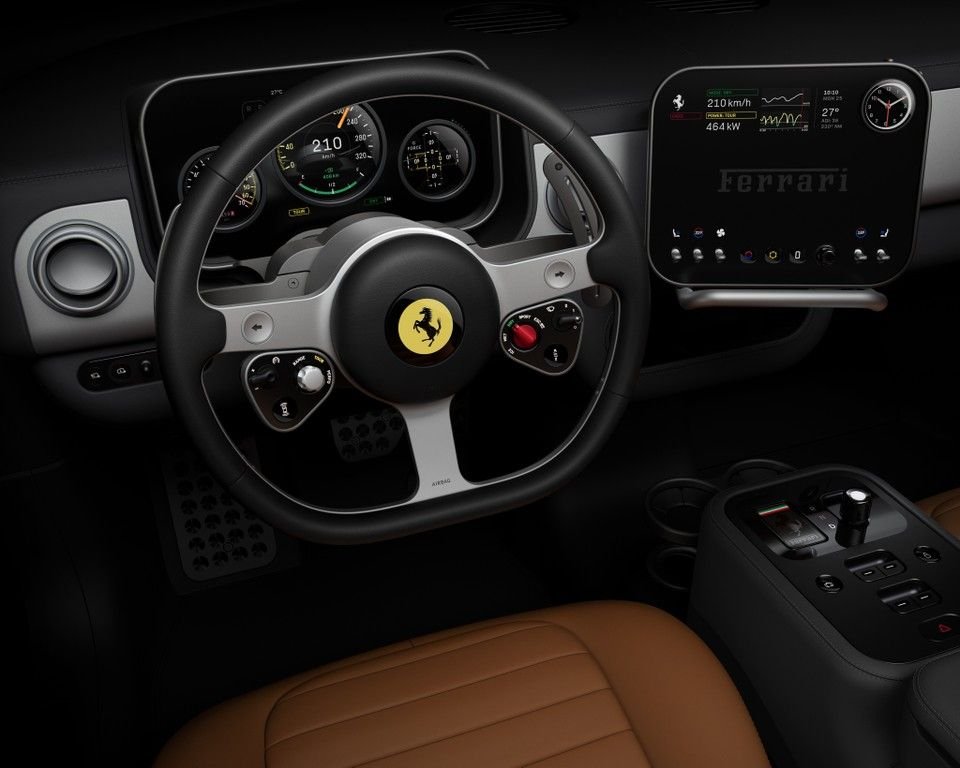
We did get to see and touch the key elements of the cockpit: the steering wheel, the binnacle behind it with speed and odometer dials, a center-dash mounted display, and a center console with a glass gear shifter.
The Luce’s steering wheel and binnacle.
Courtesy of Ferrari
The car comes to life when the key fob clicks into the console.
Courtesy of Ferrari
Oddly, none of these pieces were arranged inside an actual vehicle interior but were instead disembodied, separated, and spread out across one big room so people could wander through. One seat over here. A disassembled vent system by the far wall. It was the luxury car equivalent of a Marcel Duchamp exhibition, but instead of a urinal or galvanized-iron snow shovel (which, incidentally, went for $3 million last year), there was a steering wheel.
“Part of my grumpy belligerence now is I’m done working with assholes,” Ive said in his introduction. The line drew a laugh from the audience around him. “I’m so happy that we can just place creative excellence right at the center of what we’re doing.”
Ive may wax self-deprecatingly about his salty nature, but when he started explaining the details of all the machined aluminum buttons he had ordered and approved over the course of five years, he was positively chipper. As we wandered through the exhibit, Ive happily responded to WIRED’s questions on how things were working with Ferrari.
“It’s an important brand,” Ive said. “I like the fact that they weren’t lazy, like some other companies I know who just roll around in their success printing money.”
Not Far From the Apple Tree
The center console.
Courtesy of Ferrari
If you’re hip to Ive’s style, the Luce’s aesthetics will look familiar. Everything is presented in glass and brushed aluminum. Rounded corners are enforced with ruthless efficiency. The occasional small glass knob on the edge of screens evokes the Apple Watch’s crown. The central control panel looks very much like an iPad. Even the sizzle-reel video Ferrari used to unveil the interior was edited like the booming product videos shown at iPhone launches or WWDC.
Ive says that the emphasis on physical buttons, each with a singular purpose, is to let the driver keep their eyes on the road and off the screen. “When you look at this, you are not wondering, ‘How many layers deep am I going to have to go to find something to make my bottom warm?’” he said.
“You don’t touch anything but aluminum, glass, or leather,” multiple Ferrari employees said multiple times over the event. (The only bits of plastic they owned up to were a couple of gears in the control panel.)
The result is a truly tactile experience. Everything feels satisfyingly clicky or twisty. The aluminum buttons have, unsurprisingly, an incredible feel. The glass knobs were similarly smooth. We were particularly taken with the air vents, which have aluminum shields that flip around when you twist them open and closed. We fiddled with these over and over until the Ferrari people had to come tell us it was time to leave the room.
Familiar Friends
Ferrari’s glass partner is Corning, the company whose Gorilla Glass has been used on every iPhone model. Corning says there are more than 40 glass parts in the Luce, including buttons, screens, and even the casing of the center console and gear-shift knob.
Ive calls glass a “truthful material.” Compared to a more standard plastic option, glass certainly feels more premium as a knob or gear shifter. But will it shatter in an instant if you get in a wreck? Hopefully not, as Corning says its technicians have done countless crash tests to make sure this version of Gorilla Glass is safe enough.
The steering wheel has the signature three-spoke design Ferrari is famous for. It is almost a circle but has a squished bottom that gives the wheel a shape that evokes a dumpling (or a flat tire). The wheel has a leather grip all the way around, of course, but clicky aluminum buttons right by your fingers let you signal or change music tracks and volume.
Behind the steering wheel is the binnacle, the console where the odometer, speedometer, and other indicators are placed. Taken by itself, the screen looks like a large iPhone in landscape mode with three Apple Watches positioned in the center. Convex lenses with a parallax effect magnify the circular OLED screens supplied by Samsung, which Ferrari has partnered with for the display tech. Additional icons appear in the top-right corner to indicate things like road conditions.
Though the binnacle is dominated by screens, very select bits are entirely analog. Namely, the needles of the speedometer and odometer, which are made of aluminum and polycarbonates. When the car is off, the dials’ screens go dark and the needles seem to float in a black void. When the screens come on, they light up the needles as well, making them glow.
Taking Control
Tactile buttons line the bottom of the display, and an aluminum bar serves as a palm rest as well as a handle to reposition the screen.
Courtesy of Ferrari
The dials have digital screens behind analog needles.
Courtesy of Ferrari
To the right of the wheel sits a control panel display, a rectangular screen with smooth curved edges and almost no bezel. In other words, iPad shaped. However, the screen is mounted on a ball-and-socket joint and so can be moved around in a manner that brings to mind another relic of Ive’s tenure in Cupertino, the iMac G4.
This screen again is a Samsung OLED, this time a touchscreen. The panel tells you lots of information unique to EVs, such as battery life and which wheels are using the most power.
The idea of the panel being movable is so that the person riding shotgun, instead of the driver, can control the stuff onscreen. Ive pointed out that when the screen is in its neutral position, the driver can rest their palm on the aluminum handle for easier access to the tactile switches and buttons without needing to look directly at the panel.
In the top-right corner of this panel is a cutout for a clock. The background of this clock is digital, so it can be changed to become a stopwatch or compass. The analog hands then move depending on which setting you choose.
Fab Fob
Yes, the Luce’s key fob looks like a miniature iPhone. It has a glass back, with a Ferrari logo surrounded by yellow E Ink. That digital ink comes into play when you turn the car on.
To demonstrate, Ive fitted the fob into a slot on the center console, where it snapped in magnetically. When Ive pushed it down, the yellow E Ink on the fob dimmed, and the glass knob of the gear shifter beside it lit up with a yellow gleam. The Ferrari logo blinks on, and the dials on the dash spring to attention. It was as if that signature yellow pigment was a serum being injected into the car’s body, awakening it from slumber.
“You have this sense that it is really bringing life to the rest of the system,” Ive said.
Corning says the shifter knob has had 13,000 holes, each half the width of a human hair, laser-blasted throughout the glass so that the light can properly diffuse through it for just this purpose.
The Titan Returns
The front seat. (There is also a back seat, which we didn’t see.)
Courtesy of Ferrari
After the main event, our scrum of journalists walked a couple of blocks from the Transamerica building to LoveFrom’s headquarters. LoveFrom cofounder Marc Newson and some Ferrari reps were there, but most of the questions over the half hour that followed were directed at Ive. He rumbled out classic Ive-isms in his gentle baritone, such as, “If you can’t use something, it’s ugly” and “I love learning more than I love being right.”
However, this focus on Ive—plus the multiple echoes to Apple products past and present within the Luce—led to a nagging realization that perhaps this first EV from Ferrari is the closest we will ever get to seeing what the Cupertino company might have produced had its Project Titan ever made it out into the wild.
Ferrari knew exactly what it was buying by bringing in Ive and his team, and he has delivered. The goal of LoveFrom’s efforts with the car company is to leave users with a tactile, visceral feeling that they are interacting with something real. Yet this also feels strangely incongruous coming from the man who helped build an empire off the back of beautiful slabs of glass on which everyone now spends all day doomscrolling. (The man is also, of course, designing OpenAI’s upcoming physical hardware project that will provide an interface for its chatbot.)
To his credit, Ive seemed to recognize this incongruity and even gestured at some sort of want for atonement for the societal impact of the (very good) designs of his past.
“We’ve become more and more isolated in our digital worlds,” Ive said. “There is a growing desire to not be isolated, disconnected, whether it’s from each other or the real physical world.”
“Every bone in my body tells me some of the things that we’ve learned, some of the things that I think we’ve discovered, I’m hoping will have a much broader relevance and implication of value to a broader set of products,” Ive said.
Maybe, someday, connecting with reality will be more easily attainable for everyone and not just those lucky enough to sit inside a Ferrari EV.
