

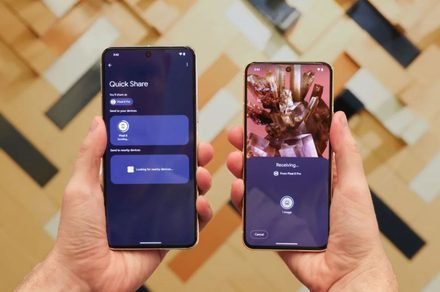
Google is bringing AirDrop support to Pixel 9 series phones
Sharing files with your iPhone friends just got easier
Google
Last year, Google first enabled AirDrop compatibility on Pixel 10 devices, a change that finally let Android phones share files with iPhones using Apple’s own system. Now, Google is expanding its Quick Share feature, and Pixel 9 phones are next in line.
Google shared the news on X, confirming that the Pixel 9, Pixel 9 Pro, Pixel 9 Pro XL, and Pixel 9 Pro Fold now support Apple’s AirDrop.
Exciting News🎉 Starting today, we are bringing Quick Share compatibility with AirDrop to the Google Pixel 9, 9 Pro and 9 Pro Fold! The feature will roll out over the next few days. https://t.co/MzJkpG4NIV
— Made by Google (@madebygoogle) February 17, 2026
However, the company hasn’t explained why the Pixel 9a is excluded from this wave of compatibility. The feature will roll out over the coming weeks in phases.
How to set up Quick Share with AirDrop on Pixel phones
To enable the feature on a Pixel 9 series phone, follow these steps: Settings > System > Software updates > install the latest Google Play System update.
Make sure the Quick Share extension is also updated by opening Settings > All services > System services > Quick Share extension and installing the available update.
To receive files from a Pixel, Apple device owners need to set their AirDrop visibility to “Everyone for 10 Minutes,” allowing the connection to establish.
Google’s promise on privacy and performance
Google says the update allows Pixel 9 users to easily share high-resolution files with iPhones, iPads, and macOS devices. This makes it easier for friends using Apple products to exchange content over Bluetooth.
Google also says that privacy and speed remain priorities, adding that the system uses multiple layers of protection to keep shared files secure. The feature uses a direct, peer-to-peer connection, so files are not sent through servers, logged, or shared beyond the transfer itself.
For Pixel 9 users, it’s a small update that finally removes a big everyday annoyance when sharing files with iPhone friends.
Manisha likes to cover technology that is a part of everyday life, from smartphones & apps to gaming & streaming…
You can now use Gemini without leaving your apps, thanks to split-screen multitasking
Google’s Gemini expands into split-screen multitasking, blending AI with phone apps
Google is rolling out a major update to its Gemini AI platform that changes how mobile users interact with artificial intelligence on Android devices. With its latest enhancement, Gemini can now operate in split-screen mode alongside other apps, allowing the AI assistant to work in context with what’s on your phone screen – without forcing you to switch between apps.
Bringing AI into your workflow
Samsung just might serve a bad price surprise for the Galaxy 26 series
With enterprise memory demand squeezing supply and Apple holding steady on Pro pricing, Samsung may struggle to avoid increasing Galaxy S26 prices at announcement time.
Ahead of the first Galaxy Unpacked event of the year, Samsung’s mobile division is struggling to finalise the pricing for the Galaxy S26. We’ve read plenty of reports about the pricing, but this one sounds, well, more realistic.
The Korean smartphone maker is grappling with two main issues here. First, memory makers are focusing on enterprise-grade memory that requires high-bandwidth chips, which usually pay better than consumer-grade chips.
Google is planning an iPhone-like face unlock system for Pixel phones and Chromebooks
From hybrid NIR sensors to under-display infrared emitters, Google may be preparing a major biometric upgrade for the Pixel 11 and next-generation Chromebooks.
Folks over at Android Authority have learned about Google’s “Project Toscana,” which seesms to be a codeword or internal name for facial recognition technology. What’s interesting is that the company is working to integrate the technology on both Pixel phones and Chromebooks.
The publication’s source has used the advanced facial recognition technology on a Pixel phone with only a single punch-hole camera on the front, and two Chromebooks (with the help of external cameras), under varied lighting conditions.
