

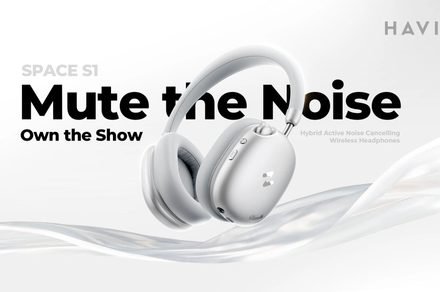
HAVIT Space S1 wireless headphones bring adaptive ANC and natural spatial audio
Digital Trends may earn a commission when you buy through links on our site. Why trust us?
HAVIT Space S1
HAVIT
For anyone who relies on headphones to get through the daily grind, there is a familiar and frustrating cycle. You buy a pair because the marketing promises the world – silence in a chaotic subway, concert-hall 3D sound, and crystal-clear calls – but reality rarely matches the hype. A week in, you realize the “active” noise cancellation stutters every time the wind blows, the “spatial audio” sounds like a cheap reverb effect, and the touch controls are so sensitive that you accidentally hang up on your boss while trying to adjust the volume.
These aren’t just minor annoyances; they are the friction points that make technology feel like a burden. It doesn’t matter how high the specs are if the device is annoying to use. This disconnect is exactly where HAVIT is aiming with its new SPACE Series, and specifically the flagship SPACE S1. Instead of chasing gimmicks, they have built a device designed to solve the actual problems people face: inconsistent silence, artificial audio, and finicky controls.
The Return of the Knob
The first thing you notice about the SPACE S1 isn’t a futuristic sensor or an LED strip – it’s a physical knob. In an era where almost every manufacturer has moved to touch-sensitive surfaces that require a manual to master, HAVIT has brought back the physical control dial. It feels like a breath of fresh air. There is something incredibly satisfying – and practical – about reaching up and spinning a tactile wheel to adjust your volume or skip a track. It relies on muscle memory, not guesswork. You can use it with gloves on, you can use it without looking, and you never have to worry about whether your tap “registered.” It’s a deliberate design choice that prioritizes usability over looking sleek.
Creating a Consistent Bubble
HAVIT describes the S1’s philosophy as creating “personal space,” which might sound like marketing fluff until you actually use the ANC. Many budget headphones struggle with “adaptive” noise cancellation – they lurch awkwardly between modes as the sound around you changes, creating a sensation of pressure in your ears. The S1’s hybrid ANC is designed to be smoother. It targets a reduction of up to -45dB, but the focus is on stability. Whether you are dealing with the low drone of an airplane engine or the sharp chatter of a coffee shop, the goal is to dampen the world consistently so you can stay in your flow state.
Then there is the audio itself. Spatial audio often gets a bad rap in the affordable bracket because it sounds artificial. HAVIT claims to have solved this by training their engine on massive datasets of head-related measurements. The result is a soundstage that feels widened, not distorted. It allows instruments to breathe and separate, giving you that immersive “live” feeling without ruining the mix. Paired with 40mm drivers and LHDC support for high-res streaming, it punches well above its weight class.
Endurance for Weeks
Perhaps the most practical feature is the battery life. We are talking about 100 hours of playback. In a world where we are constantly tethered to chargers, having headphones that can go for weeks of light use without seeing an outlet is a massive relief. Combined with the latest Bluetooth 6.0 standard for low latency, it feels like a device built to be a reliable workhorse.
For those looking to escape the noise without emptying their wallet, the HAVIT SPACE S1 is currently available starting at $39.99 on Amazon US (using promo code IKC9N5V8 until Feb 28, 2026). If you are tired of fighting with your tech and just want headphones that work, this might be the most refreshing release of the year.
Digital Trends has a simple mission: to help readers easily understand how tech affects the way they live. We are your…
A $1,100 discount makes this 65-inch Samsung OLED a no-nonsense upgrade
Samsung’s 65-inch S84F OLED drops to $899.99, a massive discount for a premium screen
If you’ve been waiting for the “okay, now OLED makes sense” moment, this is it. OLED is the upgrade people actually notice, even if they’re not TV nerds. Dark scenes look truly dark, highlights pop without turning into a washed-out mess, and everything just feels more cinematic. The Samsung 65-inch S84F OLED is $899.99, which is $1,100 off the $1,999.99 compared value. At this price, it moves from “nice someday” to “this is the one to grab.”
get the deal
Ring now lets anyone use the Neighbors app to report and find lost pets
Ring brings AI and community together to find lost pets
Millions of dogs go missing in the US every year, turning a routine walk or an open gate into a stressful search for owners. Ring wants to make those searches faster and more community-driven.
The company is now opening up its Search Party for Dogs feature so that anyone with a lost pet can ask for help through the Neighbors app, even if they do not own a Ring camera themselves.
Nothing’s cheaper Headphone (a) could be launching soon, and here’s what you can expect
Leak hints at four color options, a cheaper price tag, and an early March launch.
Nothing debuted its first headphones last year, offering users impressive audio performance in a striking design. Priced at $299, the Nothing Headphone 1 delivered a premium build, balanced sound, strong ANC, and long battery life with fast charging, making it one of the best options in the sub-$300 segment. Now, Nothing appears to be gearing up to bring a more affordable model to the market, with a new leak hinting at its potential launch date and key details.
We first caught wind of Nothing’s upcoming affordable headphones in December last year, when a leaker claimed that the company was preparing a cheaper version of the Headphone 1 with a plastic body. Tipster Billbil-kun has now shared additional details about the rumored Nothing Headphone (a), saying that it’s scheduled to launch on March 12, with pre-orders starting a week earlier on March 5.
