

Henk Rogers’ real story behind Tetris, the Perfect Game | The DeanBeat
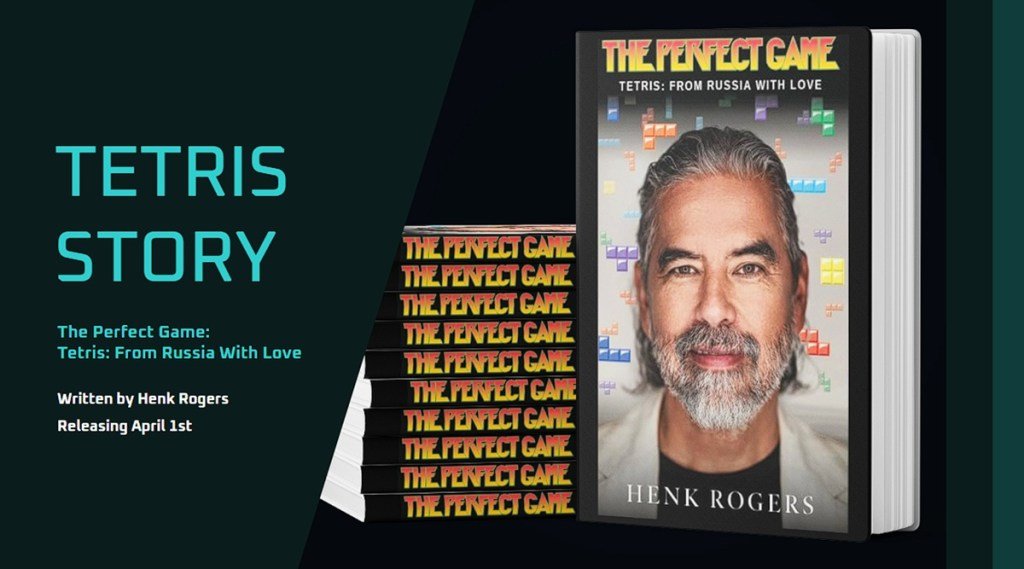
Henk Rogers wrote his adventure bring Tetris, the perfect game, to the West.
Image Credit: Tetris Company
Henk Rogers, one of the grandfathers of gaming, has a new book out, The Perfect Game, and we talked about it in an interview and again in a keynote talk at the Gamescom Latam expo in Sao Paulo, Brazil.
More than 131,800 people attended Gamescom Latam, with many of the fans dressed in cosplay. The dashing Rogers was dressed up in his best Tetris outfit, and in Brazil he could still find fans and admirers for a game that was more than 40 years old.
Rogers noted that he worked on the script with Tetris cofounder Alexy Pajitnov, and the Hollywood scriptwriters had taken so many liberties with the story behind the Tetris movie that Rogers decided to write his own autobiography. It includes the time of Rogers life before Tetris, during Tetris, and after Tetris. And it has a lot of life lessons for people like game developers to learn from. [Rogers will speak at our upcoming Xsolla Connect/GamesBeat Engage event on June 5 in Los Angeles].
Henk’s daughter Maya Rogers, who took over the Tetris company years ago as CEO, mentioned to me it was the “greatest business development story of all time.” But on stage, I told Henk that I thought the story of Tetris coming to the West was more like the greatest friendship story of all time.
Rogers discovered the game at a CES show, then hunted down its creator behind the Iron Curtain of the 1980s, when the U.S. and the Soviet Union were still in a Cold War. Rogers went to the Soviet Union on a tourist visa and tried to cut a business deal with the bosses of Alexy Pajitnov, who created the original.
During the negotiations, Rogers and creator Alexy Pajitnov got along because they were both game developers, and Pajitnov had never met another game developer before. So they got along and drank a lot together.
After Rogers won the battle for the rights to Tetris and made money with the game, Rogers went to the trouble of getting the full rights to the game. He also extracted Pajitnov from the Soviet Union and shared the profits with Pajitnov. Decades later, Tetris is still popular and Rogers is still its evangelist for gaming, Tetris — and Go. And fans loved his storytelling in Brazil.
Gamescom Latam, by the way, had more than 400 games to play from more than 40 publishers on the event floor. More than 10 million people viewed on the content online. More than 300 media channels and 2,000 partner influencers were at the event.
Here’s an edited transcript of our interview.
GamesBeat: Henk Rogers, as everybody knows, is one of the most interesting entrepreneurs in the game industry, the man who went behind the Iron Curtain and got Tetris. He has a book to talk about here. You want to introduce your book for us?
Henk Rogers: The introduction to the book is, why did I write the book? How many have you seen the movie, the Tetris movie? Alexei Pajitnov, the guy who created Tetris, he and I worked on the script. The script had so much Hollywood inside that I felt it was necessary for me to tell the true story. So I wrote the true story. Someone looked at it and said it could be a book, except it’s too thin. You need to write more. Okay, I’ll write before and after.
Basically the book turned into the history of my entire game career. It starts with me creating the first RPG in Japan. I think that’s my claim to fame. But only people in Japan know that. I’m wearing the shirt.
GamesBeat: Black Onyx, right?
Rogers: It was the first RPG in Japan, the number one game in Japan in 1984. It started my game career. All the way through to–gosh, I don’t even remember where the story ends.
GamesBeat: You also got into what kind of person you were as a kid, what kind of family you grew up in. It was a very different kind of family life that you grew up with. Do you want to talk about that a bit? I was struck that you considered your gamer life to have begun with Monopoly and Go. Those aren’t usually the games you think of when people say they’re a gamer.
Rogers: We’re talking about the dark ages. This is in the time before computers existed. When I first touched a computer in high school, it was punch cards. You would put in the punch cards and get printed output two days later. There were no games on computers back then.
GamesBeat: I’m there with you. I took a FORTRAN class in college. I had to wait for my printout.
Rogers: I used to cheat. I took my punch cards and copied them and put them in other classes, so that my output would come back in hours instead of days. My teacher thought I was a genius. I guess I was?
GamesBeat: You were always kind of a trickster, though. You’ve had this pattern in your life of getting around obstacles, thinking about how to get around problems.
Rogers: Life is a game. If you think about the objective, you have all these miniature goals that you’re trying to achieve. Each one is like winning a game. I’m a gamer. I really hate to lose. I work hard to win. If there’s something I have to do, like write a book, I’m going to do it. Nothing is going to stop me.
GamesBeat: What else was a big theme for you in writing the book? You also went well beyond your life in games. You had a life that really started after your game career.
Rogers: Before and after. But after my game career–the story, basically, my game career kind of ended in 2005 when I sold one of my companies and made a lot of money. At that moment, or about a month after, I had a 100% blockage of the widowmaker. That’s a kind of heart attack, and 95% of people who have that happen die. I’m one of the lucky 5%. In the ambulance I thought to myself, “You have to be kidding me. I haven’t spent any of that money yet.” That’s the first thing I thought. But the second was, “No, I’m not going. I still have stuff to do.”
In the recovery room I decided to figure out what was going to piss me off if I didn’t do something about it by the actual end of my life. I came up with my bucket list, my missions in life. I have four missions. I have four children. I was thinking that each of my visions, I’d give them to one of my children. That’s so not happening. You can laugh now. I’m on my own. But my first mission came to me in the back of the newspaper. This was in Hawaii. An article said we would kill all the coral in the world by the end of the century. I said, “No, we’re not.”
What’s causing it is ocean acidification, which is caused by carbon dioxide going into the ocean, which is caused by us. My mission number one was to end the use of carbon-based fuel, full stop. At the time I was living in Hawaii. We import $5 billion worth of oil a year and $1 billion worth of coal. That’s $6 billion. Half that fossil fuel we use to make electricity. The biggest thing we did in Hawaii is we passed a law that said Hawaii had to go 100% renewable electricity by 2045. Today we’re at 36%.
GamesBeat: I remember the last vacation I had in Maui. It was hard to find a beach where there wasn’t bleached coral. That’s pretty sad.
Rogers: Bleaching coral is happening more quickly because of temperatures. Theoretically, when the water temperature goes down, the coral can come back. But if the water is still too acidic, the coral can’t come back. There’s no way to fix it after that. We have to fix climate change. We have to fix the carbon dioxide we’re producing.
GamesBeat: You said you had four things you wanted to get done. What are the other three?
Rogers: I was in high school when we had the war in Vietnam. My second mission is to end war, because we were fighting against the war in Vietnam. We students demonstrated, demonstrated, demonstrated. I feel that we helped end that war. It was really not a war. It was a massacre. We had no business there, no end goal. We were just killing people for no real reason. They never hurt us. That’s number two.
Number three is to make a backup of life by going to other planets. It’s kind of Elon Musk-ey, and now I’m not sure of that mission anymore, because he’s turned into–
GamesBeat: The backup copy is still a good idea.
Rogers: The backup copy is a good idea no matter what. When I was in development, you make backups. You don’t leave all your code on one disc and then it crashes and you lose it all. You make a backup. As far as we know, all of life is on this planet. We could be the ones that mess it up. We have to find another planet and make a backup.
Number four is to find out how the universe ends and do something about it. That one exists just to make the other ones seem easy. In the scope of things, ending war or fixing climate change or making a backup, these are all things that people are going to read about in history books in the future. “We did that. Then we invented the steam engine. Then we invented the computer. Then we invented the portable phone.” We take these things for granted now, but they were huge changes when they happened. One of them is going to be, “Then we fixed climate change.”
GamesBeat: How do you think about problems that are so big that they seem impossible? It seemed impossible that one game could last for decades in the video game industry.
Rogers: There’s a lot of luck involved. I discovered the game. I didn’t create it. The fact that people still play it is just something to do with how amazing the game itself is. But other things, like creating the first RPG in Japan, that wasn’t luck. That was work. I worked my ass off to get it done.
When I started, in Hawaii, to end the use of carbon-based fuel in Hawaii, everyone said, “What are you talking about?” The governor, the head of the utility, all these people said they didn’t know how they could do that. That’s not good enough. It seemed like an insurmountable problem, but now we’re on track. Since we did Hawaii, 15 other states have copied our legislation. More than half the population of the United States lives in a state where they have to go 100% renewable energy. The federal government can’t do anything about it. We don’t care what happens in Washington. The idiot in Washington can do what he wants to do. That’s not our problem. We’re still fixing it.
GamesBeat: In the movie, one of the memorable scenes was when you sneaked into Nintendo’s headquarters and found a way to meet with the CEO. In reality, the story is very interesting. It has to do with the game Go. Could you talk about that?
Rogers: They tried to make everything happen in seconds in the movie. The story took a couple of days, the real story, but people wouldn’t understand it as part of the movie. That’s the problem. Anyway, I read an article in a Japanese magazine that said the president of Nintendo plays Go. Go is a board game with black and white stones. It’s like chess only much more complicated. Computer AI beat chess a long time ago, but only recently beat Go. Go is the most complicated, interesting game.
My father played Go, so I played Go. When somebody sent me a Go game for the Commodore 64 from England, it was on a nine by nine board. It was like children’s Go. They asked if I would like to publish it in Japan. It turned out that the Commodore 64 and the Nintendo Famicom had the same CPU. I knew that I could move the algorithm of Go from the Commodore 64 to the Famicom and it would work. The graphics, the sound, all that we had to redo, but that’s okay. That’s a simple thing, making graphics and music.
I sent Mr. Yamauchi a fax. “My name is Henk Rogers. I can make a Go game for your Famicom. I’m leaving for the states on Saturday. I’d like to see you before I leave.” I didn’t say that I lived in Japan. I just said I was leaving on Saturday. On Wednesday, the day after I sent the fax, I got a message. “Mr. Yamauchi will see you tomorrow.” That was how I got into a meeting with Mr. Yamauchi. It went fast.
The meeting went fast too. “I can make a Go game for your machine.” He said, “I can’t give you any programmers.” I said, “I don’t need them. I have programmers. I just need money.” He asked, “How much money?” I thought of the biggest number I could think of at the time and said, “$300,000.” He said, “Deal.” That was it. Then I contacted the guy in England and told him he had to come to Japan and move his code over to the Famicom. It took nine months. That’s how I became friends with Mr. Yamauchi.
GamesBeat: Talking to him about Tetris turned out to be easier. He must have remembered you.
Rogers: By the time Tetris came around I’d already met him many times for many reasons. Whenever I made a meeting with Yamauchi, we would meet at the end of the day, after all of his other meetings. Then we’d play Go for the rest of the day. I played Go with him many times. I was the only one in the industry who played Go. Everybody else played computer games or something. It was just a different culture. I was the crossover person.
GamesBeat: Were there other key stories that didn’t fit in the book, things that are still on your mind?
Rogers: What I’m doing now didn’t really fit in the book. I wanted to have more accomplishments around my fight to end climate change before I started writing a book about it. Hopefully this book will help me become a bit more famous, and then I can say I have book number two. Book number two will be about how we fixed climate change.
GamesBeat: What were some things behind the scenes of getting the rights to Tetris that are in the book, but the movie couldn’t cover?
Rogers: When I went to the Soviet Union, I was in a room with seven Russians, a couple of whom must have been KGB. They were, how can I say it, interrogating me. Who they hell are you? Why are you in the Soviet Union? I was very suspicious, first of all. I was a Dutchman that sounded like an American living in Japan. Okay, that’s weird. Who the hell is this guy?
They actually sent two agents to my office in Yokohama to make sure that the story about having a company in Japan was true. Everybody in the office was terrified. They didn’t know what was going on with me. I’d just disappeared into the Soviet Union. At the time, to make a phone call from there you placed the call and had to wait eight hours for the return to come through. I would set the call at midnight, go to sleep, wake up in the morning, and the call would come through. Don’t ask me what they were doing for eight hours. Making sure that the right people were listening, I’m sure.
GamesBeat: I remember talking to your daughter, Maya Rogers, about the movie for the first time. She’s running Tetris as the CEO now. She said, “This is the greatest business development story of all time.” Having seen the movie and read the book, I happen to disagree with that interpretation. I think this is one of the greatest friendships. That’s really been fascinating to see, that you guys even today are still friends, you and Alexei Pajitnov. [In fact, Rogers got Pajitnov out of the Soviet Union and shared the profits of Tetris with him].
Rogers: In that room with the seven interrogators was Alexei Pajitnov. He was also interrogated. After a while he figured out that I had started as a game designer. They asked me how I started my business and so on. I said, “I’m a game designer.” He had never met a game designer before. That’s when he became so interested. At the end of the meeting he came to my side of the table and said, “Let’s meet tonight.” I thought that was impossible. I thought there was something wrong with me speaking to a Russian. He said, “Well, you thought it was against the law. I knew it was against the law. That’s the difference.”
GamesBeat: What’s the most important message you want to get out, either through the book or just on your own?
Rogers: The message is that if you set your mind to do something, there’s nothing that can stop you from doing it. This happened to me many times in my life. There’s nothing that can stop you if you decide you’re going to do it. That’s the message I want everyone to get. The story is rags to riches. I started with zero. I made a computer game, made some money, made a company, and on it goes. I guess I’m a serial entrepreneur. Not all of them have been successful, absolutely not. But on the average I made a lot of money. Just go for it. If it fails, get up and do it again. Start another one.
Disclosure: Gamescom Latam paid my where to Brazil, where I moderate multiple talks.
GB Daily
Stay in the know! Get the latest news in your inbox daily
Read our Privacy Policy
Thanks for subscribing. Check out more VB newsletters here.
An error occured.
