

High above the equator, Russia is stalking satellites used by NATO armed forces
“Russia and China already occupy important strategic hills and mountains in space.”
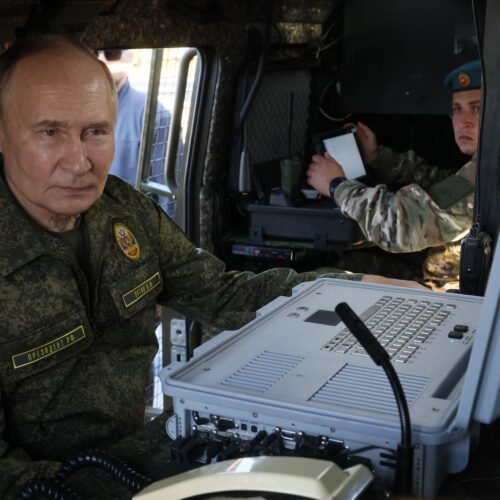
Russia’s President Vladimir Putin tours an exhibition of military equipment while inspecting joint Russian-Belarusian military drills at a training ground on September 16, 2025.
Credit:
Mikhail Metzel/Pool/AFP via Getty Images
Germany’s defense minister, Boris Pistorius, said Thursday that it’s time for his country to consider putting “offensive capabilities” in space after revealing Russian spacecraft are tracking two communications satellites used by the German military.
Speaking at the German industry’s Space Congress event in Berlin, Pistorius said the country must ramp up its investment in space security to counter threats from Russia and China, which he said have rapidly expanded their capacity for space warfare.
“They can jam, blind, manipulate, or kinetically destroy satellites,” Pistorius said. “There are no borders or continents in space. Russia and China are our direct neighbors there.”
Controlling the high ground is often a military imperative, Pistorius said, adding: “Russia and China already occupy important strategic hills and mountains in space—a threat we can no longer ignore.”
“Satellite networks are now the Achilles heel of modern societies,” Pistorius said. “Anyone who attacks them can paralyze entire countries. We know that the conflicts of the future will no longer be confined to Earth. They will also be fought openly in orbit.”
Germany on the offense
Pistorius said Germany is “ready to assume more responsibility” for defense and deterrence in space, with plans to invest 35 billion euros ($40.8 billion) in space security through 2030. Focus areas include satellite constellations, ground stations, secure launch capabilities, improved cybersecurity measures, and radars and telescopes to track orbital traffic.
It’s also time for Germany to “discuss offensive capabilities” in space, Pistorius said. This is a reversal of the country’s long-standing policy against anti-satellite weapons.
Germany has historically relied on the United States and other European countries for many critical space capabilities, such as missile warning, intelligence gathering, and launch services. Germany’s military has instead focused on developing its own radar surveillance satellites as part of a data-sharing agreement with allies.
Christian Mölling, the former research director at the German Council on Foreign Relations, wrote in 2022 that German politicians were content with this strategy.
“The German government has so far shown little commitment to considering the space issue beyond the current infrastructure,” Mölling wrote. “This will only change if Germany actively creates a higher level of political ambition and military potential. Options for this are conceivable, especially if they help Germany gain a stronger profile in the EU and NATO context.”
That is exactly what Pistorius said Germany is seeking to do. He said his country’s contributions in space security will make Germany a “strong pillar in NATO” and will complement European Union programs. Germany and France recently agreed to cooperate on a satellite-based missile warning network, a new system that could reduce Europe’s reliance on the United States.
“We plan to acquire new satellite constellations for early warning, reconnaissance, and communications,” Pistorius said.
Boris Pistorius, Germany’s federal minister of defense, speaks at German industry’s Space Congress in Berlin.
Credit:
Annette Riedl/picture alliance via Getty Images
Germany is a partner on the European Union’s planned IRIS² constellation of nearly 300 satellites to create a smaller, independent version of SpaceX’s Starlink network. However, German officials have balked at the program’s expected $12.3 billion (10.6 billion euro) cost and suggested Germany that wants a national constellation of its own.
A fully independent European space program will also require a more robust launch industry on the continent. Europe’s new Ariane 6 rocket has flown successfully three times, relieving some of the need for European governments to look to the United States for SpaceX rockets to launch their military satellites.
But the Ariane 6 and the smaller Italian Vega C rocket aren’t reusable like SpaceX’s rockets, a design choice that has led to higher costs and a lower flight rate. Pistorius said Germany “needs secure, on-demand space transport capacities” that include a mix of small launchers and heavy-lift carriers “developed in competition.”
There’s a surge of interest in Europe to ramp up defense spending as government leaders feel they can no longer rely on the United States. Earlier this year, Germany’s new chancellor, Friedrich Merz, suggested Germany, France, and the United Kingdom should explore cooperation on a European nuclear deterrent to replace that of the United States, which has committed to protecting European territory from Russian attack for more than 75 years.
Last week, the head of French Space Command warned of intensifying “hostile or unfriendly” activity in space, Reuters reported. Maj. Gen. Vincent Chusseau said one of his priorities is to accelerate the ability to carry out “a wide spectrum of effects in space … not only to see and understand, but also to act.” French Space Command officials told Reuters they also aim to acquire “surface-to-space capabilities to deny, prohibit, and disrupt adversaries.”
US Space Force officials have similarly suggested a growing need for offensive space weapons, a change in tone Ars has reported on several times in the past year.
Members of the German Armed Forces, known as the Bundeswehr, seen at German Space Command in Uedem, Germany, in July 2024.
Credit:
Andreas Rentz/Getty Images
Russia up to old tricks
Pistorius singled out Russia as a particular concern for Germany.
“Russia is positioning its reconnaissance satellites in close proximity to space systems of the German Armed Forces and friendly nations,” he said. “Currently, two Intelsat satellites, which are also used by the German Armed Forces, are being tracked by two Russian Luch/Olymp reconnaissance satellites.”
Intelsat is an international communications satellite operator providing connectivity to commercial and government customers. Intelsat operates a fleet of approximately 57 satellites in geosynchronous orbit more than 22,000 miles (nearly 36,000 kilometers) above the equator.
A satellite in this type of orbit moves around the Earth at the same rate as the planet’s rotation, causing it to hover over the same location. Commercial and military-owned geosynchronous satellites typically spend years in the same location, or slot, to provide communications services to users.
Russia’s two Olymp satellites, also known as Luch, are different. They have wandered around geosynchronous orbit since their launches in 2014 and 2023, routinely changing longitude and moving from slot to slot to loiter near Western-owned communications satellites for several months at a time.
Western analysts believe the Luch/Olymp satellites are likely meant to eavesdrop on the signals relayed through other spacecraft in geosynchronous orbit. Analysts at the Center for Strategic and International Studies (CSIS) wrote last year that the Luch/Olymp satellites might also be validating a concept of operations for future orbital attacks, “or as some speculate, it may be carrying an electronic attack satellite-jamming payload.”
US officials and government leaders from other Western nations have previously cried foul about the Luch/Olymp satellites. The first Luch/Olymp satellite flew close to several Intelsat satellites in 2015, and then spent time near a French-Italian military satellite in 2017.
Florence Parly, France’s defense minister at the time, said the Russian satellite has “big ears” but is a “bit indiscreet.”
“Trying to listen to one’s neighbor is not only unfriendly. It’s called an act of espionage,” Parly said in 2018. “It got close. A bit too close. So close that one really could believe that it was trying to capture our communications.”
A robotic servicing vehicle captured this black-and-white image of the Intelsat 10-02 communications satellite as it moved in for docking in 2021.
Credit:
Space Logistics/Intelsat
Russia launched a second Luch/Olymp satellite into geosynchronous orbit in 2023, bringing it near a US military communications satellite and multiple spacecraft owned by the French operator Eutelsat.
Last September, this second Russian eavesdropping satellite maneuvered close to an Intelsat satellite named Intelsat 10-02, coming as close as 1 kilometer (about 3,300 feet) from it in January, according to a CSIS space threat assessment. Notably, Intelsat 10-02 was docked with a commercial servicing spacecraft at the time, and in a twist of irony, was launched by a Russian rocket in 2004.
The same Luch/Olymp satellite then fired its thrusters to begin drifting to another slot thousands of miles away to sidle up next to another Intelsat bird named Intelsat 39.
Intelsat 10-02 and Intelsat 39 each provide C-band and Ku-band services across Europe and the Middle East, including Ukraine.
A Russian cyberattack also disrupted a ViaSat satellite communications network on the eve of Russia’s invasion of Ukraine in 2022.
It’s worth noting that the US government has also used roving satellites to surveil other spacecraft in geosynchronous orbit. These include satellites apparently so secret that the US government refused to identify the agency that owns them.
Similarly, Russia has concealed the true purpose of its Luch/Olymp satellites. The Luch name, which means “beam” in Russian, was previously used for a series of civilian data relay satellites connecting Russian space stations with mission control.
Stephen Clark is a space reporter at Ars Technica, covering private space companies and the world’s space agencies. Stephen writes about the nexus of technology, science, policy, and business on and off the planet.

#/media/File:%D0%A1%D0%BF%D1%83%D1%82%D0%BD%D0%B8%D0%BA_%D0%A0%D0%B5%D1%82%D1%80%D0%B0%D0%BD%D1%81%D0%BB%D1%8F%D1%82%D0%BE%D1%80_%D0%9B%D1%83%D1%87_%D0%B2_%D0%BC%D1%83%D0%B7%D0%B5%D0%B5_%D1%81%D0%B2%D1%8F%D0%B7%D0%B8,_%D0%A1%D0%9F%D0%91_001.jpg)