

How NTT Research has shifted more basic R&D into AI for the enterprise | Kazu Gomi interview
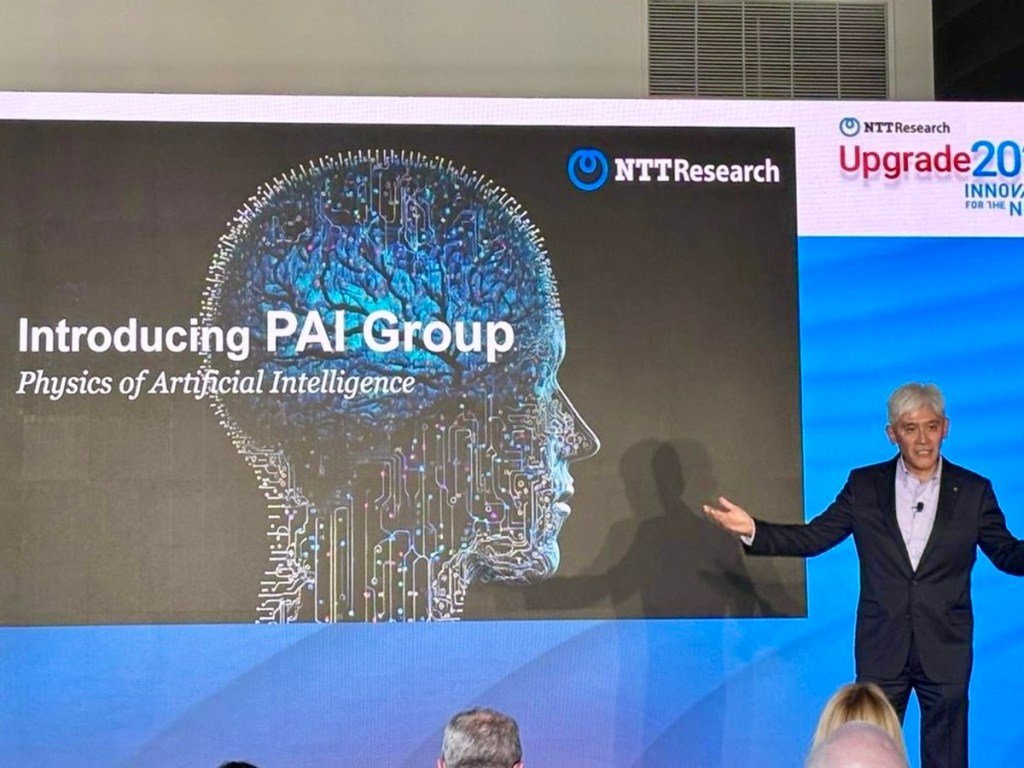
Kazu Gomi introduces the PAI Group at NTT Research.
Image Credit: NTT Research
Kazu Gomi has a big view of the technology world from his perch in Silicon Valley. And as president and CEO of NTT Research, a division of the big Japanese telecommunications firm NTT, Gomi can control the R&D budget for a sizable chunk of the basic research that is done in Silicon Valley.
And perhaps it’s no surprise that Gomi is pouring a lot of money into AI for the enterprise to discover new opportunities to take advantage of the AI explosion. Last week, Gomi unveiled a new research effort to focus on the physics of AI and well as a chip design for an AI inference chip that can process 4K video faster. This comes on the heels of research projects announced last year that could pave the way for better AI and more energy efficient data centers.
I spoke with Gomi about this effort in the context of other things big companies like Nvidia are doing. Physical AI has become a big deal in 2025, with Nvidia leading the charge to create synthetic data to pretest self-driving cars and humanoid robotics so they can get to market faster.
And building on a story that I first did in my first tech reporting job, Gomi said the company is doing research on photonic computing as a way to make AI computing a lot more energy efficient.
Decades ago, I toured Bell Labs and listened to the ambitions of Alan Huang as he sought to make an optical computer. Gomi’s team is trying to do something similar decades later. If they can pull it off, it could make data centers operate on a lot less power, as light doesn’t collide with other particles or generate friction the way that electrical signals do.
During the event last week, I enjoyed talking to a little table robot called Jibo that swiveled and “danced” and told me my vital signs, like my heart rate, blood oxygen level, blood pressure, and even my cholesterol — all by scanning my skin to see the tiny palpitations and color change as the blood moved through my cheeks. It also held a conversation with me via its AI chat capability.
NTT has more than 330,000 employees and $97 billion in annual revenue. NTT Research is part of NTT, a global technology and business solutions provider with an annual R&D budget of $3.6 billion. About six years ago it created an R&D division in Silicon Valley.
Here’s an edited transcript of our interview.
VentureBeat: Do you feel like there’s a theme, a prevailing theme this year for what you’re talking about compared to last year?
Kazu Gomi: There’s no secret. We’re more AI-heavy. AI is front and center. We talked about AI last year as well, but it’s more vivid today.
VentureBeat: I wanted to hear your opinion on what I absorbed out of CES, when Jensen Huang gave his keynote speech. He talked a lot about synthetic data and how this was going to accelerate physical AI. Because you can test your self-driving cars with synthetic data, or test humanoid robots, so much more testing can be done reliably in the virtual domain. They get to market much faster. Do you feel like this makes sense, that synthetic data can lead to this acceleration?
Gomi: For the robots, yes, 100%. The robots and all the physical things, it makes a ton of sense. AI is influencing so many other things as well. Probably not everything. Synthetic data can’t change everything. But AI is impacting the way corporations run themselves. The legal department might be replaced by AI. The HR department is replaced by AI. Those kinds of things. In those scenarios, I’m not sure how synthetic data makes a difference. It’s not making as big an impact as it would for things like self-driving cars.
VentureBeat: It made me think that things are going to come so fast, things like humanoid robots and self-driving cars, that we have to decide whether we really want them, and what we want them for.
Gomi: That’s a big question. How do you deal with them? We’ve definitely started talking about it. How do you work with them?
VentureBeat: How do you use them to complement human workers, but also–I think one of your people talked about raising the standard of living [for humans, not for robots].
Gomi: Right. If you do it right, absolutely. There are many good ways to work with them. There are certainly bad scenarios that are possible as well.
VentureBeat: If we saw this much acceleration in the last year or so, and we can expect synthetic data will accelerate it even more, what do you expect to happen two years from now?
Gomi: Not so much on the synthetic data per se, but today, one of the press releases my team released is about our new research group, called Physics of AI. I’m looking forward to the results coming from this team, in so many different ways. One of the interesting ones is that–this humanoid thing comes near to it. But right now we don’t know–we take AI as a black box. We don’t know exactly what’s going on inside the box. That’s a problem. This team is looking inside the black box.
There are many potential benefits, but one of the intuitive ones is that if AI starts saying something wrong, something biased, obviously you need to make corrections. Right now we don’t have a very good, effective way to correct it, except to just keep saying, “This is wrong, you should say this instead of that.” There is research saying that data alone won’t save us.
VentureBeat: Does it feel like you’re trying to teach a baby something?
Gomi: Yeah, exactly. The interesting ideal scenario–with this Physics of AI, effectively what we can do, there’s a mapping of knowledge. In the end AI is a computer program. It’s made up of neural connections, billions of neurons connected together. If there’s bias, it’s coming from a particular connection between neurons. If we can find that, we can ultimately reduce bias by cutting those connections. That’s the best-case scenario. We all know that things aren’t that easy. But the team may be able to tell that if you cut these neurons, you might be able to reduce bias 80% of the time, or 60%. I hope that this team can reach something like that. Even 10% is still good.
VentureBeat: There was the AI inference chip. Are you trying to outdo Nvidia? It seems like that would be very hard to do.
Gomi: With that particular project, no, that’s not what we’re doing. And yes, it’s very hard to do. Comparing that chip to Nvidia, it’s apples and oranges. Nvidia’s GPU is more of a general-purpose AI chip. It can power chat bots or autonomous cars. You can do all kinds of AI with it. This one that we released yesterday is only good for video and images, object detection and so on. You’re not going to create a chat bot with it.
VentureBeat: Did it seem like there was an opportunity to go after? Was something not really working in that area?
Gomi: The short answer is yes. Again, this chip is definitely customized for video and image processing. The key is that without reducing the resolution of the base image, we can do inference. High resolution, 4K images, you can use that for inference. The benefit is that–take the case of a surveillance camera. Maybe it’s 500 meters away from the object you want to look at. With 4K video you can see that object pretty well. But with conventional technology, because of processing power, you have to reduce the resolution. Maybe you could tell this was a bottle, but you couldn’t read anything on it. Maybe you could zoom in, but then you lose other information from the area around it. You can do more with that surveillance camera using this technology. Higher resolution is the benefit.
VentureBeat: This might be unrelated, but I was interested in Nvidia’s graphics chips, where they were using DLSS, using AI to predict the next pixel you need to draw. That prediction works so well that it got eight times faster in this generation. The overall performance is now something like–out of 30 frames, AI might accurately predict 29 of them. Are you doing something similar here?
Gomi: Something related to that–the reason we’re working on this, we had a project that’s the precursor to this technology. We spent a lot of energy and resources in the past on video codec technologies. We sold an early MPEG decoder for professionals, for TV station-grade cameras and things like that. We had that base technology. Within this base technology, something similar to what you’re talking about–there’s a bit of object recognition going on in the current MPEG. Between the frames, it predicts that an object is moving from one frame to the next by so much. That’s part of the codec technology. Object recognition makes that happen, those predictions. That algorithm, to some extent, is used in this inference chip.
VentureBeat: Something else Jensen was saying that was interesting–we had an architecture for computing, retrieval-based computing, where you go into a database, fetch an answer, and come back. Whereas with AI we now have the opportunity for reason-based computing. AI figures out the answer without having to look through all this data. It can say, “I know what the answer is,” instead of retrieving the answer. It could be a different form of computing than what we’re used to. Do you think that will be a big change?
Gomi: I think so. A lot of AI research is going on. What you said is possible because AI has “knowledge.” Because you have that knowledge, you don’t have to go retrieve data.
VentureBeat: Because I know something, I don’t have to go to the library and look it up in a book.
Gomi: Exactly. I know that such and such event happened in 1868, because I memorized that. You could look it up in a book or a database, but if you know that, you have that knowledge. It’s an interesting part of AI. As it becomes more intelligent and acquires more knowledge, it doesn’t have to go back to the database each time.
VentureBeat: Do you have any particular favorite projects going on right now?
Gomi: A couple. One thing I want to highlight, perhaps, if I could pick one–you’re looking closely at Nvidia and those players. We’re putting a lot of focus on photonics technology. We’re interested in photonics in a couple of different ways. When you look at AI infrastructure–you know all the stories. We’ve created so many GPU clusters. They’re all interconnected. The platform is huge. It requires so much energy. We’re running out of electricity. We’re overheating the planet. This isn’t good.
We want to address this issue with some different tricks. One of them is using photonics technology. There are a couple of different ways. First off, where is the bottleneck in the current AI platform? During the panel today, one of the panelists talked about this. When you look at GPUs, on average, 50% of the time a GPU is idle. There’s so much data transport happening between processors and memory. The memory and that communication line is a bottleneck. The GPU is waiting for the data to be fetched and waiting to write results to memory. This happens so many times.
One idea is using optics to make those communication lines much faster. That’s one thing. By using optics, making it faster is one benefit. Another benefit is that when it comes to faster clock speeds, optics is much more energy-efficient. Third, this involves a lot of engineering detail, but with optics you can go further. You can go this far, or even a couple of feet away. Rack configuration can be a lot more flexible and less dense. The cooling requirements are eased.
VentureBeat: Right now you’re more like data center to data center. Here, are we talking about processor to memory?
Gomi: Yeah, exactly. This is the evolution. Right now it’s between data centers. The next phase is between the racks, between the servers. After that is within the server, between the boards. And then within the board, between the chips. Eventually within the chip, between a couple of different processing units in the core, the memory cache. That’s the evolution. Nvidia has also released some packaging that’s along the lines of this phased approach.
VentureBeat: I started covering technology around 1988, out in Dallas. I went to visit Bell Labs. At the time they were doing photonic computing research. They made a lot of progress, but it’s still not quite here, even now. It’s spanned my whole career covering technology. What is the challenge, or the problem?
Gomi: The scenario I just talked about hasn’t touched the processing unit itself, or the memory itself. Only the connection between the two components, making that faster. Obviously the next step is we have to do something with the processing unit and the memory itself.
VentureBeat: More like an optical computer?
Gomi: Yes, a real optical computer. We’re trying to do that. The thing is–it sounds like you’ve followed this topic for a while. But here’s a bit of the evolution, so to speak. Back in the day, when Bell Labs or whoever tried to create an optical-based computer, it was basically replacing the silicon-based computer one to one, exactly. All the logic circuits and everything would run on optics. That’s hard, and it continues to be hard. I don’t think we can get there. Silicon photonics won’t address the issue either.
The interesting piece is, again, AI. For AI you don’t need very fancy computations. AI computation, the core of it is relatively simple. Everything is a thing called matrix-vector multiplication. Information comes in, there’s a result, and it comes out. That’s all you do. But you have to do it a billion times. That’s why it gets complicated and requires a lot of energy and so on. Now, the beauty of photonics is that it can do this matrix-vector multiplication by its nature.
VentureBeat: Does it involve a lot of mirrors and redirection?
Gomi: Yeah, mirroring and then interference and all that stuff. To make it happen more efficiently and everything–in my researchers’ opinion, silicon photonics may be able to do it, but it’s hard. You have to involve different materials. That’s something we’re working on. I don’t know if you’ve heard of this, but it’s lithium niobate. We use lithium niobate instead of silicon. There’s a technology to make it into a thin film. You can do those computations and multiplications on the chip. It doesn’t require any digital components. It’s pretty much all done by analog. It’s super fast, super energy-efficient. To some extent it mimics what’s going on inside the human brain.
These hardware researchers, their goal–a human brain works with maybe around 20 watts. ChatGPT requires 30 or 40 megawatts. We can use photonics technology to be able to drastically upend the current AI infrastructure, if we can get all the way there to an optical computer.
VentureBeat: How are you doing with the digital twin of the human heart?
Gomi: We’ve made pretty good progress over the last year. We created a system called the autonomous closed-loop intervention system, ACIS. Assume you have a patient with heart failure. With this system applied–it’s like autonomous driving. Theoretically, without human intervention, you can prescribe the right drugs and treatment to this heart and bring it back to a normal state. It sounds a bit fanciful, but there’s a bio-digital twin behind it. The bio-digital twin can precisely predict the state of the heart and what an injection of a given drug might do to it. It can quickly predict cause and effect, decide on a treatment, and move forward. Simulation-wise, the system works. We have some good proof that it will work.
VentureBeat: Jibo, the robot in the health booth, how close is that to being accurate? I think it got my cholesterol wrong, but it got everything else right. Cholesterol seems to be a hard one. They were saying that was a new part of what they were doing, while everything else was more established. If you can get that to high accuracy, it could be transformative for how often people have to see a doctor.
Gomi: I don’t know too much about that particular subject. The conventional way of testing that, of course, they have to draw blood and analyze it. I’m sure someone is working on it. It’s a matter of what kind of sensor you can create. With non-invasive devices we can already read things like glucose levels. That’s interesting technology. If someone did it for something like cholesterol, we could bring it into Jibo and go from there.
GB Daily
Stay in the know! Get the latest news in your inbox daily
Read our Privacy Policy
Thanks for subscribing. Check out more VB newsletters here.
An error occured.
