

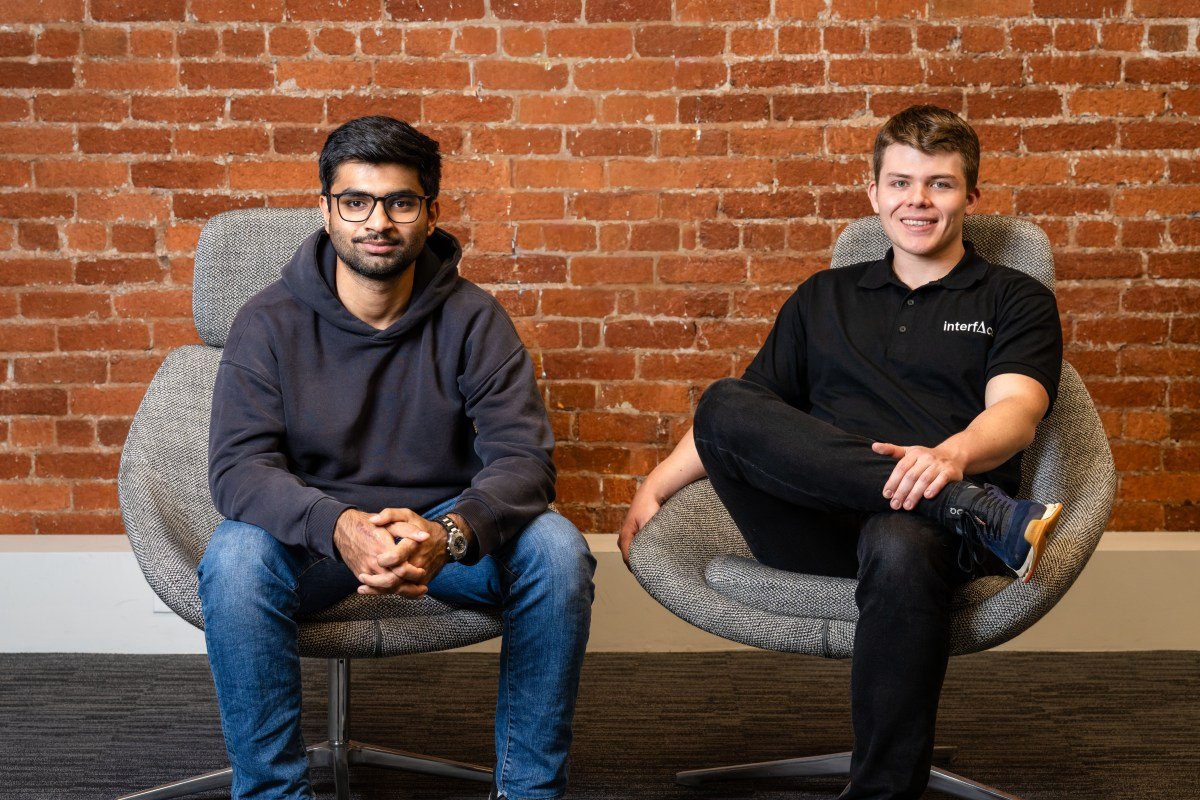
How this founder’s unlikely path to Silicon Valley could become an edge in industrial tech
Thomas Lee Young doesn’t sound like your typical Silicon Valley founder.
The 24-year-old CEO of Interface, a San Francisco startup using AI to prevent industrial accidents, is a white guy with a Caribbean accent and a Chinese last name, a combination he finds amusing enough to mention when he’s first introduced to business contacts. Born and raised in Trinidad and Tobago, the site of substantial oil and gas exploration activity, Young grew up around oil rigs and energy infrastructure because his entire family worked as engineers, stretching back generations to his great-grandfather, who immigrated to the island nation from China.
That background has become his calling card in pitch meetings with oil and gas executives today, but it makes for more than a great conversation starter; it underscores a path that has been anything but straightforward and that Young might argue gives Interface an edge.
It was years in the making. From age 11, Young fixated on Caltech with the intensity of someone much older. He watched shows about Silicon Valley online, mesmerized by the idea that people could build “anything and everything” in America. He did everything possible to secure admission, even writing his application essay about hijacking his family’s Roomba to create 3D spatial maps of his house.
The ploy worked – Caltech accepted him in 2020 – but then COVID-19 hit, and so did its ripple effects. For one thing, Young’s visa situation became nearly impossible (visa appointments were cancelled and processing came to a halt). At the same time, his college fund, carefully built over six or seven years to $350,000 to cover his education, “basically got hit entirely” by the abrupt market downturn in March of that year.
Without a lot of time to decide his future, he chose a cheaper three-year engineering program at the University of Bristol in the UK, studying mechanical engineering, but never abandoning his Silicon Valley dreams. “I was devastated,” he says, “but I realized I could still get something done.”
At Bristol, Young landed at Jaguar Land Rover, working in something called human factors engineering – essentially the UX and safety design of industrial systems. “I had never heard of it before I even joined,” he admits. The role involved figuring out how to make cars and manufacturing lines as safe as possible, ensuring they were “dummy proof” for smooth operations.
Techcrunch event
San Francisco
|
October 13-15, 2026
It was there, inside heavy industry, that Young saw the problem that would become Interface. He says the tools many companies use to manage safety documentation are either nonexistent – pen and paper – or so siloed and poorly designed that workers hate them. Worse, the operating procedures themselves — the instruction manuals and checklists that blue-collar workers rely on to stay safe — are riddled with errors, outdated, and nearly impossible to maintain.
Young pitched Jaguar on letting him build a solution, but the company wasn’t interested. So he started plotting his exit. When he learned about Entrepreneur First (EF), a European talent incubator that recruits promising individuals before they have a co-founder or even an idea, he cold applied despite its 1% acceptance rate. He was accepted to essentially pitch himself.
He told Jaguar he was going to a wedding in Trinidad and would be away for a week. Instead, he went to EF’s selection process, impressed the organizers, and the day he returned to the office, quit. “They realized, ‘Oh, so you probably weren’t at a wedding,’” he laughs.
At EF, Young met Aaryan Mehta, his future co-founder and CTO. Mehta, of Indian descent but born in Belgium, had his own thwarted American dream. He’d been accepted to both Georgia Tech and Penn but similarly couldn’t get a visa appointment during COVID. He ended up studying math and computer science at Imperial College London, where he developed AI for fault detection before building machine learning pipelines at Amazon.
“We had similar backgrounds,” Young says. “He’s super international. He speaks five languages, very technical, amazing guy, and we got along very well.” In fact, they were the only team in their EF cohort not to break up, says Young.
More than that, today, they live together in San Francisco’s SoMa neighborhood, though asked about spending so much time together, Young is adamant that that’s not an issue given their respective workloads. “Over the last week, I’ve seen [Aaryan] at home for maybe a combined total of 30 minutes.”
As for what, exactly, they are building, Interface’s pitch is straightforward: use AI to make heavy industry safer. The company autonomously audits operating procedures using large language models, cross-checking them against regulations, technical drawings, and corporate policies to catch errors that could – in a worst-case scenario – get workers killed.
Some of the numbers are arresting. For one of Canada’s largest energy companies, where Interface is now deployed across three sites (Young declines to name the brand), Interface’s software found 10,800 errors and improvements across the company’s standard operating procedures in just two and a half months. As Young tells it, the same work done manually would have cost more than $35 million and taken two to three years.
One error Young found particularly troubling, he says, was a document that had been in circulation for 10 years with the wrong pressure range listed for a valve. “They’re just lucky that nothing happened,” says Medha Agarwal, a partner at Defy.vc, which led Interface’s $3.5 million seed round earlier this year, with participation from Precursor, Rockyard Ventures, and angel investors, including Charlie Songhurst.
The contracts are considerable. After initially trying outcome-based pricing (the energy company “hated it,” Young says), Interface adopted a hybrid per-seat model with overage costs. A single contract with the Canadian energy company is worth more than $2.5 million annually, and Interface has more fuel and oil services customers coming online in Houston, Guyana, and Brazil.
The total addressable market isn’t entirely clear, but it’s not small. In the U.S. alone, there are something like 27,000 oil and gas services companies, per the market research outfit IBISWorld, and that’s just the first vertical that Interface wants to tackle.
The outsider’s edge
Interestingly, Young’s age and background – things that might seem like disadvantages when it comes to more established industries – have become his secret weapons. When he walks into a room of executives twice or three times his age, he says, there’s initial skepticism. “Who the hell is this young guy and how does he know what he’s talking about?”
But then, he says, he delivers his “wow moment,” by explaining an understanding of their operations, their workers’ daily routines, and exactly how much time and money Interface can save them. “Once you can flip them, they will absolutely love you and advocate and fight for you,” he says. (He claims that after a recent, first site visit with operators, five workers asked when they could invest in Interface, which made him particularly proud, given the field workers typically “hate software providers.”)
Indeed, though Young works from Interface’s office in San Francisco’s Financial District, his hard hat sits on a table not far from his desk, ready for the next site visit. (Agarwal suggests Young could use a little more down time in his life, recalling a recent call where Young told her that he hadn’t seen the sun all day.)
The company now has eight employees – five in the office, three remote – mostly engineering hires, plus an operations person who started just this week. Interface’s biggest challenge is hiring fast enough to keep up with demand, a problem that requires its small team to tap networks across both Europe and the US.
As for what Young makes of the life in San Francisco he wanted and is now living, he marvels at how accurate the Silicon Valley stereotypes turned out to be. “You see people online talking about, ‘Oh, you go to a park and the person sitting next to you has raised $50 million building some insane AI agent.’ But it is actually like that,” he says. “I think back to what life was like in Trinidad. I mention these ideas to people back home, and they just don’t believe me.”
He occasionally makes time to go out in nature with friends – he says they went to Tahoe recently – and Interface hosts events like a hackathon they threw last weekend. But mostly, it’s work, and most of that work involves AI, just like everyone else’s in San Francisco right now.
Which makes the trips to oil rigs oddly appealing.
Indeed, that hard hat at the office isn’t just a practical necessity; it’s also a lure, suggests Young. For engineers tired of building “some low-impact B2B sales or recruiting tool,” as Young puts it, the promise of occasionally leaving the Bay Area bubble to work with operators in the field has become a recruiting advantage. Less than 1% of San Francisco startups work in heavy industry, he notes, and that scarcity is part of the appeal, for him and for the people he’s hiring.
It’s probably not quite the version of the Silicon Valley dream he spent his childhood chasing from Trinidad: long hours, intense pressure, endless AI discussions everywhere, punctuated by the occasional trip to an oil rig.
Still, for now, he doesn’t seem to mind it. “Over the last month or two months, I have not done much at all [outside the office], because there’s just been so much intensity here, with building, hiring, selling.” But “I feel pretty strong,” he adds.
