

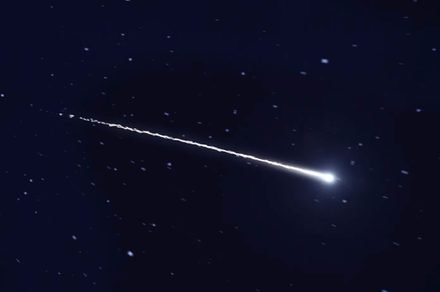
How to watch the Geminid meteor shower, and other skywatching tips for December
The meteor shower will peak toward the middle of the month.
NASA
December is an exciting month for those who like to look up, with a comet, a meteor shower, and a conjunction between the moon and Jupiter all featuring over the coming weeks.
Comet 3I/ATLAS
First up, for those with a telescope with an aperture of at least 30 centimeters, this month offers a chance to view Comet 3I/ATLAS, the third object in history from outside of our own solar system to be spotted within our solar system, and one that’s been in the news quite a bit recently.
During its closest approach to Earth on December 19, look east to northeast in the early pre-dawn morning and you should be able to spot the comet directly beneath Regulus, a star at the heart of the constellation Leo, the lion.
If you have an observatory in your area, check to see if it’s holding any skywatching events to view the comet later this month.
NASA notes that Comet 3I/ATLAS poses no threat to Earth. “On its closest approach to our planet on December 19, it will still be about 170 million miles away, or more than 700 times the distance between the Earth and the moon,” the space agency said on its website.
Geminid meteor shower
This year, the Geminid meteor shower peaks on the evenings of December 13 and 14.
NASA notes that this particular meteor shower, which is made up of debris trailing the asteroid 3200 Phaethon, is known for being “bright and colorful,” so it’s definitely one to watch.
To do so, look to the eastern sky anytime throughout the evenings of December 13 and 14. The meteors will appear near the bright planet Jupiter, which is easy to spot with the naked eye. With the darkest possible skies, and away from bright city lights, you may be lucky enough to witness as many as 120 Geminid meteors every hour.
The moon and Jupiter
The moon will appear close to Jupiter on the evening of December 7, a striking scene that you can easily enjoy with the naked eye.
“During a conjunction, objects in the sky — like planets and moons — appear close together even though they’re actually far apart,” NASA explained. “For example, while the moon and Jupiter will buddy up this month from our view, in space, they’re actually hundreds of millions of miles apart.”
Not so many moons ago, Trevor moved from one tea-loving island nation that drives on the left (Britain) to another (Japan)…
Window cleaning meets the final frontier as cosmonaut gets the sponge out
NASA shares a photo of a space-based window cleaner.
NASA astronaut Zena Cardman has shared some striking photos showing a Russian cosmonaut during a spacewalk.
One of the images (above) shows Alexey Zubritsky performing what is a mundane task on Earth but something altogether more challenging when you’re orbiting Earth 250 miles up: window cleaning.
SpaceX setback for Starship lunar landing mission, report claims
Internal documents suggest a new timeline for the much-anticipated mission.
NASA is aiming to launch its highly anticipated Artemis III mission in mid-2027 at the earliest, landing humans on the moon for the first time since the final Apollo mission in 1972.
But SpaceX, the company tasked with providing the mission’s lunar lander, estimates that the earliest it’ll be ready will be September 2028, according to information in internal SpaceX documents seen by Politico.
Four volunteers are a month into their ‘life on Mars’
Only 344 days left!
NASA’s Johnson Space Center reminded everyone on Monday that its four volunteers have been inside its Mars simulation habitat for a whole month now, though they still have 344 days to go before they emerge.
Johnson released a short video (below) showing the four-person CHAPEA (Crew Health and Performance Exploration Analog) crew entering the Mars Dune Alpha habitat on October 19, where they’re now living “like Martian explorers” to assist NASA as it gets ready to send humans back to the moon, and later to Mars in the first-ever crewed mission to the distant planet.
