

How Two Point Studios stands out in the competitive management sim genre
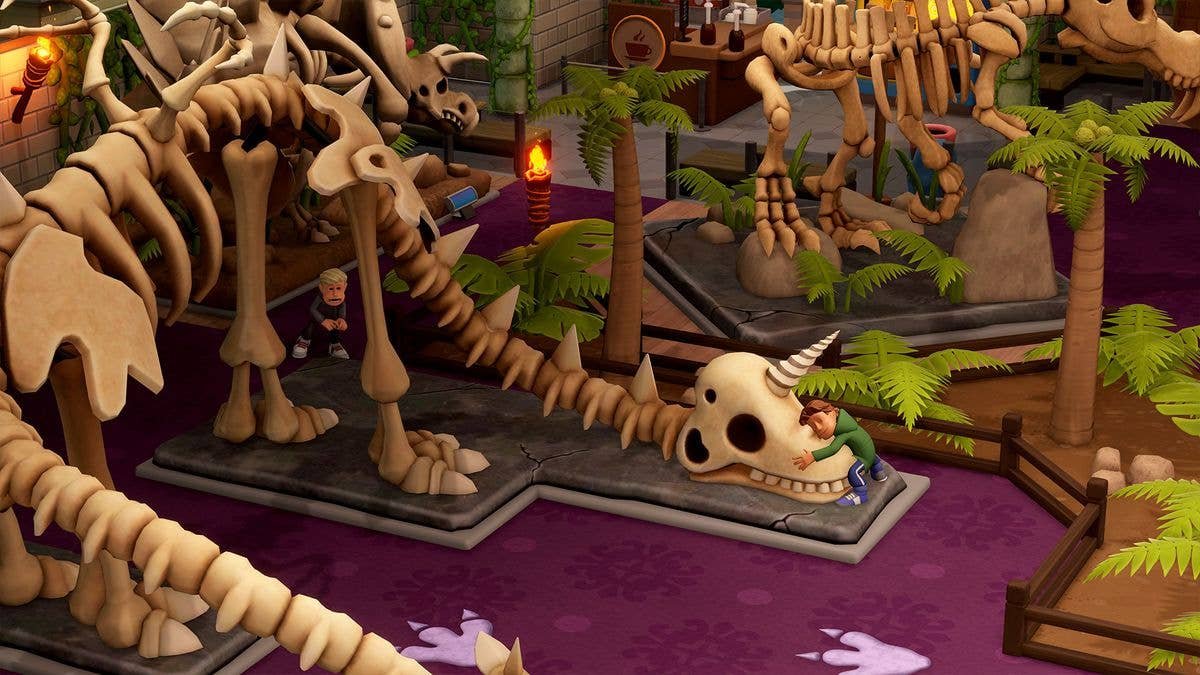
Two games and a pandemic later, Two Point Studios recently released the next game in its management sim franchise – Two Point Museum.
But in a climate filled with simulation titles across various genres, there’s certainly a challenge in standing out. With that in mind, Two Point’s design director Ben Huskins tells GamesIndustry.biz that the team had a few tricks up its sleeves to set them apart from the rest.
“For us, there are a couple of things we do to differentiate the Two Point games from other management sims,” he says. “Firstly, we absolutely lean into the fact that we don’t take ourselves too seriously – we’re not trying to simulate reality. This allows us to mix grounded elements with things that are much more wild and wonderful, and we can take as many liberties as we need to make something fun.
“Our little people are packed full of personality and charm, and they’re almost cartoonishly expressive in a way that simultaneously helps convey what’s happening in the simulation and also offers those moments of comic relief.”
Personality is one way Two Point’s games are distinguishable from its competitors, but the developer is still faced with the challenge of appealing to players who aren’t familiar with previous games in the series.
Huskins explains that the team thinks about the different types of players that enjoy management sims, which include everyone from “manic managers” that want to control every detail to “decorators” that vibe with creativity and customisation.
They also consider what fans want from the game and compare that to the needs of new players – it’s all about maintaining a balance between familiarity and ease of access.
“This is a way for us to test our decisions along the way – we’re not being massively scientific about it,” he notes. “There’s a lot of overlap between these different groups and playstyles, but it’s a useful thought experiment as we’re designing each feature.”
The team tends to focus on the opening hours of the game to introduce core features, then focus on how they can add more gradually without overwhelming players.
Huskins emphasises that first impressions mean everything, even for fans who are versed in how these games work. Two Point wants to subvert expectations with their games, while also keeping it familiar.
“Ultimately, our goal is to make sure that a more advanced player can get to the depth of the game at a pace that’s satisfying to them, but a more casual player doesn’t feel overwhelmed,” says Huskins. “It’s a challenge, but it’s something that’s important to us. So we’re keen to invest that time getting it right.”
“The other thing we focus on is ‘accessible depth’. Management sims typically have a lot of complex systems, which always make it challenging to onboard new players without overwhelming them. With every feature we design, we think about how we can layer it on to introduce it to players, and how it will appeal to different playstyles.
We’re keen for anyone to be able to pick up our games and feel at home immediately, then gradually introduce them to the depth as the game progresses so that within a few hours they’re spinning plates in a way that they never imagined.”
“We absolutely lean into the fact that we don’t take ourselves too seriously”
This translates to specific features within the settings of each game. For Museum, it’s about exhibitions, expeditions, and making sure the museum runs efficiently.
“[Accessible depth] was really useful as we were discussing our approach to decoration and customisation within Museum,” explains Huskins. “We wanted it to be satisfying for creative players who may be focused on making an exhibition space look great, but at the same time serve a gameplay purpose that makes decoration engaging for players who are more focused on trying to make their museum more profitable or run more efficiently.”
As with any management sim, Two Point develops its games with a complex system that provides detailed control to players.
To develop this sort of game system early on, Huskins says the team makes sure it has “iteration time” to focus on prototyping and experimentation early on before focusing on new features and mechanics.
“Being able to play something, however rough and ready it is, allows us to start learning about what’s working, what’s not working, and what’s resonating with us internally – iteration is key throughout development,” he says.
“If something isn’t working, we’re not afraid to redesign it. For important features, we’ll build that iteration time into the plan as early as possible to make sure we give ourselves time to get it right.”
Two Point’s focus on iteration can be seen in how the team has built each game in the series using the same base concept of a management sim, but also how it’s differentiated them from each other. Not just in setting, but in the ways players interact with the game more broadly, to avoid simply reskinning what’s come before. .
“With each game we decide early on what the most important features are, and where we want to focus our attention,” notes Huskins. “Everything is designed with those pillars in mind. We want each game to stand on its own, so it’s important for us to find those unique hooks that differentiate it not only from our previous games, but also other games out there [in the same genre].”
The unique hook this time around for Museums is expeditions – a feature where players send teams of staff off on treasure hunts to collect items and artefacts to place in exhibitions.
“Right from the start, we knew the expedition system was going to be key to this game – that sense of exploration and discovery, and also having an increased focus on creativity and customisation,” says Huskins. “As we designed the game, we kept going back to those high-level ideas to make sure everything reinforced those elements: creative freedom and that feeling of discovering.”
The exhibition system was inspired by the Speedy Recovery DLC for Two Point Hospital (sending teams of paramedics out to rescue patients) and the archaeology course in Two Point Campus (where students visit dig-sites and uncover ancient artefacts).
“The combination of those two things became the seed of the idea that eventually turned into our expedition system,” he clarifies.
“We knew the expedition system was going to be one of the [main] features of the game, but also that it would require lots of experimentation. The first version was super primitive – you’d click a button, a progress bar would fill up, then a random exhibit would appear in your inventory. It was enough to get us going, and we kept adding more layers from there.
“We ended up doing about 15 iterations of the expedition system, each one teaching us a bit more about what works best for the game and adding extra layers of strategy.”
Two Point has been making these games, which are interconnected and set in the fictional Two Point county, for nine years.
“We want each game to stand on its own, so it’s important for us to find those unique hooks”
Each game has helped the next one improve, with Huskins emphasising that Museum wouldn’t be the game it is without the learnings taken from Hospital and Campus.
“Hospital taught us a lot, both from a development point of view and the design of the game itself,” he explains. “We learned about how to make a sim game that’s approachable, how to ease players into the game and gradually introduce them to deeper management mechanics as they progress.
“Likewise, how to design a user interface for a sim game that keeps it friendly but gives people the level of control they want from a management sim.”
Speaking of particular lessons learned, Huskins recalls how the console version of Hospital launched 18 months after its PC debut in 2018.
He emphasises it was a long gap, but it gave the studio “time to figure out how games should play with a controller” and that “those learnings have carried through to all the games since.”
With the baseline of Hospital, the team were able to flex their creative muscles on Campus – especially with player customisation.
“Players had more freedom to design their own buildings, decorate inside and outside, lay down paths and terrain,” describes Huskins. “This was a real stepping stone towards the expanded customisation tools in Museum.”
The difference in development for Campus was that it was mostly done remotely, as we previously discussed with the team during the making of Museum last November. They also had to contend with releasing the game across multiple platforms for the first time at launch.
“That was a real challenge at the time, but an invaluable experience going forward,” says Huskins. “Post-release we also dabbled in modding and user-generated content in Campus – this laid the groundwork for the modding we now have in Museum at release.”
“Museum is really the culmination of everything we’ve learned from Hospital and Campus. Much more freedom building and a massively expanded suite of creative tools. More management depth, taking the best bits from both games and evolving them to fit the gameplay of Museum.
“Even the structure of the game has evolved, taking what we learned from the three-star system of Hospital and Campus and reimagining it as something more open-ended, less linear, and more about player choice.”
Huskins continued: “This felt like the right game to do that. We wanted players to grow attached to their museums, giving them reasons to return and making it feel worthwhile investing the time to design and refine the exhibition spaces. Staff feel more important than ever too, combining ideas from staff management of Hospital and with the student nurturing of Campus, and adding the perils of expedition.”
“We’re keen to keep surprising players with each new game, so we might not do what people expect us to”
Speaking of players, Huskins emphasises the importance of community feedback in inspiring and pushing the direction of each game. Player suggestions make it into each iteration, which in turns makes the title unique compared to the last.
“We thrive on community feedback,” he says. “There’s a lot we’ve learned from both Hospital and Campus that we’ve been able to apply to Museum, both from a development point of view but also in terms of resonating with our players and what players want to see in our games.
“We get a lot of great suggestions from the community, and some of those we’ve been able to incorporate into the existing games through free updates and DLC. But some we keep on the backlog of ideas for future games. In Museum, we’ve been able to include quite a few features requested for previous games, such as staff zoning and colour-customisable items.
“Of course, we’re also keen to keep surprising players with each new game, so we might not do what people expect us to.”
