I just proved the Samsung Galaxy S26 Ultra screen is slightly dimmer than the S25 Ultra — but it doesn’t make me love it any less
The Samsung Galaxy S26 Ultra is unquestionably a brilliant flagship smartphone with a powerful, AI-ready processor, excellent cameras, a splendid design, and feature highlights like Super Steady Video and Privacy display. However, it’s that last bit that may be responsible for a rather surprising S26 Ultra issue: the screen is ever-so-slightly dimmer than the S25 Ultra, even with the Privacy display disabled.
There have been online complaints about the Galaxy S26 Ultra screen, including some claiming it causes eye strain. As someone who spent many days staring at the 6.9-inch Dynamic AMOLED screen, I can tell you that I never experienced that. As far as I could tell, the screen looked bright, clear, and color-rich.
Article continues below
After reading today’s story and the concerns of Reddit, however, I decided to take another look.
First, I dug back into the Future Labs benchmarks, focusing specifically on brightness in Nits and color volume. The Galaxy S26 Ultra is rated by Samsung for 2600 peak nits, the same number as the S25 Ultra’s screen (other than Privacy display, these panels are essentially identical), but it’s rare for any flagship to meet these criteria under all of our test conditions.
As you can see below, HDR brightness is generally lower than the rated number for both phones. However, you might also notice that there is a very tiny difference between the S26 Ultra and S25 Ultra, and, yes, the S25 Ultra is ever-so-slightly brighter in our tests. It also bests, by a very slim margin, the S26 Ultra in color volume.
Swipe to scroll horizontally
| Row 0 – Cell 0 |
Samsung Galaxy S26 Ultra |
Samsung Galaxy S25 Ultra |
|
Color Gamut (sRGB) |
151 |
151.5 |
|
Volume (DCI-P3 |
106.9 |
107.3 |
Swipe to scroll horizontally
| Row 0 – Cell 0 |
Samsung Galaxy S26 Ultra |
Samsung Galaxy S25 Ultra |
|
Adaptive Brightness on |
1303 |
1328 |
|
Adaptive Brightness off |
1272 |
1282 |
The variances are so small as to be negligible, and I’d challenge anyone to notice these differences at a glance. If you happen to be holding an S26 Ultra, I’m sure you see the same bright and colorful screen I did. I, however, have an advantage. I still have the excellent Galaxy S25 Ultra on hand.
I decided to conduct a simple side-by-side visual test. First, I made sure both phones had all their platform updates. Next, I made sure that all screen settings were the same, including resolution and brightness. I turned off adaptive brightness and, on the S26 Ultra, made sure Privacy Display was off.
Then, I placed the two phones next to each other, screen up.
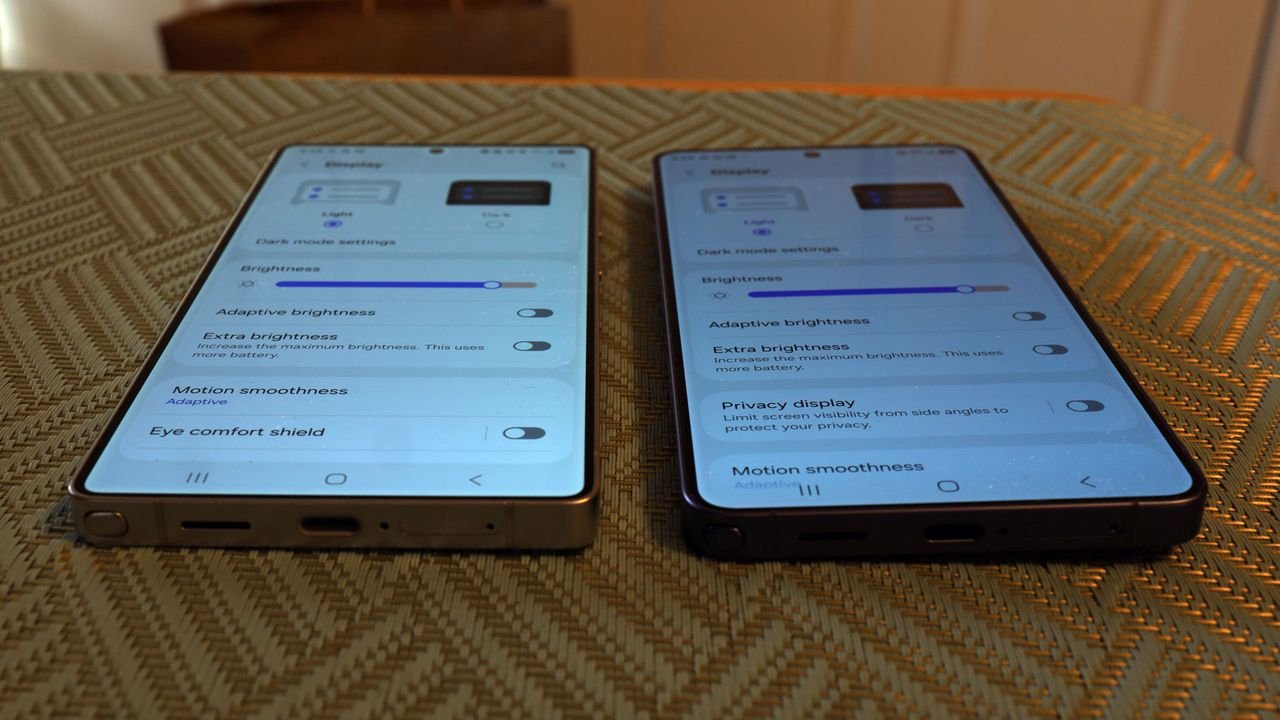
Looking dead on, with my eyes perpendicular to the screen, I thought I detected a slight difference, with the S25 Ultra possibly a hint brighter. The difference is so small, I’m not sure it’s evident in this photo.
However, when I shifted perspective to more of an off-angle view, the difference was stark. Granted, I would not normally view my screen this way, but I think this offers some evidence that the difference may be driven by how Samsung is now handling wide pixels. In Privacy display, they are turned off, but perhaps their configuration, even with Privacy display off, is slightly altered as compared to how the S25 Ultra’s pixels are arrayed.
I have sent Samsung the image and asked for comment. I’ll update this post with their reply.
What I think we may have here is a reasonable tradeoff: an almost imperceptible screen adjustment on brightness (and maybe color saturation) for a powerful and currently unmatched mobile phone privacy tool.
I have suffered zero eyestrain using the Galaxy S26 Ultra and stand by my original review. It’s still the best Android out there. That said, Samsung should step forward and outline exactly what the Privacy display technology does or does not do to the screen in default mode and address the small changes in screen brightness.
We test MacBook Neo, unpacking Sam Altman’s QuitGPT controversy, and how Sonos got its groove back – YouTube
Follow TechRadar on Google News and add us as a preferred source to get our expert news, reviews, and opinion in your feeds. Make sure to click the Follow button!
And of course, you can also follow TechRadar on YouTube and TikTok for news, reviews, unboxings in video form, and get regular updates from us on WhatsApp too.
” data-join-the-conversation-text=”Join the Conversation”>
You must confirm your public display name before commenting
Please logout and then login again, you will then be prompted to enter your display name.