

If Star Wars Eclipse was Quantic Dream’s safe bet, Spellcasters Chronicles is the wild card
We’ve known since 2021 that French studio Quantic Dream – known for its narrative-led single-player titles like Heavy Rain and Detroit: Become Human – has been working on the action-adventure game Star Wars Eclipse. But what we didn’t know, until now, is that the studio has also been working on a multiplayer title at the same time: Spellcasters Chronicles. It marks the first time Quantic Dream has stepped foot into the hotly contested waters of multiplayer.
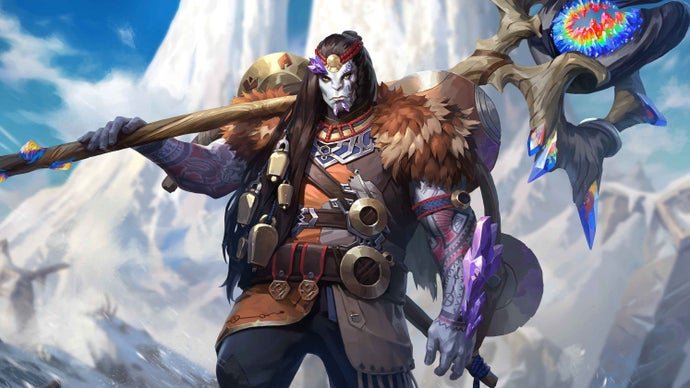
Spellcasters is a free-to-play, 3v3 blend of action and strategy, which sees teams of magic-wielding mages attempting to destroy the opposition’s Lifestone. In addition to attacking the opposing team directly with spells, players can summon creatures or create buildings on their own territory, with the game allowing competitors to customise their spell deck to suit their playstyle. Most eye-catchingly of all, players can summon enormous Titans to potentially turn the tide of battle, once certain conditions are met.
The monetisation model is based around cosmetics, and Quantic Dream hopes to launch a closed beta before the end of the year.
Work on Spellcasters began seven years ago, shortly after the completion of Detroit: Become Human. “It started up really as a pet project, but somehow we really fell in love with that game,” says game director Gregorie Diaconu. “I think at the beginning it was three or four people. It was a concept initially that came up from David Cage.”
The team relished the change from Quantic Dream’s usual fare. “It was so different from what we’ve done before, and we love to challenge ourselves to create new things, to innovate and both on the artistic side and the gameplay side.”
Lead producer Laura Courouble points out that although Quantic Dream has never shipped a multiplayer game, it has always done things differently, right from its debut title, Omikron: The Nomad Soul. “Innovation has always been in the DNA of the studio,” she says. Spellcasters was about asking what the studio could add for the multiplayer space: “What can we bring to the table?”
But there was an obvious lack of multiplayer expertise inside Quantic Dream – which is why the vast majority of the hundred or so people in the Spellcasters team are new hires. Courouble joined from Ubisoft six years ago, and the studio has been steadily building up the team over the past half decade.
“People that have had previous experiences in multiplayer, in competitive games, in stylized art have joined us,” says Courouble, although she says that hiring was made more difficult owing to the intense secrecy around the project. It was a “little miracle” that there were no leaks in the past seven years, she adds.
Courouble says the new hires fall broadly into two groups. “There were those that were curious,” she says, intrigued by Quantic Dream’s new direction, and there were those who came recommended by others. “For example, on our network and online team that has been built in the new studio in Montreal, there are a lot of very, very senior people that have more than 20, 25 years experience that first joined because they were interested by the promises. But they know people that [might] be working in a different industry, but still on network or online, and that might be interested in coming back to video games.”
In-house tech
The minority of Quantic Dream veterans on the Spellcasters team are mostly working on the game’s engine. It’s the same in-house tech that was used for Quantic Dream’s single-player titles, although the stylised art is a world away from the realism-focused visuals of games like Detroit: Become Human.
It’s been a lot of work to get an online multiplayer game working on an engine that was never designed for such things, but Quantic Dream didn’t consider switching to something like Unreal Engine instead. “I think it’s part of our culture to do things in-house,” says Diaconu, noting that they had faith in their engine team, some of whom have been with the studio for decades. He cites Quantic Dream’s in-house engine as a key strength. “It’s really the tech that lets us make games that don’t necessarily look like others,” he says. “It’s something that helps us stand the test of time more than other games that rely on the latest fashionable tech.”
Courouble says that although switching to Unreal would have made it easier to hire experienced people, and would have provided ready-made network solutions, it would have also split the engineering team. “We would have had the traditional engineer team that would’ve stayed on our internal tech, and we would’ve needed to hire new engineers that would also have to learn of the ways that we are producing things at Quantic Dream.”
Guillaume de Fondaumière, co-CEO of Quantic Dream, takes a more holistic view. “The question of whether or not we should have our own tech has always been very pregnant at the studio, and we are looking at what others are doing, in particular Unreal of course. But there are three main reasons why we keep developing our own engine.”
One is giving the studio’s artists precisely the tools they need. “We have a strong focus on cinematography, on creating living, believable characters,” he says. “This required us in the past, and still today, to create tailored tools for artists.” The second reason is independence. “When you work with a third-party engine and middleware, if you want something specific, you just put a ticket in and wait for that need to be probably more broadly needed before it’s eventually going to be developed – and that’s not helping us.”
With Quantic Dream’s internal tech, such needs can be addressed almost immediately. “My tech art lead is sitting right next to the engineer lead,” says Courouble, “and she’s always asking him, ‘Anthony, can we have that? Can we add that?”
“If you have a dependency to a third party that is not going to prioritize you, you never get the tool in time and it creates all sorts of chaos and problems,” says de Fondaumière. “We now have a research and development team of 140, and that’s a lot, that’s a big investment. But on the other hand, we keep all the revenue just for ourselves.”
The third reason is more nebulous. “It’s also, I would say, a human thing,” says de Fondaumière. “We like to keep the knowhow. We don’t want to let go of people. We think very, very carefully [about how] not to disrupt the company culture, which is very much keeping our talents and giving them new challenges.”
The game
At the start, there was almost a “game jam feeling” about the development of Spellcasters, says Diaconu. “Like, for instance, one day somebody says, ‘Hey, why can’t we fly?’ Oh, let’s try it. And it became one of the defining aspects of the game.”
That aspect – that the player can fly anywhere on the map with no restrictions – seems like the kind of thing that would completely break a multiplayer game. But here, where Spellcasters is almost a mix between a hero shooter and an RTS, it makes sense.
“We just added this idea as a test, and we said, ‘Oh, that’s absolutely great,’ because it makes you feel both the fantasy of being all-powerful, but also gives you a more strategic view of the battle,” says Diaconu. Naturally, there were worries about destroying any kind of balance and making players too powerful. “And we said, ‘No, actually that’s the fun of it,'” recalls Diaconu. “Let’s break the thing. Let’s use things that usually would break the game and build the game around that. And in the end, it makes the game unique.”
The character designs we’ve seen so far look impressive – and vaguely reminiscent, perhaps, of the art style of Prince of Persia: The Lost Crown. “We wanted to have something that looks stylized,”says Diaconu. “It was fresh for us. Personally, I love anime, and so it was a way to make an almost playable anime, with a more western touch. And something that we also wanted to showcase in the game is that magic can be representative of a lot of things in different cultures. Of course, there’s the typical vision of Gandalf in The Lord of the Rings, the very western aspect of it, but we really wanted to put the emphasis on showcasing magic from different cultures, with different inspirations.” The idea is that everyone should be able to find a character that suits them, a character where the player can “see their point of view and see why they fight,” he says.
The game’s wow factor comes from the Titans – huge, screen-filling beasts that slowly stomp towards the opponent’s Lifestone. One of the reasons that the team decided to go with a third-person viewpoint was to provide a sense of scale, says Diaconu, showing the smallness of the player against armies of creatures and towering Titans. The latter have proven to be a big hit with players, says Courouble. “I always remember one of the first play tests where we had them,” she says, “and one of the players reacted like, ‘Whoa!’ And it was just such a childish, ‘Whoa!’ I loved it.”
Like Helldivers 2, Spellcasters Chronicles includes a persistent narrative, whereby the outcomes of battles have knock-on effects for the fate of the world – although Quantic Dream won’t go into the specifics of that narrative at this point.
Each battle is fairly short, at 25 minutes, and with only three players per team, matchmaking should be fairly quick. “So it’s easier to set up,” says Diaconu. “I wouldn’t say casual, but it’s easy to do a quick game, but do really deep dives if you want to get more involved. We wanted to approach the game as something that can be played either in addition to the other games that hardcore competitive players are playing, or something that you can really dedicate your time to.”
Target audience
Which brings us on to the question of how Spellcasters Chronicles plans to compete in an extremely crowded multiplayer market, dominated by evergreen titles like League of Legends and Fortnite. How is Quantic Dream going to tempt players away from those behemoths?
“Well, as usual, we are going to present what we do, and tell players, ‘Have a taste of it, and play it, and tell us if that is something for you,'” says de Fondaumière. “And then hopefully we’ll have enough players to be able to continue to develop the game and create new content for it.
“When you innovate, it is very hard to determine in a very precise manner what your target audience is, what share of the market you’re going to take. You’re just innovating, and hoping that you’re going to attract a sufficient amount of players around the world to sustain the project.”
He recalls being told there wasn’t a market for games with interactive storytelling back in 2004, ahead of the launch of Fahrenheit (also known as Indigo Prophecy). “Well, we’ve shown game after game that there are people that are interested in this, and we’ve grown steadily game after game.
“With Spellcasters Chronicles, we have the same approach. Yes, there are always going to be competitors, there are going to be people who are fighting for brain time or leisure time. I think coming with something unique, intriguing, that is offering something really distinctive, something that you’ve never played before, is a first step in the right direction.”
He’s hoping that Spellcasters will offer something of interest for players of games like Fortnite, League of Legends, and Smite – but he admits he doesn’t know quite how large the audience will be. “Honestly, we have difficulties ourselves building forecasts at the moment, but we’re confident that it’s going to be large enough for us to sustain the team and continue to develop this game further. That’s the bet.”
He is well aware that Spellcasters is the riskier of the two games Quantic Dream has in development. But it’s all part of the vision. Back in 2019, the Chinese giant NetEase took a minority stake in Quantic Dream, and later, in 2022, bought the studio outright. It was all about “finding the financial means to set up the studio in such a way that we could self-develop and self-finance our games,” says de Fondaumière. “We thought, Okay, we’re going now without any publisher, and we’re venturing into this new world for us on two paths.
“There’s one path which is continuing to work on the single-player, narrative-branching experiences that we have been creating for so many years – and that is Star Wars Eclipse. Most of the people that worked on Detroit: Become Human, with a few exceptions, are today working on Star Wars Eclipse.”
The other path is Spellcasters Chronicles. “One, from a business standpoint, can be regarded as risky, a bold, new move into a totally new direction,” says de Fondaumière. The other path, by contrast, is “more secure”, a path of “continuing on something that we know works, and that has been successful,” he says. “We’re still going to innovate on Star Wars Eclipse, don’t get me wrong, but it’s in a similar genre and in a similar orientation that the studio has always had.”
The buck stops here
A safe bet, and a risky venture. Given that their money is behind all this, what does NetEase think about Quantic Dream’s bold move into multiplayer? “They were very surprised, like a lot of people, when we came up with this concept,” says Diaconu. “But they really wanted to see where we would take it.
“They managed to provide us with support on some aspects: for instance, in terms of process or good practices when it comes to maintaining a live game, which is something we’ve never done before. They were really excited. We had the chance to do a playtest in their office in China last year. We actually had the opportunity to meet the Marvel Rivals team at the time, and we exchanged creatively with them. So they gave us success to a large pool of knowledge and passion, and that’s absolutely great for us.”
Has NetEase given any directions on the way the game should be made? “On the creative aspect of it, they were very, very eager to understand what we wanted to make,” says Diaconu. “They never gave us notes about how you shouldn’t do the game like this or this. They were more like a big brother that will give us some good advice, and that’s something that personally I really appreciate.”
“Sometimes they would warn us,” adds Courouble, “because they have this huge expertise in terms of live-ops games and stuff like that. So they were like, ‘How are you handling your balancing?'” And for the technical aspects, she adds, “of course we had access to their huge infrastructure.”
De Fondaumière emphasises that Quantic Dream has maintained its independence under NetEase. “They’ve treated us as a fully independent studio,” he says. “Of course, you need to convince the management of the financial aspect of the project, but once it’s greenlit, then it’s a go.” They meet with NetEase “three, four times a year just to say, okay, this is where we are, this is how much it costs, this is how much we think eventually the project is going to [make]. But that’s it.”
Self-publishing has obviously been freeing for Quantic Dream. Yet there’s still the fact that ultimately, the buck now stops with NetEase – which seems to go against Quantic Dream’s much-talked-about need for independence in terms of things like maintaining its own in-house engine. De Fondaumière is aware that in the end, it’s a compromise. “Unfortunately, neither David nor I are billionaires, and thereby we can’t independently fund our game. So yes, there is this financial dependency on shareholders, but then it’s up to David and myself to set the limits of how we want to work, and how we want this dependency to evolve through time.”
Spellcasters Chronicles is a fascinating bet to place from a studio that’s known for single-player, story-driven titles. And we’ve seen plenty of high-profile titles fail in the multiplayer space. But Star Wars Eclipse provides some relative security for Quantic Dream – and if Spellcasters finds an audience, the rewards could be considerable. “It’s bold, but if it succeeds it’s going to open up new opportunities for the studio,” says de Fondaumière.
