

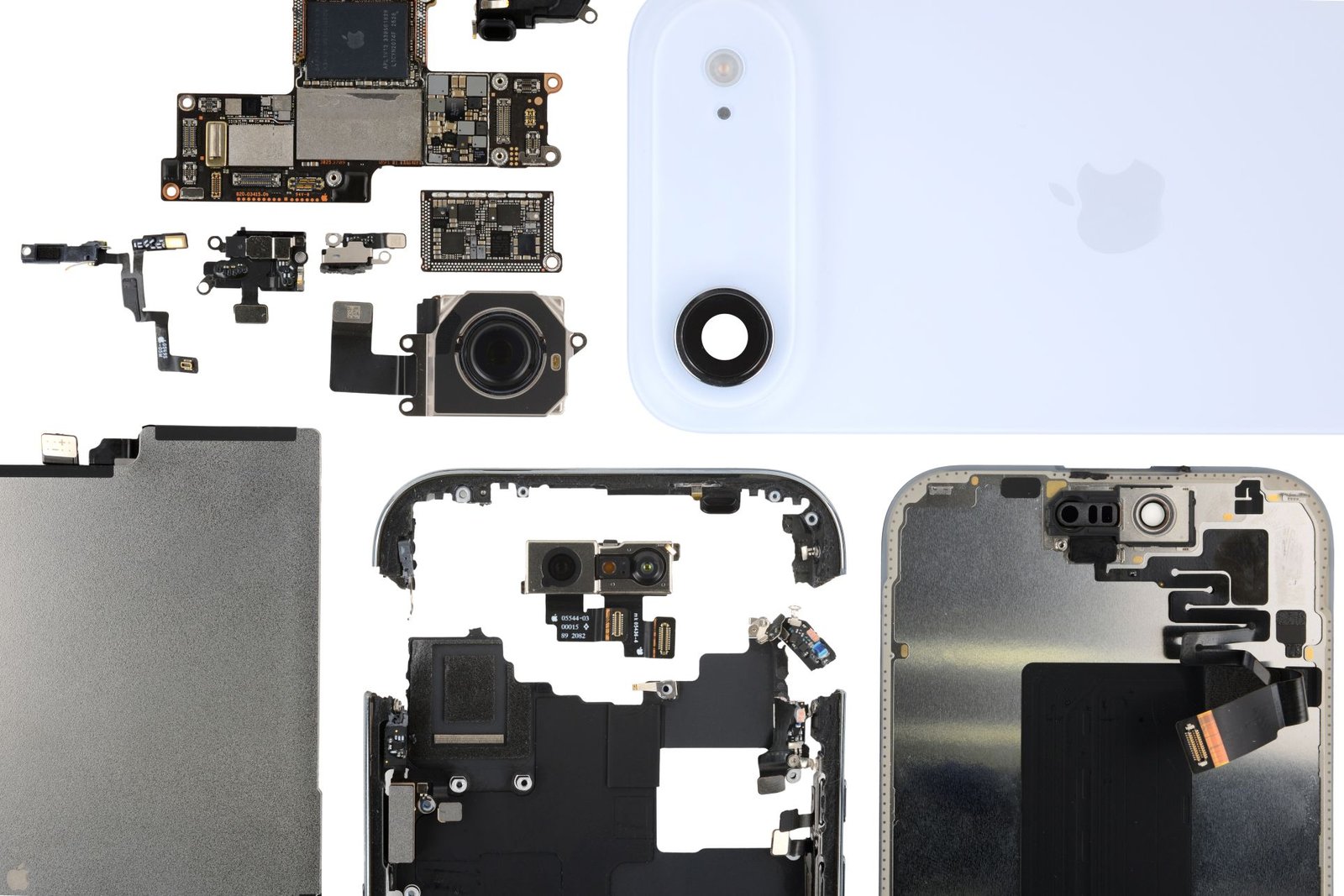
iFixit iPhone Air teardown
To be honest, we were holding our breath for the iPhone Air. Thinner usually means flimsier, harder to fix, and more glued-down parts. But the iPhone Air proves otherwise. Apple has somehow built its thinnest iPhone ever without tanking repairability.
Just a few months ago, Samsung’s Galaxy S25 Edge pulled off a similar trick in an ultra-thin package. How’d they do it? And how’d Apple follow suit?
The secret: Thinner can actually be more repairable, with clever design.
Clever Use of Space
Apple made one huge design shift in the Air, which they teased in their keynote and we confirmed with our Lumafield Neptune CT scanner: The middle of this phone is basically just a battery with a frame around it. Apple popped the logic board up above the battery, a large part of how their design got thinner without compromising repair.
When we score repairability, 80% of our score is determined by the ease of replacing the parts that are most important and most likely to break. To figure this out, we build a model of the repair process. What’s the path you have to take to get to the battery, or to the screen? We call this the “disassembly tree.” The ideal (if unlikely) disassembly tree is flat. No parts in the way of other parts.
A thin device often means, advantageously, a flat disassembly tree. Stacked parts are thicker than parts side-by-side. Our friends over at Framework have been saying this for a long time: It’s totally possible to make a thin and light device that’s also built for repair. The Framework Laptop has done this from the start, with nearly all major components accessible when you remove the cover.
And that’s exactly what we’re seeing in the Air. The logic board shift freed up room for the battery and helped the phone stay thin without cramming parts on top of each other. It also conveniently puts less stress on the board if the phone flexes in your pocket. It’s a smart workaround for the “bendgate” problems that haunted earlier slim iPhone designs. Not that the Air’s really going to be bending much, as Zack’s test at Jerry Rig Everything suggests.
(By the way, did you see we’re teaming up with Zack to bring you a toolkit that’s made for on-the-go repairs and durability testing?)
The Air trims a few extras compared to the Plus line it succeeds, losing the lower speaker and a rear camera. Like the 16e, it’s got just a single rear camera.
Inside, though, it packs the upgraded C1X modem, a new N1 WiFi chip, and the A19 Pro system-on-chip, all tucked into the logic board sandwich. It’s a lean, efficient setup that makes the most of limited space. This reduced complexity also contributes to quicker disassembly—fewer features, fewer parts, and fewer points of failure.
Battery Life? Eh. Battery Swaps? No Big Deal
There’s been a lot of buzz about battery life on this phone. Apple said “all-day battery life,” and tech reviewers of the world, noting the lack of watt-hour specificity and immediate announcement of an add-on battery pack, said, “really now?” At 12.26 Wh, this battery is certainly smaller than recent iPhones (closest comparison being the 13 Pro’s 11.97 Wh), and that raises questions about longevity. More charging cycles usually means faster wear. Still, Apple’s efficiency tricks give it solid runtime, at least for now.
But no battery lasts forever, so how difficult will swaps be? We’re relieved to see that the Air has all the greatest hits of the last few iPhone battery designs.
The Air’s battery is easy to find and accessible through the back glass thanks to Apple’s dual entry design. Even better, it’s a metal-encased battery. This thin layer of armor makes it more bend resistant and safer to replace. Even better than that, it’s mounted with electrically debonding adhesive strips. Hook them up to a power source and the battery lifts right out, no dangerous prying required. We used our FixHub Portable Power Station for an easy 12 V, and each strip freed after about 70 seconds.
Even though it’s comparably a small battery, its heft accounts for 28% of the phone’s total weight, more than any other component.
And in a fun twist, we’ve confirmed that it’s the exact same cell found in Apple’s MagSafe battery pack. You can swap between them and the phone still boots up just fine. Like a rear-mounted spare tire on an SUV, an iPhone Air with a MagSafe battery pack is ready for an on-the-go swap, if you will. Granted it’ll take a bit more than a tire iron to make it happen.
Modular Port, but How About Parts to Back It Up?
How about other likely-to-fail parts? USB-C ports are among the most common failure points in modern phones. Ports tend to collect moisture, which can cause corrosion, and no one is immune to pocket lint. Not to mention the standard port problems caused by mechanical wear and tear.
Now, to be clear, if your phone stops charging consistently, you shouldn’t jump straight to replacing the port. Every time you stick a charge cable into the port, you’re jamming pocket lint against the back. Give your charge port a cleanout before you replace it.
Featured Guide
How to Clean the Ports on your Electronic Device
Use this guide to clean the ports on your…
But when you do need to replace an Air charging port, you’ll be glad to know it’s decently modular, following the trend of the last few iPhone models. It’s a tedious process, with delicate flex cables, adhesive, and hard-to-reach screws, but it’s still feasible.
Interestingly, the modularity of the USB-C port doesn’t seem to be a serviceability choice. Apple won’t do USB-C repairs in-house and they don’t sell replacement ports for iPhones. Of course that won’t stop us from selling the parts as soon as we can get them—and regardless of intent, this modularity is nice to have.
Third-party parts manufacturers may take a bit to catch up, since this is a brand new architecture for the housing of the USB port. Apple reportedly used 3D printing to shrink the housing to fit the slim frame of the 6.5mm iPhone Air.
Apple says this process reduced material usage by 33% compared to conventional forging processes. Granted, the USB-C port is already tiny. But this isn’t the only place they’re using it: The Apple Watch Ultra 3 uses the same titanium-printing process in its case.
We took a close look at the titanium material in the USB-C port, with our Evident DSX2000 microscope.
What we saw was fascinating: these regular bubble-like structures.
We tapped in some friends in the additive manufacturing industry, who said it wasn’t quite like any metal 3D printing they’d seen before. Their best guess is that Apple’s using a binder or aerosol jet process in addition to some after-printing machining. This aligns with a binder jetting patent Apple inherited back in 2015 when they acquired Metaio. Whatever the exact process, the result is some truly impressive titanium manipulation.
(If you’re a metal 3D printing expert and want to give us your thoughts in the comments, we’d love to hear from you!)
How Strong Is Thin?
Titanium may have retired from the rest of the iPhone line (possibly for geopolitical more than technical reasons) but it’s back as the backbone of this slim smartphone. This tough metal is a good choice, but it’s only as strong as its weak points. Our empty-frame bend test snapped the Air at its plastic antenna passthroughs—a necessity if you want your phone to phone properly. CT scans make it clear: Apple reinforced the center section, but the top and bottom remain vulnerable.
Of course, the center is where the phone is most likely to bend, and so far testing hasn’t given any indication of undue flexibility. Will that design affect the durability of the phone? We doubt we’ll see instances of Airs snapping at the ends, but only time will tell.
The Verdict: A 7 out of 10 Repairability Score
At 6.5 mm, the Air is a hair thinner than Samsung’s Galaxy S25 Edge, yet it manages to keep modular parts and early battery access. Apple’s dual entry design makes battery swaps simple and keeps the fancy OLED out of harm’s way. Electrically debonding adhesive makes battery replacements a lot more consistent than traditional or stretch-release adhesive, and most other major components are simple to access and remove. Apple also kept their best-in-class clipped- and screwed-in screen and back glass architecture, enabling quick reassembly without requiring special adhesive.
Combined with Apple’s continued commitment to day-one repair manuals, the iPhone Air earns a provisional 7 out of 10 repairability score. (We’re waiting on Apple to make good on their parts availability commitment as well as final results on our parts pairing tests. Their recent track record’s pretty good, though.)
Apple has proved that thin doesn’t have to mean unfixable. The iPhone Air is slimmer than any iPhone before it, but its layout and design tradeoffs make repairs more approachable, not less. It still has limits, but the design shows that good engineering can make even the slimmest devices last longer in the real world. Successful field test for your new foldable, Apple. We’re onto you!
More Apple 2025 lineup teardowns coming soon. Bonus round: Can TechWoven handle… hot sauce?
