

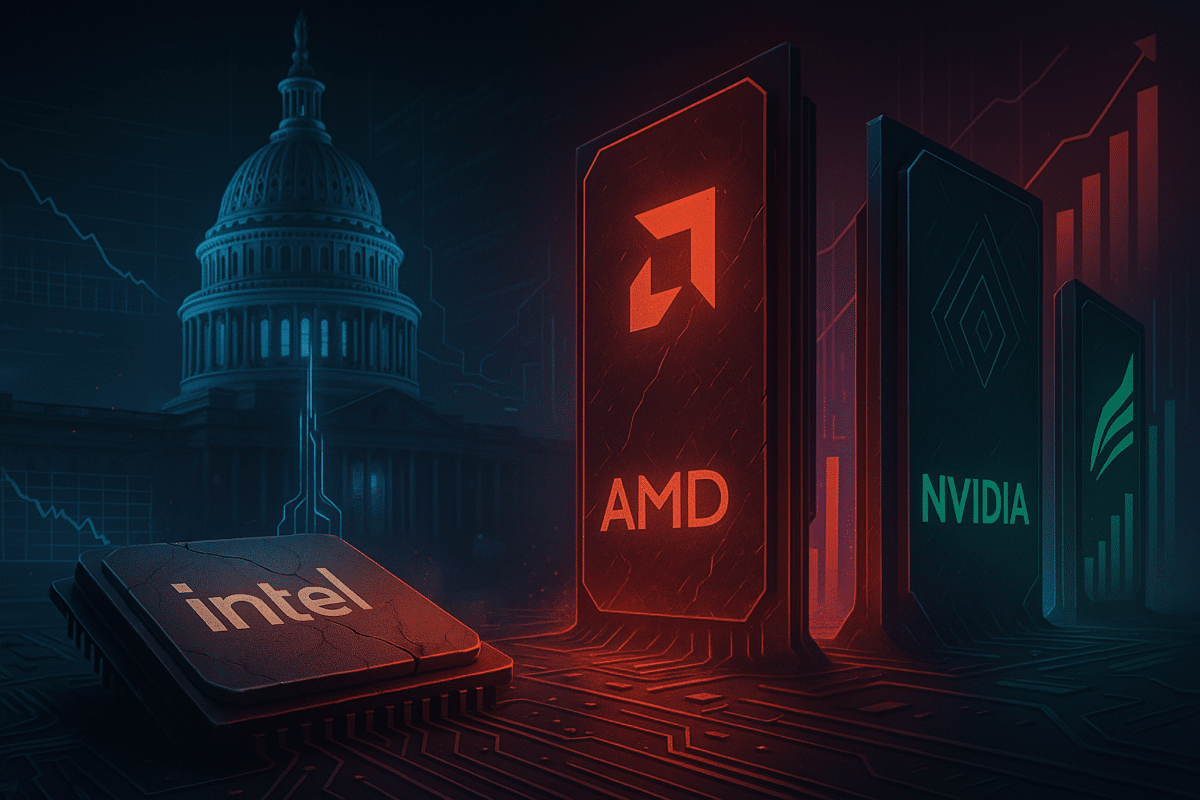
Intel Is Losing Ground in the High-End CPU Segment. Can the US Government Save the Legacy Company?
Key takeaways:
- AMD is Winning the High-End CPU Race: Despite Intel maintaining 75% of consumer CPU unit sales, AMD’s Ryzen 9000 and X3D chips now dominate in performance, efficiency, and revenue growth in the consumer market, rapidly eroding Intel’s premium market share.
- Intel’s Decline Is Self-Inflicted: Years of missed innovation cycles — from mobile to AI — have left Intel behind rivals. The company posted a $2.9B Q2 2025 loss, announced no less than 24,000 layoffs, and scrapped major projects, signaling systemic weakness.
- Government Bets $8.9B on Intel’s Future: The U.S. acquired a 10% stake in Intel as part of a strategic effort to reduce reliance on Taiwan’s TSMC and secure domestic chip production, giving Intel political backing beyond traditional investors.
- Uncertain Path to Recovery: While government support may give Intel preferential treatment and funding, questions remain whether it can overcome technical setbacks, rebuild trust with consumers, and realistically compete with AMD and Nvidia in the next decade.
Intel is declining, losing market share and revenue, laying off employees, halting investment plans, and even selling part of the company.
The brand is mainly struggling in the high-end B2C CPU market, where AMD has taken a commanding lead. Consumers are quickly abandoning Intel for better performance and reliability. Things are not looking in the business market either, where better performance and lower energy costs have enabled AMD to capture the top #30 positions for professional workloads according to PassMark benchmark numbers.
A computing giant that once dominated the US and global markets has lost half its valuation in less than 18 months, and might be sliding down further still.
What could have gone so wrong to bring it in this situation? That’s exactly what we’ll explore in this article, along with how the US government is now managing Intel’s situation.
Let’s start by looking at some figures that will give you an idea of how the market is gradually shifting to AMD for high-end CPUs.
Intel still dominated the unit sales share (75%) in the consumer CPU market in Q2 2025, while AMD held 23.9%. However, AMD’s revenue share in this quarter increased to 27.8% (a 9.8% YoY growth). This indicates that, although AMD isn’t selling many units, its CPUs are of higher value with better margins, and the rest of the market is catching on.
The story is similar in the desktop CPU sector, where AMD’s revenue share has increased by 20.5% YoY, now at 39.3%. Meanwhile, its unit sales also rose 9.2% YoY, with a current share of 32.2%. The boost in revenue is primarily due to AMD’s Ryzen 9000-series and X3D models.
Interestingly, Intel currently outsells AMD 2:1, meaning that for every one CPU AMD sells, Intel sells two. This might seem like a big difference until you consider past numbers.
In 2023, Intel outsold AMD 4:1, while in 2016, the ratio was a staggering 9:1. So, in less than 10 years, AMD has made significant progress, and if this trend continues, we might see AMD outsell Intel within the next five years.
What’s Intel’s Problem?
Many may wonder what the problem is with Intel. After all, it’s the same company that once led the markets not long ago. So, why has Intel lost market share to Nvidia and AMD? One answer could be lack of innovation. Another could be rushed development.
Intel missed the mobile revolution and also missed the AI movement. The CEO publicly acknowledged in July 2025, “We are not in the top 10 semiconductor companies.” The company has been slow to adapt to the changing market and is consequently falling behind.
Think of Nokia, the mobile phone company that dominated the industry 20 years ago. Once smartphones arrived, the company was too slow to innovate, slowly becoming out of touch with the market. Nokia didn’t keep up with the changing world, and it seems that Intel has made this same mistake over the last decade.
At the other end of the spectrum, chip makers like Nvidia were quick to capitalize on this opportunity. They saw an opening with the rise of AI and have now become the world’s largest company with a market cap of around $4 trillion. Sure, it’s a different kind of chip, but rumors have it Nvidia itself might be making an entrance to the CPU market in the near future, whereas Intel simply doesn’t have the products that can compete with a competitor Nvidia, not today or in the near future.
Intel CPU Performance Issues, an Example
Let’s look at the high end of the consumer market, where Intel’s $600 Core 9 285K high-end CPU falls behind the Ryzen 9 9950X3D on several key benchmarks, per Tom’s hardware and many, many other reviewers:
- Ryzen 9 offers 34% higher FPS (194.8) than Intel (144.9). The 285K doesn’t even manage to outperform AMD’s more mid-segment Ryzen 9 9950X.
- The 285K also exhibits higher power consumption of 219W to 325W during intensive tasks, compared to the Ryzen 9 9950X3D’s 178W to 228W.
- Ryzen, built on the AM5 platform, offers support till 2027, offering more longevity than Intel’s LGA1851 platform.
- The Ryzen 9 9950X3D also offers 16% more base clock speed than its Intel counterpart, whereas the boost clock speed is identical for both CPUs.
- Ryzen 9 9950X3D has 3.2x more L3 cache, with a total cache memory of 144MB (16MB L2 + 128MB L3), compared to Intel’s capacity of 76MB
Now, Intel fans may argue that these are just on-paper specifications. But all of the above is notwithstanding the high percentage of returns they’ve faced with the latest generations. If any potential buyer looks up “Intel RMA issues” there are a multitude of recent stories from longstanding Intel consumers facing critical issues:
Michael Stapelberg, a long-time Intel user, started facing problems with the Intel 285K CPU, which died twice within months. The user’s high-end Linux PC failed to wake from sleep and became unresponsive even after resets, pointing to mainboard/CPU failure.
The CPU ran at 100°C, below the advised threshold of 110°C, and ambient heat didn’t possibly cause the issue, as the room was air-conditioned to maintain temperatures.
Plus, long-term intensive jobs, such as batch processing with Tesseract/CUDA, seem to worsen Intel 285K’s problems and instability. Michael went to the retailer’s site only to find tons of negative reviews of users facing similar issues.
That’s when he pulled the plug and switched to AMD Ryzen 9 9950X3D. AMD rendered better performance, though build time was 24s compared to Intel’s 26s, whereas the Linux compile time was 1m56s vs Intel’s 2m07s. Plus, AMD’s V-Cache offered more control, durability, and power optimization.
This isn’t just one isolated instance; you’ll find hundreds of negative reviews about Intel’s recent unreliability regarding high-end CPUs. In times when AI dominates almost every industry, businesses can’t walk around with a unreliable hardware, especially when billions of dollars are at stake. Hence, Intel is quickly losing ground in the high-end CPU sector.
Negative future projections are probably the reason why the company announced mass layoffs during its Q2 earnings release. Intel plans to lay off a staggering 24,000 people before the end of this year. At the end of 2024, the company had 99,500 ‘core employees,’ which it plans to shrink to 75,000.
Intel will also shut down ‘Intel automotive’ and lay off almost all workers in the sector, following weak demand for products. Plus, the company will also not go ahead with its ‘mega fabs’ in Germany and Poland, which planned to employ more than 5,000 people. The news on halting EU developments comes after Intel reported a net loss of $2.9B in the second quarter.
The US Government Acquires 10% Stake in Intel
Donald Trump is truly on a ‘deal-making’ spree. In April 2025, he made more or less a full-fledged acquisition deal with Intel. The US government acquired 10% stake in Intel for $8.9B.
The first question that would pop up in anyone’s mind is ‘Why’? Why would the US government want a 10% stake in a company that has been struggling for the best part of the last decade. Unlike President Obama’s government, which acquired stakes in several car companies during the 2008 recession to prevent them from going out of business, this Intel deal isn’t some save local jobs and support local economy move, rather thought out geopolitical play.
Now, it’s no secret that the entire world is dependent on TSMC, a Taiwanese chip-making giant that dominates the chip industry. As of 2024, TSMC holds a massive 64% market share in the dedicated contract chipmaking industry, with a total semiconductor output of $165B.
As per another report, in 2021, about 44.2% of U.S. imports of logic chips were manufactured in Taiwan. While some may say that this data is 4 years old, the situation hasn’t changed much since then.
The US government has been trying hard to counter this over-reliance on TSMC for some time, since Taiwan has been a red-hot zone for geopolitical conflict in the Far East, with China claiming it as its own, de facto territory.
A full scale conflict can throw the entire US chip importers in jeopardy. Companies like Nvidia, AMD, and Intel may have to move from pillar to posts to meet their chip requirement, and even that may not be enough. And there’s always the risk of China arm twisting TSMC to reduce (or even stop) exports to the US, which is exactly what Trump is worried about.
That’s probably why the CHIPS Act was born during Biden’s administration, a piece of legislation which looks to incentivize local chip manufacturing companies with a total incentive of $52B. As a result, Intel started investing heavily in its own foundry in the US, called the Intel Foundry, which aims to manufacture semiconductors and chips within the US itself.
But, building a foundry isn’t child’s play. Apart from the billions of dollars of investments needed, there’s complicated machinery involved along with large-scale high-skilled workforce. So, it’s safe to say that the US is still a decade or so from becoming from self-reliant in this domain, even at full speed in terms of investments.
So, Trump came up with a plan – he picked a horse and bet $8.9B on it to solve the dependency crisis for the US. Setting up a foundry is one thing but getting other importers to buy chips from Intel is another.
Why would a company like AMD or Nvidia, which have been using TSMC chips for years and has given them great results, suddenly shift to Intel-made chips just because they’re locally manufactured? Well, maybe because the US government can now arm-twist via tariffs and other mechanisms to shift a part of their chip export to local chips, and say, ‘Buy it from Intel or we’ll make importing a lot harder.’
What’s in It for Intel?
Intel has secured a $7.86B grant under the CHIPS Act under the Biden administration. But this meant that the company had to comply with a slew of conditions and oversight, project milestones, construction, reporting, tracking, and so on. It’s like having a ghost watch your back at all times.
However, this $8.9B investment comes with no such conditions like having to give up 10% of the company. In fact, it’s likely that it was a strategic infusion from the US government, which might now be pulling strings for the company. Who knows what trade deals will be because that’s the horse the US bet on and they certainly don’t want it to lose?
Intel has been an institutional company for the US in the past and is of strategic importance to Trump. Seeing them lose out to competitors doesn’t paint a good picture for the country. Maybe this is the US government’s attempt to keep the company afloat amidst rising competition and failing innovation.
Money has never been Intel’s problem. Until recently, hundreds of investors would line up to offer Intel $10B because they believed the company could make them money hand over fist in the next 30 years. The real question is ‘Can they?’ Does Intel have it in them to rise up from rock bottom and punch above its weight to compete against the likes of AMD and potentially Nvidia in the near future? The market certainly doesn’t buy this possibility.
The US government’s stake changes the odds a bit, though. Intel is now like Trump’s child, who’ll get favorable treatment for as long as the government is invested. So, we might see Intel making domestic chips in the next decade, selling them to other companies, and turning profitable once more. After all, their brand might have taken some big hit with the last generations, but it certainly didn’t die.
That said, this won’t happen in the blink of an eye. It will take time and precious resources, which is precisely why the US government decided to get involved.
As technology continues to evolve—from the return of ‘dumbphones’ to faster and sleeker computers—seasoned tech journalist, Cedric Solidon, continues to dedicate himself to writing stories that inform, empower, and connect with readers across all levels of digital literacy. With 20 years of professional writing experience, this University of the Philippines Journalism graduate has carved out a niche as a trusted voice in tech media. Read more
Whether he’s breaking down the latest advancements in cybersecurity or explaining how silicon-carbon batteries can extend your phone’s battery life, his writing remains rooted in clarity, curiosity, and utility. Long before he was writing for Techreport, HP, Citrix, SAP, Globe Telecom, CyberGhost VPN, and ExpressVPN, Cedric’s love for technology began at home courtesy of a Nintendo Family Computer and a stack of tech magazines. Growing up, his days were often filled with sessions of Contra, Bomberman, Red Alert 2, and the criminally underrated Crusader: No Regret.
But gaming wasn’t his only gateway to tech. He devoured every T3, PCMag, and PC Gamer issue he could get his hands on, often reading them cover to cover. It wasn’t long before he explored the early web in IRC chatrooms, online forums, and fledgling tech blogs, soaking in every byte of knowledge from the late ’90s and early 2000s internet boom. That fascination with tech didn’t just stick. It evolved into a full-blown calling. After graduating with a degree in Journalism, he began his writing career at the dawn of Web 2.0.
What started with small editorial roles and freelance gigs soon grew into a full-fledged career. He has since collaborated with global tech leaders, lending his voice to content that bridges technical expertise with everyday usability. He’s also written annual reports for Globe Telecom and consumer-friendly guides for VPN companies like CyberGhost and ExpressVPN, empowering readers to understand the importance of digital privacy.
His versatility spans not just tech journalism but also technical writing. He once worked with a local tech company developing web and mobile apps for logistics firms, crafting documentation and communication materials that brought together user-friendliness with deep technical understanding. That experience sharpened his ability to break down dense, often jargon-heavy material into content that speaks clearly to both developers and decision-makers. At the heart of his work lies a simple belief: technology should feel empowering, not intimidating.
Even if the likes of smartphones and AI are now commonplace, he understands that there’s still a knowledge gap, especially when it comes to hardware or the real-world benefits of new tools. His writing hopes to help close that gap. Cedric’s writing style reflects that mission. It’s friendly without being fluffy and informative without being overwhelming. Whether writing for seasoned IT professionals or casual readers curious about the latest gadgets, he focuses on how a piece of technology can improve our lives, boost our productivity, or make our work more efficient.
That human-first approach makes his content feel more like a conversation than a technical manual. As his writing career progresses, his passion for tech journalism remains as strong as ever. With the growing need for accessible, responsible tech communication, he sees his role not just as a journalist but as a guide who helps readers navigate a digital world that’s often as confusing as it is exciting. From reviewing the latest devices to unpacking global tech trends, Cedric isn’t just reporting on the future; he’s helping to write it. Read less
The Tech Report editorial policy is centered on providing helpful, accurate content that offers real value to our readers. We only work with experienced writers who have specific knowledge in the topics they cover, including latest developments in technology, online privacy, cryptocurrencies, software, and more. Our editorial policy ensures that each topic is researched and curated by our in-house editors. We maintain rigorous journalistic standards, and every article is 100% written by real authors.
