

Is the UK’s New Online Safety Act About Protection or Control?
Key Takeaways
- New UK Online Safety Act has layers: The UK’s newest provisions to the Online Safety Act claim to protect children from harmful online content (pornographic, specifically), but is that really all there is to it?
- The people have spoken: Proton VPN reported a 1,400% surge in UK signups only minutes after the bill was passed, showing exactly what many people thought of the new legislation.
- The ‘porn block’ might involves more control than protection: The new provisions may potentially open the door to content over-moderation, privacy infringement, and security vulnerabilities. After all, online platforms (like PornHub, which suffered multiple data leaks) will have more of your personal data (like your ID).
If Orwell had a social media account, it’s pretty likely he would have been shadowbanned by now. Not for being rude, but for being a little too on point.
The UK has officially passed and signed into law the Online Safety Act’s newest provision At first glance, it sounds like a well-intended no-brainer: a sweeping effort to protect children from the myriad of harmful content on the internet.
But dig a little deeper, and it starts to look a little unsettling.
Critics argue that the law might clean up some of the internet’s darker corners, but on the flipside, it runs a high risk of turning the internet into a tightly policed echo chamber. Vague terms like ‘legal but harmful’ give platforms broad leeway to take down anything that could plausibly upset anyone.
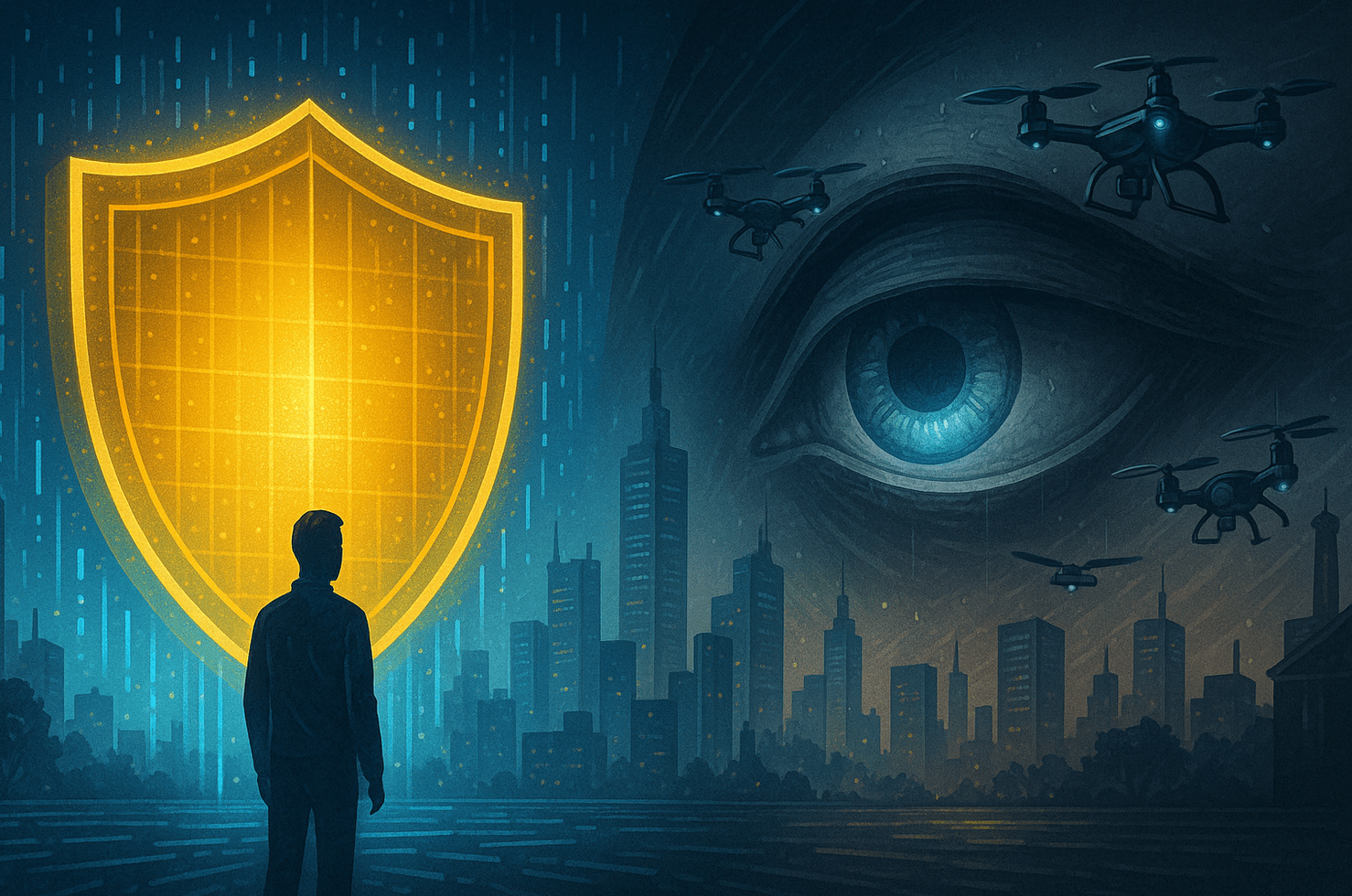
Is this law a genuine attempt to make the online world safer? Or is it simply a convenient vehicle to exert a little more control over it?
What the Law Says, and Why People Are Worried
The Online Safety Act gives Ofcom, the UK’s communications regulator (or media watchdog as referred to by the Brits), broad powers to oversee digital platforms. This ranges from social media giants like X (formerly Twitter) to messaging apps, forums, and even online games.
It affects virtually all platforms that let UK users interact with one another, and this includes companies not headquartered in the UK but with a large UK user base.
Here’s a summary of what changed on July 25, 2025:
- The ‘Are you 18?’ checkbox was replaced with an age verification process
- Facial age estimation and email-based age verification have become necessary steps
- Banks and mobile providers will be able to confirm your adult status
- Official ID verification (driver’s license or passport) to access ‘potentially harmful’ platforms
- Platforms enforce more restrictive content controls for children
- Online services must report on actions they take to keep children safe on their platforms
Ofcom’s stated goal: to protect users, particularly children, from online harm.
This includes a few things that most of us can generally agree are harmful: cracking down on child exploitation, terrorism-related content, and cyberbullying.
However, it gets a little murky with the phrase ‘legal but harmful.’ This gives regulators the right to pressure platforms into removing content that isn’t illegal but that, for whatever reason, they deem harmful.
This may sound harmless on the surface. But who defines what’s ‘harmful’? And to whom is it harmful exactly?
Without a more rigid definition for these things, platforms can (and most likely will) over-police and pre-emptively remove anything ‘potentially’ offensive: a political meme, a protest video, or simply an awkward joke.
You know that running gag about people yelling ‘I feel offended by this?’ Well, the UK might have just officialized legal repercussions for these things.
This isn’t just hypothetical. Even before the law fully kicked in, users and moderators had reported increased takedowns on platforms like Discord, Reddit, and X. Entire communities have disappeared. Conversations once considered edgy or critical are being throttled, flagged, or shadowbanned.
When your law relies on self-perceived emotional harm to police online content, platforms will start being afraid to host speech that isn’t illegal but that might cause someone to complain.
And that’s a losing move for internet users, free speech, and digital freedom.
The Public Reaction Was Instant (and Loud)
Government officials framed the Online Safety Act as a protective measure; the public, however, seemed to interpret it differently. Within minutes of the law going into effect, UK residents started making moves online, and fast.
Proton VPN, one of the world’s most privacy-focused VPN providers, reported a 1,400% surge in UK signups just minutes after the bill had passed.
No, that’s not a typo. It was the largest spike they’d ever seen from a single country, and unlike other VPN surges triggered by one-off censorship events, such as France’s adult site block, this one didn’t fade.
This reaction says a lot more than any think tank or government press release could.
People saw the law for what it could become: a way to monitor, censor, and control. And, accordingly, they responded by masking up digitally and protecting themselves as best they could. There have even been over 446,000 signatures for a petition to repeal the Act.
That’s almost half a million people that joined in protest in less than a week since the new provisions passed into law.
VPNs, privacy forums, and encrypted apps are no longer niche. They’re becoming a necessary digital self-defense.
And remember, this whole UK ‘porn block’ initially started from a 2015 poll made by OnePoll, a survey company known for polls like ‘The World’s Coolest Man Bun’ and ‘Wrong Side of the Bed: Myth or Fact.’
Was It Ever Just About Protecting the Children?
On paper, the Online Safety Act is about shielding children from harmful content: a cause we can all get behind. But if that was really the goal, why are adults losing access to forums, private servers, and even something as harmless as political memes?
The truth is, this law reaches far beyond explicit material. It’s already affecting:
- Gaming communities on Discord, where moderators and moderation bots receive directions to remove ‘harmful’ messages
- Political discourse on X, where posts criticizing UK policy are disappearing or receiving warnings
- Encrypted chats, where the threat of backdoor access looms despite resistance from the industry
Then, there’s also the growing push for mandatory age verification, which requires users to upload government-issued ID just to access certain websites. You don’t have to be an expert to see the massive privacy risk this presents, especially if the data ends up in the wrong hands, as it often tends to.
A month ago, we reported on a data leak compilation of 16 billion passwords. It’s one of the largest cybersecurity leaks in history (despite not being new).
Did you know that pornography sites might collect more data than Netflix or Hulu? Imagine what happens when these platforms fall prey to hacks.
Uhm… wait. They were:
- Brazzers in 2012 – email addresses, usernames, and passwords leaked for almost 800 accounts
- YouPorn in 2012 – email addresses and passwords leaked for 1.3M accounts
- High Tail Hall & Wife Lovers in 2018
- PornHub itself seems to have suffered a data breach in 2023
Now imagine that PornHub gets another data leak, but this time, they have more personal data (albeit encrypted) on their servers – like your ID and picture from the facial age estimation process.
What would a data leak associating people with their porn histories and preferences look like?
The government claims this is about protecting children. In reality, it’s breaking the internet for everyone. Imagine having to scan your passport just to scroll Reddit or join a private server.
That’s not child protection. That’s adult surveillance, and it’s a slippery slope that takes us out of reality and into fiction, 1984-type fiction to be more specific.
What’s Next, and Why Should You Care?
The UK may be the first off the mark with this type of sweeping internet legislation, but it likely won’t be the last. EU lawmakers (and not only – look at Switzerland) are already discussing similar laws, and Big Tech platforms are under increasing pressure to standardize their content moderation globally.
And, unfortunately, a VPN is only a band-aid solution. The UK government has already floated proposals to regulate or block access to privacy tools that don’t comply with state mandates. This includes VPNs, encrypted messaging apps, and even browsers that resist data collection.
This is no longer just about free speech. It’s about the internet infrastructure itself: who controls it, how you access it, what you see, and perhaps more importantly, who you are.
This is breaking the Internet for everyone in the UK (and also affecting EU users), and is turning out to be [a] tool for mass censorship and allowing malicious sites to collect gov IDs en masse, which will later be sold on the dark web.
If you’re outside the UK, don’t just tune this out. The narrative is being written as we speak, and other governments are taking notes.
Conclusion: What Happens When Free Speech Becomes a Filter?
The UK government says the Online Safety Act is about protecting people, especially children. However, the real-world impact paints a much more complex picture: disappearing posts, stricter controls, and a surge in VPN usage as citizens find ways around the system.
When you label legal speech as ‘harmful,’ and privacy tools come under threat, it’s not just the fringe voices that get suppressed: it’s everyone who says anything uncomfortable or politically unpopular.
So what can you do?
- Stay informed. Follow organizations like the Open Rights Group, Index on Censorship, and Big Brother Watch.
- Use privacy tools, and support them financially where possible.
- Share your experiences when content disappears or moderation goes too far.
- Push back. Sign petitions. Talk to your local MP. Discuss the issues with people who think it won’t affect them.
Once the infrastructure for censorship is established, it rarely stays focused on its original target.
The internet was meant to be a place for open conversation, creativity, and dissent. If we let those things slip away, we may not notice they’re gone until it’s too late.
Monica is a tech journalist and content writer with over a decade of professional experience and more than 3,000 published articles. Her work spans PC hardware, gaming, cybersecurity, consumer tech, fintech, SaaS, and digital entrepreneurship, blending deep technical insight with an accessible, reader-first approach. Read more
Her writing has appeared in Digital Trends, TechRadar, PC Gamer, Laptop Mag, SlashGear, Tom’s Hardware, The Escapist, WePC, and other major tech publications. Outside of tech, she’s also covered digital marketing and fintech for brands like Whop and Pay.com.
Whether she’s explaining the intricacies of GPU architecture, warning readers about phishing scams, or testing a liquid-cooled gaming PC, Monica focuses on making complex topics engaging, clear, and useful. She’s written everything from deep-dive explainers and product reviews to privacy guides and e-commerce strategy breakdowns.
Monica holds a BA in English Language and Linguistics and a Master’s in Global Media Industries from King’s College London. Her background in language and storytelling helps her craft content that’s not just informative, but genuinely helpful—and a little bit fun, too.
When she’s not elbow-deep in her PC case or neck-deep in a Google Doc file, she’s probably gaming until the early hours or spending time with her spoiled-rotten dog. Read less
The Tech Report editorial policy is centered on providing helpful, accurate content that offers real value to our readers. We only work with experienced writers who have specific knowledge in the topics they cover, including latest developments in technology, online privacy, cryptocurrencies, software, and more. Our editorial policy ensures that each topic is researched and curated by our in-house editors. We maintain rigorous journalistic standards, and every article is 100% written by real authors.
