

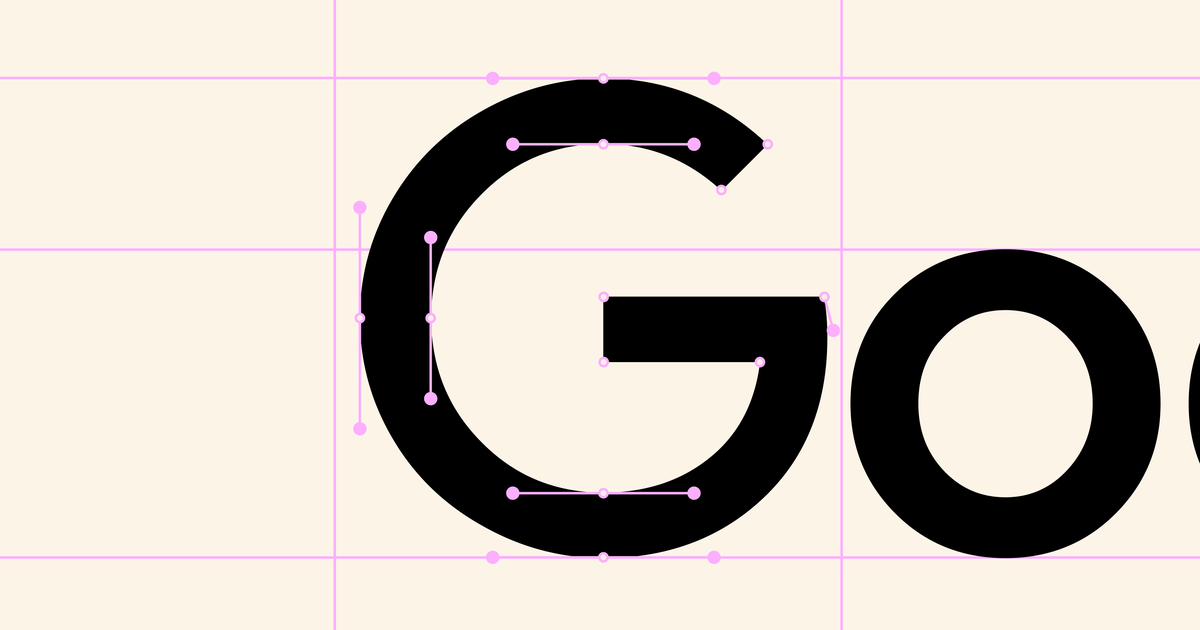
Making Google Sans Flex
When Google Sans rolled out in 2018, designers were initially ecstatic. “It meant we could finally use typography for a stronger brand statement,” recalls UX Designer Miche Alvarez. “But it also created a dual-font system using Google Sans for larger display text and Roboto for smaller text. It ended up being a compromise.”
Designers fought for a Google Sans version that would work at smaller sizes. So the team collaborated with designers in Search and at Colophon Foundry to refine the font, ultimately launching Google Sans Text (GST) in 2020.
Unlike the geometric Google Sans, the characters in Google Sans Text are taller, more condensed, and less circular. The typeface also includes more spacing between characters to aid readability. The numerals are less geometric, and the angled cuts on terminals are less severe, creating a more uniform and readable experience, even at small sizes. It was also designed to match the proportions of Roboto, Android’s default typeface, to make switching from Roboto a smoother process.
Google Sans Text rolled out on the Pixel 3, creating a more unified typographic experience.
Product teams eagerly adopted Google Sans and Google Sans Text but soon highlighted a new issue: Billions of people around the globe use non-Latin scripts like Arabic, Chinese, and Thai — writing systems not included in the initial character sets of Google Sans.
“Our mission is ‘to organize the world’s information,’” explains Dave Crossland, the Lead UX Program Manager for Google Fonts. “There was a clear need to expand Google Sans to all the languages that Google’s products get localized into.”
The effort was monumental. It meant meticulously crafting hundreds of thousands of new glyphs across more than 20 additional writing systems, each with its own unique design principles and visual nuances. The undertaking involved collaborating with expert type foundries worldwide, specialists familiar with the intricate requirements of each script — from the flowing curves of Arabic to the complex strokes of Japanese and the distinct forms of Ge’ez, the script used for Ethiopian and other languages in that region.
All together, this massive global language support makes Google Sans one of the world’s largest typeface families.
Google Sans Mono was created in 2020 to support contexts that needed fixed-width characters for editorial design, at medium and large text sizes. Despite this, it soon got its first big product integration, replacing Roboto Mono in Google Chat. The only problem? Developers hated it.
Because the font wasn’t intended to be used at smaller sizes, the letterforms weren’t legible. It was especially difficult to tell the a and o apart. “That can actually be catastrophic for code,” says Tobias Kunisch. “One misplaced character can break an entire program.”
Recognizing this critical need, a dedicated effort was launched to craft Google Sans Code, a monospaced typeface specifically designed to make code more readable. This involved thorough research into the 20 most common programming languages and how developers interact with code, aiming to make the new coding typeface more visually appealing while reducing the ambiguity of similar-looking letterforms. Based on these insights, Google tasked the Universal Thirst foundry to meticulously focus on specific letters, numbers, and operators to meet these requirements. The result is an eminently readable and surprisingly playful typeface.
Google Sans Code launched as an open-source font in 2025, and is the typeface used to display code in Gemini.
Google Sans launched as a proprietary brand typeface — meaning that it could only be used in Google products. While that control was great for protecting Google’s brand, it created a fragmented typographic experience across the digital ecosystem. You might see Google Sans in Gmail, then open WhatsApp and see Roboto or a device-specific font. It’s a persistent, if subtle, point of friction.
“It just doesn’t feel as nice,” stresses Visual Designer Megan Lynch. “On a subconscious level it impacts the experience.” This fragmented visual language, unlike the unified font experiences on some other platforms, made the digital journey less than seamless.
So this year — 2025 — Google decided to make Google Sans and Google Sans Flex open-source. It isn’t just about making a great font available; it’s about fostering a more consistent and polished digital environment for everyone. By offering Google Sans and Google Sans Flex to the wider community, we hope more developers and designers will bridge the visual gap between first-party and third-party apps. The goal is a more unified experience across devices and platforms, creating clearer, more comfortable interfaces for users wherever they engage with technology.
The story of Google Sans is a masterclass in need-based design — it was created not by a single flash of inspiration, but a thoughtful, human-centered evolution. Each problem, from misaligned lockups to illegible code, revealed an unmet need and ultimately led to innovation and improved user experience.
By making Google Sans Flex open-source, we’re extending that commitment beyond our walls. It’s an invitation to designers and developers worldwide: Use these tools, contribute to their growth, and together, let’s build clearer, more accessible, and more beautiful digital experiences for everyone. With your help, we can shape a more legible future, one character at a time.
Try Google Sans Flex, as well as our other fonts, at Google Fonts.
Special thanks to the hundreds of people who have contributed to making and evolving Google Sans, including: Akaki Razmadze, Aleksandra Samulenkova, Alex Blattmann, Alexei Vanyashin, Ali Almasri, Anagha Narayanan, Anaïs Lievens, Andy Stewart, Anonta Mon, Anthony Sheret, Anurag Gautam, Anuthin Wongsunkakon, Ashler, Ben Mitchell (Fontpad), Bianca Berning, Black Foundry, Borna Izadpanah, Botio Nikoltchev, Cadson Demak, Carmen Eva Marseille, Chris Simpkins, Colophon Foundry, Dalton Maag, Damien Correll, Daniel Grumer, Daniel Yacob, Dave Crossland, David Berlow, Denis Moyogo Jacquerye, Edd Harrington, Eduardo Rennó, Elena Peralta, Erin McLaughlin, Fiona Ross, Font Bureau, Fontef, Gor Design, Gor Jihanian, Gunjan Panchal, Gunnar Vilhjálmsson, Hanna Donker, Harry Dalton, Hilary Palmén, Hitesh Malaviya, Irene Vlachou, Jack McCabe, Jamra Patel, Jany Belluz, Jimmy Mooney, Joana Ranito, Jonathan Lee, Jonny Pinhorn, Jotika Khur-Yearn, Kalapi Gajjar, Khaled Hosny, Knaz Uiyamathiti, Lipi Raval, Mamoun Sakkal, Marc Foley, Marianna Paszkowska, Mark Jamra, Megan Lynch, Meir Sadan, Michele Patanè, Mike Guss, Mohamed Gaber, Namrata Goyal, Nance Cunningham, Natalia Qadreh, Neil Patel, Nikolaus Waxweiler, Omer Ziv, Pablo Bosch, Panuwat Usakunwathana, Pathum Egodawatta, Patrick McCormick, Pratyush Das, Riccardo De Franceschi, Richard Bailey, Ricky Atkins, Salomi Desai, Samir Souza Reis, Santiago Orozco, Simon Cozens, Sophia Siao, Sovichet Tep, Stephen Morey, Suppakit Chalermlarp, Tobias Kunisch, U+ Type, Universal Thirst, Vaishnavi Murthy, Yanek Iontef, and Ye Myat Lwin.
Shout out to Sarah Daily and Susanna Zaraysky for additional reporting. Illustration and motion by Arthur Ribeiro Vergani.
