

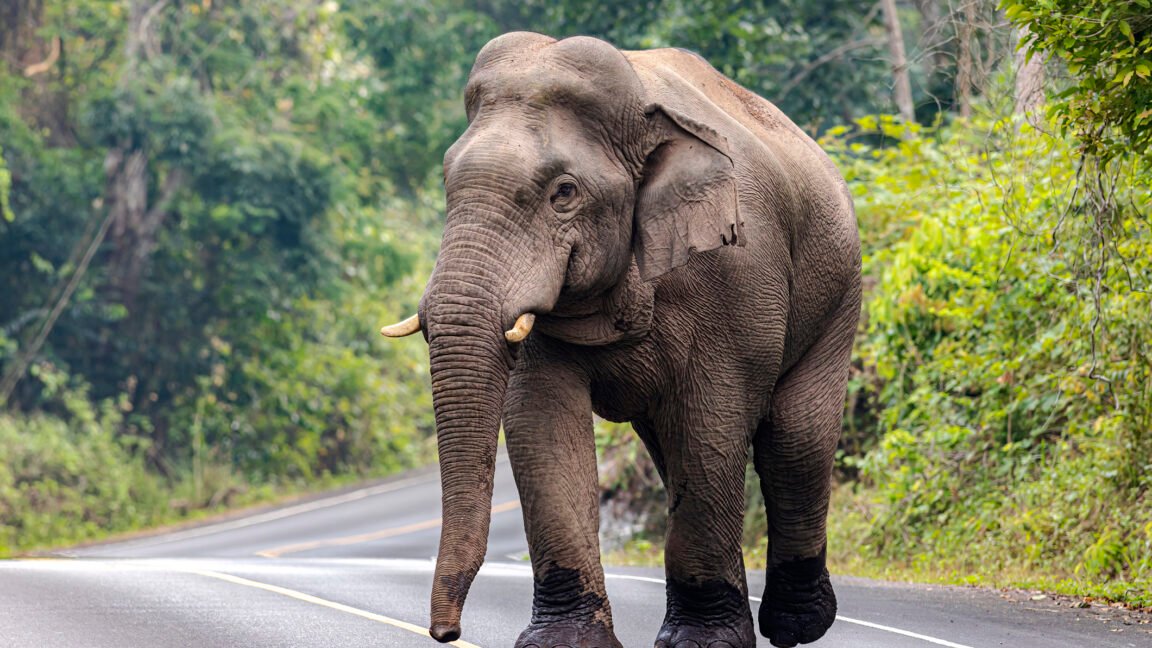
Mammoth de-extinction is bad conservation
The start-up Colossal Biosciences aims to use gene-editing technology to bring back the woolly mammoth and other extinct species. Recently, the company achieved major milestones: last year, they generated stem cells for the Asian elephant, the mammoth’s closest living relative, and this month they published photos of genetically modified mice with long, mammoth-like coats. According to the company’s founders, including Harvard and MIT professor George Church, these advances take Colossal a big step closer to their goal of using mammoths to combat climate change by restoring Arctic grassland ecosystems. Church also claims that Colossal’s woolly mammoth program will help protect endangered species like the Asian elephant, saying “we’re injecting money into conservation efforts.”
In other words, the scientific advances Colossal makes in their lab will result in positive changes from the tropics to the Arctic, from the soil to the atmosphere.
Colossal’s Jurassic Park-like ambitions have captured the imagination of the public and investors, bringing its latest valuation to $10 billion. And the company’s research does seem to be resulting in some technical advances. But I’d argue that the broader effort to de-extinct the mammoth is—as far as conservation efforts go—incredibly misguided. Ultimately, Colossal’s efforts won’t end up being about helping wild elephants or saving the climate. They’ll be about creating creatures for human spectacle, with insufficient attention to the costs and opportunity costs to human and animal life.
Shaky evidence
The Colossal website explains how they believe resurrected mammoths could help fight climate change: “cold-tolerant elephant mammoth hybrids grazing the grasslands… [will] scrape away layers of snow, so that the cold air can reach the soil.” This will reportedly help prevent permafrost from melting, blocking the release of greenhouse gasses currently trapped in the soil. Furthermore, by knocking down trees and maintaining grasslands, Colossal says, mammoths will help slow snowmelt, ensuring Arctic ecosystems absorb less sunlight.
Conservationists often claim that the reason to save charismatic species is that they are necessary for the sound functioning of the ecosystems that support humankind. Perhaps the most well-known of these stories is about the ecological changes wolves drove when they were reintroduced to Yellowstone National Park. Through some 25 peer-reviewed papers, two ecologists claimed to demonstrate that the reappearance of wolves in Yellowstone changed the behavior of elk, causing them to spend less time browsing the saplings of trees near rivers. This led to a chain of cause and effect (a trophic cascade) that affected beavers, birds, and even the flow of the river. A YouTube video on the phenomenon called “How Wolves Change Rivers” has been viewed more than 45 million times.
But other scientists were unable to replicate these findings—they discovered that the original statistics were flawed, and that human hunters likely contributed to elk population declines in Yellowstone.Ultimately, a 2019 review of the evidence by a team of researchers concluded that “the most robust science suggests trophic cascades are not evident in Yellowstone.” Similar ecological claims about tigers and sharks as apex predators also fail to withstand scientific scrutiny.
Elephants—widely described as “keystone species”—are also stars of a host of similar ecological stories. Many are featured on the Colossal website, including one of the most common claims about the role elephants play in seed dispersal. “Across all environments,” reads the website, “elephant dung filled with seeds serve to spread plants […] boosting the overall health of the ecosystem.” But would the disappearance of elephants really result in major changes in plant life? After all, some of the world’s grandest forests (like the Amazon) have survived for millennia after the disappearance of mammoth-sized megafauna.
For my PhD research in northeast India, I tried to systematically measure how important Asian elephants were for seed dispersal compared to other animals in the ecosystem; our team’s work, published in five peer-reviewed ecological journals (reviewed here), does find that elephants are uniquely good at dispersing the seeds of a few large-fruited species. But we also found that domestic cattle and macaques disperse some species’ seeds quite well, and that 80 percent of seeds dispersed in elephant dung end up eaten by ants. After several years of study, I cannot say with confidence that the forests where I worked would be drastically different in the absence of elephants.
The evidence for how living elephants affect carbon sequestration is also quite mixed. On the one hand, one paper finds that African forest elephants knock down softwood trees, making way for hardwood trees that sequester more carbon. But on the other hand, many more researchers looking at African savannas have found that elephants knock down lots of trees, converting forests into savannas and reducing carbon sequestration.
Colossal’s website offers links to peer-reviewed research that support their suppositions on the ecological role of woolly mammoths. A key study offers intriguing evidence that keeping large herbivores—reindeer, Yakutian horses, moose, musk ox, European bison, yaks, and cold-adapted sheep—at artificially high levels in a tussock grassland helped achieve colder ground temperatures, ostensibly protecting permafrost. But the study raises lots of questions: is it possible to boost these herbivores’ populations across the whole northern latitudes? If so, why do we need mammoths at all—why not just use species that already exist, which would surely be cheaper?
Plus, as ecologist Michelle Mack noted, as the winters warm due to climate change, too much trampling or sweeping away of snow could have the opposite effect, helping warm the soils underneath more quickly—if so, mammoths could be worse for the climate, not better.
All this is to say that ecosystems are diverse and messy, and those of us working in functional ecology don’t always discover consistent patterns. Researchers in the field often struggle to find robust evidence for how a living species affects modern-day ecosystems—surely it is far harder to understand how a creature extinct for around 10,000 years shaped its environment? And harder still to predict how it would shape tomorrow’s ecosystems? In effect, Colossal’s ecological narrative relies on that difficulty. But just because claims about the distant past are harder to fact-check doesn’t mean they are more likely to be true.
Ethical blind spots
Colossal’s website spells out 10 steps for mammoth resurrection. Steps nine and 10 are: “implant the early embryo into the healthy Asian or African elephant surrogates,” and “care for the surrogates in a world-class conservation facility for the duration of the gestation and afterward.”
Colossal’s cavalier plans to use captive elephants as surrogates for mammoth calves illustrate an old problem in modern wildlife conservation: indifference towards individual animal suffering. Leading international conservation NGOs lack animal welfare policies that would push conservationists to ask whether the costs of interventions in terms of animal welfare outweigh the biodiversity benefits. Over the years, that absence has resulted in a range of questionable decisions.
Colossal’s efforts take this apathy towards individual animals into hyperdrive. Despite society’s thousands of years of experience with Asian elephants, conservationists struggle to breed them in captivity. Asian elephants in modern zoo facilities suffer from infertility and lose their calves to stillbirth and infanticides almost twice as often as elephants in semi-wild conditions. Such problems will almost certainly be compounded when scientists try to have elephants deliver babies created in the lab, with a hodge podge of features from Asian elephants and mammoths.
Even in the best-case scenario, there would likely be many, many failed efforts to produce a viable organism before Colossal gets to a herd that can survive. This necessarily trial-and-error process could lead to incredible suffering for both elephant mothers and mammoth calves along the way. Elephants in the wild have been observed experiencing heartbreaking grief when their calves die, sometimes carrying their babies’ corpses for days—a grief the mother elephants might very well be subjected to as they are separated from their calves or find themselves unable to keep their chimeric offspring alive.
For the calves that do survive, their edited genomes could lead to chronic conditions, and the ancient mammoth gut microbiome might be impossible to resurrect, leading to digestive dysfunction. Then there will likely be social problems. Research finds that Asian elephants in Western zoos don’t live as long as wild elephants, and elephant researchers often bemoan the limited space, stimulation, and companionship available to elephants in captivity. These problems will surely also plague surviving animals.
Introduction to the wild will probably result in even more suffering: elephant experts recommend against introducing captive animals “that have had no natural foraging experience at all” to the wild as they are likely to experience “significant hardship.” Modern elephants survive not just through instinct, but through culture—matriarch-led herds teach calves what to eat and how to survive, providing a nurturing environment. We have good reason to believe mammoths also needed cultural instruction to survive. How many elephant/mammoth chimeras will suffer false starts and tragic deaths in the punishing Arctic without the social conditions that allowed them to thrive millennia ago?
Opportunity costs
If Colossal (or Colossal’s investors) really wish to foster Asian elephant conservation or combat climate change, they have many better options. The opportunity costs are especially striking for Asian elephant conservation: while over a trillion dollars is spent combatting climate change annually, the funds available to address the myriad of problems facing wild Asian elephants are far smaller. Take the example of India, the country with the largest population of wild Asian elephants in the world (estimated at 27,000) in a sea of 1.4 billion human beings.
Indians generally revere elephants and tolerate a great deal of hardship to enable coexistence—about 500 humans are killed due to human-elephant conflict annually there. But as a middle-income country continuing to struggle with widespread poverty, the federal government typically budgets less than $4M for Project Elephant, its flagship elephant conservation program. That’s less than $200 per wild elephant and 1/2000th as much as Colossal has raised so far. India’s conservation NGOs generally have even smaller budgets for their elephant work. The result is that conservationists are a decade behindwhere they expected to be in mapping where elephants range.
With Colossal’s budget, Asian elephant conservation NGOs could tackle the real threats to the survival of elephants: human-elephant conflict, loss of habitat and connectivity, poaching, and the spread of invasive plants unpalatable to elephants. Some conservationists are exploring creative schemes to help keep people and elephants safe from each other. There are also community-based efforts toremove invasive species like Lantana camara and restore native vegetation. Funds could enable development of an AI-powered system that allows the automated identification and monitoring of individual elephants. There is also a need for improved compensation schemes to ensure those who lose crops or property to wild elephants are made whole again.
As a US-based synthetic biology company, Colossal could also use its employees’ skills much more effectively to fight climate change. Perhaps they could genetically engineer trees and shrubs to sequester more carbon. Or Colossal could help us learn to produce meat from modified microbes or cultivated lines of cow, pig, and chicken cells, developing alternative proteins that could more efficiently feed the planet, protecting wildlife habitat and reducing greenhouse gas emissions.
The question is whether Colossal’s leaders and supporters are willing to pivot from a project that grabs news headlines to ones that would likely make positive differences. By tempting us with the resurrection of a long-dead creature, Colossal forces us to ask: do we want conservation to be primarily about feeding an unreflective imagination? Or do we want evidence, logic, and ethics to be central to our relationships with other species? For anyone who really cares about the climate, elephants, or animals in general, de-extincting the mammoth represents a huge waste and a colossal mistake.
Nitin Sekar served as the national lead for elephant conservation at WWF India for five years and is now a member of the Asian Elephant Specialist Group of the International Union for the Conservation of Nature’s Species Survival Commission The views presented here are his own.
