

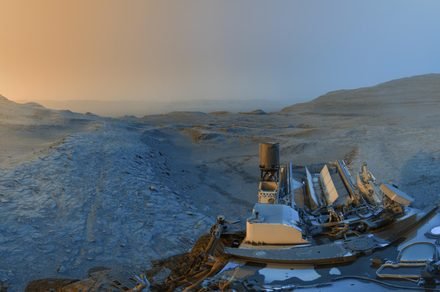
Mars has never looked so serene in this gorgeous image from a NASA rover
NASA/JPL-Caltech
Nearly 14 years ago, NASA’s Curiosity rover landed on Mars for a mission to explore the red planet and discover if it had an environment capable of supporting microbial life.
Over the years, the rover has also been beaming back striking images of its surroundings, including the stunner at the top of this page captured toward the end of last year.
It’s actually a composite combining two images — one taken in the morning and the other in the early evening.
Originally black and white, color was later added, with blue representing the morning panorama and yellow representing the afternoon one.
NASA’s Jet Propulsion Laboratory, which is overseeing the Mars mission, says that merging images in this way helps to bring out details in the landscape.
“The scene captured in this postcard shows Curiosity at the top of a ridge referred to as a boxwork formation,” JPL explains on its website. “These formations crisscross a region in the lower foothills of Mount Sharp, a 3-mile-tall (5-kilometer-tall) mountain which Curiosity has been climbing since 2014.”
It adds: “The boxwork formations are believed to have been created billions of years ago when water on ancient Mars dripped through rock cracks, carrying minerals with them. The minerals hardened after the water dried up; eons later, wind sandblasted the softer rock around these hardened minerals, exposing the ridges Curiosity is exploring today.”
The image was taken from the floor of Gale Crater, with the crater’s rim visible around 25 miles (40 kilometers) away.
Look closely and you can also see the rover’s wheel tracks leading from a place named as Valle de la Luna where last year Curiosity drilled for a rock sample.
The Curiosity mission was designed to last less than two years, so the fact that the rover is still trundling along and communicating with Earth is a testament to its robust design and NASA’s impressive engineering skills.
Since Curiosity’s arrival, NASA has dropped off another even more advanced rover — Perseverance. Arriving in spectacular fashion in 2021, the newer rover is also continuing to explore the martian surface, with some of its efforts paving the way for the first-ever crewed mission, which could take place in the 2030s.
Not so many moons ago, Trevor moved from one tea-loving island nation that drives on the left (Britain) to another (Japan)…
NASA’s mega moon rocket has arrived at the launchpad. What’s next?
Humans could be flying around the moon in just a few weeks from now.
NASA’s Space Launch System (SLS) rocket and Orion spacecraft reached the Launch Pad 39B at the Kennedy Space Center in Florida on Saturday following a 4-mile, 12-hour crawl from the Vehicle Assembly Building.
The rocket is being prepped for the Artemis II mission, which will carry three Americans and one Canadian on a voyage around the moon, taking humans further from Earth than ever before.
How to watch SpaceX Crew-11 splash down a month early
A medical issue with one of the astronauts prompted NASA to bring the crew home early.
It’s turned into an unusual mission for SpaceX’s Crew-11. Instead of remaining at the International Space Station (ISS) for the full duration of their mission, the four crew members are coming home a month early due to a medical issue with one of the astronauts.
Crew-11 departed the ISS on Wednesday afternoon and is due to splash down in the early hours of Thursday. Read on for full details on how to watch.
Piece by piece, SpaceX preps first Starship flight from Space Coast
The launch site at Cape Canaveral is gradually coming together.
SpaceX is making steady progress toward building out the pad at NASA’s Cape Canaveral site in Florida for the first Starship launch from the Space Coast.
On Tuesday, SpaceX installed the Ship Quick Disconnect (QD) arm on the launch tower at Launch Complex 39A (LC-39A). Space launch enthusiast site NASASpaceflight shared footage of engineers putting the part in place.
