

Misunderstood “photophoresis” effect could loft metal sheets to exosphere
Photophoresis can generate a tiny bit of lift without any moving parts.
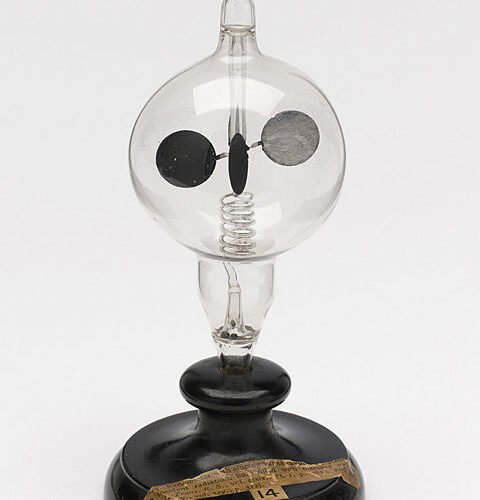
Most people would recognize the device in the image above, although they probably wouldn’t know it by its formal name: the Crookes radiometer. As its name implies, placing the radiometer in light produces a measurable change: the blades start spinning.
Unfortunately, many people misunderstand the physics of its operation (which we’ll return to shortly). The actual forces that drive the blades to spin, called photophoresis, can act on a variety of structures as long as they’re placed in a sufficiently low-density atmosphere. Now, a team of researchers has figured out that it may be possible to use the photophoretic effect to loft thin sheets of metal into the upper atmosphere of Earth and other planets. While their idea is to use it to send probes to the portion of the atmosphere that’s too high for balloons and too low for satellites, they have tested some working prototypes a bit closer to the Earth’s surface.
Photophoresis
It’s quite common—and quite wrong—to see explanations of the Crookes radiometer that involve radiation pressure. Supposedly, the dark sides of the blades absorb more photons, each of which carries a tiny bit of momentum, giving the dark side of the blades a consistent push. The problem with this explanation is that photons are bouncing off the silvery side, which imparts even more momentum. If the device were spinning due to radiation pressure, it would be turning in the opposite direction than it actually does.
An excess of the absorbed photons on the dark side is key to understanding how it works, though. Photophoresis operates through the temperature difference that develops between the warm, light-absorbing dark side of the blade and the cooler silvered side.
Any gas molecule that bumps into the dark side will likely pick up some of the excess thermal energy from it and move away from the blade faster than it arrived. At the sorts of atmospheric pressures we normally experience, these molecules don’t get very far before they bump into other gas molecules, which keeps any significant differences from developing.
But a Crookes radiometer is in a sealed glass container with a far lower air pressure. This allows the gas molecules to speed off much farther from the dark surface of the blade before they run into anything, creating an area of somewhat lower pressure at its surface. That causes gas near the surface of the shiny side to rush around and fill this lower-pressure area, imparting the force that starts the blades turning.
It’s pretty impressively inefficient in that sort of configuration, though. So people have spent a lot of time trying to design alternative configurations that can generate a bit more force. One idea with a lot of research traction is a setup that involves two thin metal sheets—one light, one dark—arranged parallel to each other. Both sheets would be heavily perforated to cut down on weight. And a subset of these holes would have a short pipe connecting the ones on the top and bottom sheet. (This has picked up the nickname “nanocardboard.”)
These pipes would serve several purposes. One is to simply link the two sheets into a single unit. Another is to act as an insulator, keeping heat from moving from the dark sheet to the light one, and thus enhancing the temperature gradient. Finally, they provide a direct path for air to move from the top of the light-colored sheet to the bottom of the dark one, giving a bit of directed thrust to help keep the sheets aloft.
Optimization
As you might imagine, there are a lot of free parameters you can tweak: the size of the gap between the sheets, the density of perforations in them, the number of those holes that are connected by a pipe, and so on. So a small team of researchers developed a system to model different configurations and attempt to optimize for lift. (We’ll get to their motivations for doing so a bit later.)
Starting with a disk of nanocardboard, “The inputs to the model are the geometric, optical and thermal properties of the disk, ambient gas conditions, and external radiative heat fluxes on the disk,” as the researchers describe it. “The outputs are the conductive heat fluxes on the two membranes, the membrane temperatures, and the net photophoretic lofting force on the structure.” In general, the ambient gas conditions needed to generate lift are similar to the ones inside the Crookes radiometer: well below the air pressure at sea level.
The model suggested that three trends should influence any final designs. The first is that the density of perforations is a balance. At relatively low elevations (meaning a denser atmosphere), many perforations increase the stress on large sheets, but they decrease the stress for small items at high elevations. The other thing is that, rather than increasing with surface area, lift tends to drop because the sheets are more likely to equilibrate to the prevailing temperatures. A square millimeter of nanocardboard produces over 10 times more lift per surface area than a 10-square-centimeter piece of the same material.
Finally, the researchers calculate that the lift is at its maximum in the mesosphere, the area just above the stratosphere (50–100 kilometers above Earth’s surface).
Light and lifting
The researchers then built a few sheets of nanocardboard to test the output of their model. The actual products, primarily made of chromium, aluminum, and aluminum oxide, were incredibly light, weighing only a gram for a square meter of material. When illuminated by a laser or white LED, they generated measurable force on a testing device, provided the atmosphere was kept sufficiently sparse. With an exposure equivalent to sunlight, the device generated more than it weighed.
It’s a really nice demonstration that we can take a relatively obscure and weak physical effect and design devices that can levitate in the upper atmosphere, powered by nothing more than sunlight—which is pretty cool.
But the researchers have a goal beyond that. The mesophere turns out to be a really difficult part of the atmosphere to study. It’s not dense enough to support balloons or aircraft, but it still has enough gas to make quick work of any satellites. So the researchers really want to turn one of these devices into an instrument-carrying aircraft. Unfortunately, that would mean adding the structural components needed to hold instruments, along with the instruments themselves. And even in the mesosphere, where lift is optimal, these things do not generate much in the way of lift.
Plus, there’s the issue of getting them there, given that they won’t generate enough lift in the lower atmosphere, so they’ll have to be carried into the upper stratosphere by something else and then be released gently enough to not damage their fragile structure. And then, unless you’re lofting them during the polar summer, they will likely come floating back down at night.
None of this is to say this is an impossible dream. But there are definitely a lot of very large hurdles between the work and practical applications on Earth—much less on Mars, where the authors suggest the system could also be used to explore the mesosphere. But even if that doesn’t end up being realistic, this is still a pretty neat bit of physics.
John is Ars Technica’s science editor. He has a Bachelor of Arts in Biochemistry from Columbia University, and a Ph.D. in Molecular and Cell Biology from the University of California, Berkeley. When physically separated from his keyboard, he tends to seek out a bicycle, or a scenic location for communing with his hiking boots.
