

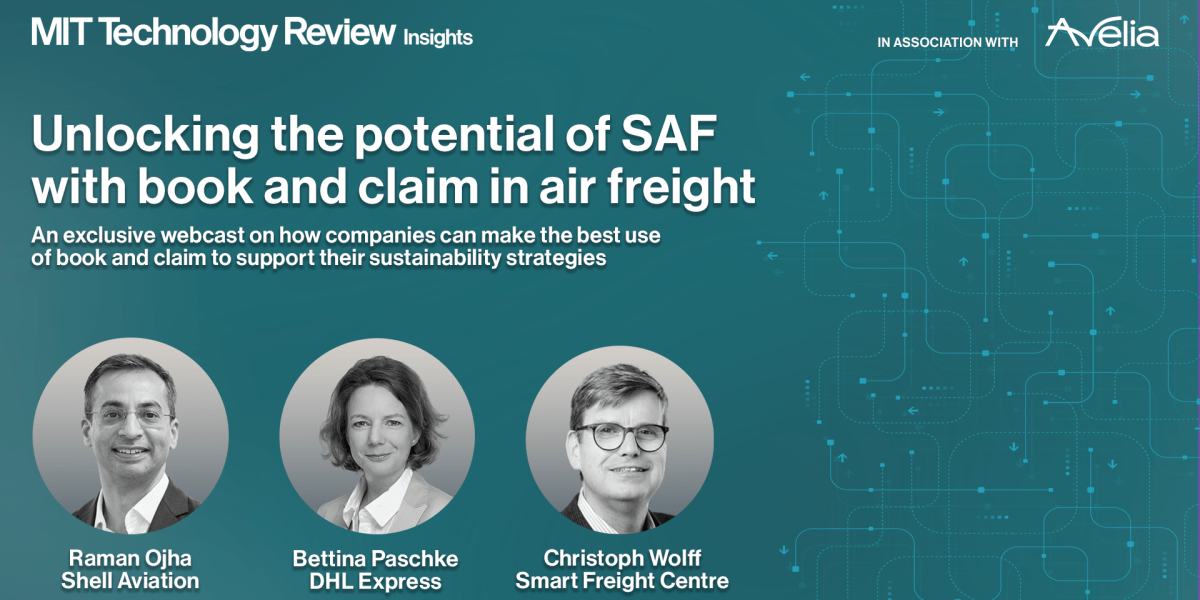
Mitigating emissions from air freight: Unlocking the potential of SAF with book and claim
Emissions from air freight have increased by 25% since 2019, according to a 2024 analysis by environmental advocacy organization Stand.Earth.
The researchers found that the expansion of cargo-only fleets to transport goods during the pandemic — as air travel halted, slower freight modes faced disruption, but demand for rapid delivery soared — has led to a yearly increase of almost 20 million tons of carbon dioxide, making up 93.8m tonnes from air freight overall.
And though fleet modernization and operational improvements by freight operators have contributed to ongoing decarbonization efforts, sustainable aviation fuel (SAF) looks set to be instrumental in helping the sector achieve its ambitions to reduce environmental footprint in the long-term.
When used neat, or pure and unblended, SAF can help reduce the life cycle of greenhouse gas emissions from aviation by as much as 80% relative to conventional fuel. It’s why the International Air Transport Association (IATA) estimates that SAF could account for as much as 65% of total reduction of emissions.
For Christoph Wolff, CEO of the Smart Freight Centre, “SAF is the main pathway” to decarbonization across both freight and the wider aviation ecosystem.
“The great thing about SAF is it’s chemically identical to Jet A fuel,” he says. “You can blend it [which means] you have a pathway to ramp it up. You can start small and you can scale it. By scaling it there is the promise or the hope that the price comes down.”
At at least twice the price of conventional jet fuel, cost is a significant barrier hindering broader adoption.
And it isn’t the only one standing between SAF and wider penetration.
Bridging the gap between a concentrated supply of SAF and global demand also remains a major hurdle.
Though the number of verified SAF outlets has increased from fewer than 20 locations in 2021 to 114 as of April 2025, according to sustainability solutions framework 4Air, that accounts for only 92 airports worldwide out of more than 40,000.
“SAF is central to the decarbonization of the aviation sector,” believes Raman Ojha, president of Shell Aviation. “Having said that, adoption and penetration of SAF hasn’t really picked up massively. It’s not due to lack of production capacity, but there are lots of things that are at play. And book and claim in that context helps to bridge that gap.”
Bridging the gap with book and claim
Book and claim is a chain of custody model, where the flow of administrative records is not necessarily connected to the physical product through the supply chain (source: ISO 22095:2020).
Book and claim potentially enables airlines and corporations to access the life cycle GHG emissions reduction benefits of SAF relative to conventional jet fuel even when SAF is not physically available at their location; this model helps bridge the gap between that concentrated supply and global demand, until SAF’s availability improves.
“To be bold, without book and claim, no short-term science-based target will be achieved,” says Bettina Paschke, vice president of ESG accounting, reporting and controlling at DHL Express. “Book and claim is essential to achieving science-based targets.”
“SAF production facilities are not everywhere,” she reiterates. “They’re very focused on one location, and if a customer wants to fulfil a mass balance obligation, SAF would need to be shipped around the world just to be at that airport for that customer. That would be very complicated, and very unrealistic.” It would also, counterintuitively, increase total emissions. By using book and claim instead, air freight operators can unlock the life cycle greenhouse gas emissions reduction benefits of SAF relative to conventional jet fuel now, without waiting for supply to broaden. “It might no longer be needed when we have SAF product facilities at each airport in the future,” she points out. “But at the moment, that’s not the case.”
At DHL itself, the mechanism has become central to achieving its own three interconnected sustainability pillars, which focus on decarbonizing logistics supply chains, supporting customers toward their decarbonization goals, and ensuring credible emission claims can be shared along the value chain.
Demonstrating the importance of a credible and viable framework for book and claim systems is also what inspired the 2022 launch of Shell’s Avelia, one of the first blockchain-powered digital SAF book and claim solutions for aviation, which expanded in 2024 to encompass air freight in addition to business travel. Depending on the offering, Avelia offers freight forwarders the opportunity to share the life cycle greenhouse gas emissions reduction benefits of SAF relative to conventional jet fuel across the value chain with shippers using their services.
“It’s also backed by a physical supply chain, which gives our customers — whether those be corporates or freight forwarders or even airlines — a peace of mind that the SAF has been injected at a certain airport, it’s been used and environmental attributes, with the help of blockchain, have been tracked to where they’re getting retired,” says Ojha.
He adds: “The most important or critical part is the transparency that it’s providing to our customers to be sure that they’re not saying something which they can’t confidently stand behind.”
Moving beyond early adoption
To scale up SAF via book and claim and help make it a more commercially viable lower-carbon solution, its adoption will need to be a coordinated “ecosystem play,” says Wolff. That includes early adopters, such as DHL, inspiring action from peers, solution providers such as Shell, working with various stakeholders to drive joint advocacy, and industry associations, like the Smart Freight Centre creating the required frameworks, educational resources, and industry alignment.
An active book and claim community made up of many forward-thinking advocates is already driving much of this work forward with a common goal to develop greater standardization and consensus, Wolff points out. “It helps to make sure all definitions on the system are compatible and they can talk to one another, provide educational support, and [also that] there’s a repository of transactions so that it can be documented in a way that people can see and think, ‘oh this is how we do it.’ There are some early adopters that are very experienced, but it needs a lot more people for it to get comfortable.”
In early 2024, discussions were held with a diverse group of expert book and claim stakeholders to develop and refine 11 key principles and best practices book and claim models. These represent an aligned set of principles informed by practical successes and challenges faced by practitioners working to decarbonize the heavy transport sector.
Adherence to such a framework is crucial given that book and claim is not yet accepted by the Greenhouse Gas (GHG) Protocol nor the Science Based Targets Initiative (SBTi) as a recognized model for reducing greenhouse gas emissions — though there are hopes that might change.
“The industrialization of book and claim delivery systems is key to credibility and recognition,” says Wolff. “The Greenhouse Gas Protocol and the Science Based Targets Initiative are making steps in recognizing that. There’s a pathway that the Smart Freight Centre is very closely involved in the technical working groups for [looking]to build such a system where, in addition to physical inventory, you also pursue market-based inventories.”
Paschke urges companies not to sit back and wait for policy to change before taking action, though. “The solution is there,” she says. “There are companies like DHL that are making huge upfront investments, and every single contribution helps to scale the industry and give a strong signal to the eco-space.”
As pressure to accelerate decarbonization gains pace, it’s critical that air freight operators consider this now, agrees Ojha. “Don’t wait for perfection in guidelines, regulations, or platforms — act now,” he says. “That’s very, very critical. Second, learn by doing and join hands with others. Don’t try to do everything independently or in-house.
“Third, make use of registries and platforms, such as Avelia, that can give credibility. Join them, utilize them, and leverage them so that you won’t have to establish auditability from scratch.
“And fourth, don’t look at scope book and claim as a means for acquiring a certificate for environmental attributes. Think in terms of your decarbonisation commitment and think of this as a tool for exposure management. Think in terms of the bigger picture.”
That bigger picture being a significant sector-wide push toward faster decarbonization — and turning the tide on emissions’ steep upward ascent.
This content was produced by Insights, the custom content arm of MIT Technology Review. It was not written by MIT Technology Review’s editorial staff. It was researched, designed, and written by human writers, editors, analysts, and illustrators. This includes the writing of surveys and collection of data for surveys. AI tools that may have been used were limited to secondary production processes that passed thorough human review.
This content is produced by MIT Technology Review Insights in association with Avelia. Avelia is a Shell owned solution and brand that was developed with support from Amex GBT, Accenture and Energy Web Foundation. The views from individuals not affiliated with Shell are their own and not those of Shell PLC or its affiliates. Cautionary note | Shell Global
