

NASA heads to Death Valley to test new Mars drone tech
A team is testing new flight software following the success of its Ingenuity aircraft.
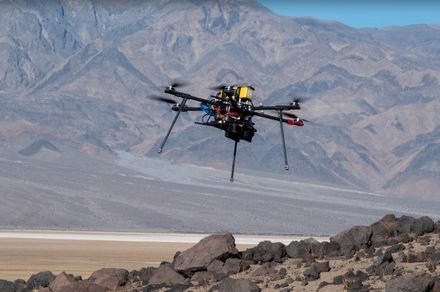
A NASA drone flies over Death Valley’s Mars Hill.
NASA/JPL-Caltech
After reaching Mars with the Perseverance rover in early 2021, NASA’s Ingenuity helicopter proved a huge success as it exceeded expectations with an astonishing 72 flights across the Martian surface.
But three years after entering the history books by becoming the first aircraft to achieve powered, controlled flight on another planet, Ingenuity sustained damage to one of its rotor blades in early 2024, preventing it from flying again.
Still, the aircraft’s successful mission, which saw it map parts of the Martian surface and assist Perseverance, inspired NASA’s Jet Propulsion Laboratory (JPL) engineers to work on next-generation models for future missions to Mars and possibly beyond.
Testing the new helicopter’s software and hardware involves heading to locations that offer something close to Mars-like conditions — minus the red planet’s extremely thin atmosphere, of course.
Such work has seen a JPL team recently head to California’s Death Valley National Park, a barren, dusty landscape that bears some resemblance to the fourth planet from the sun. The engineers flew tested new software by flying a drone over Death Valley’s Mars Hill and Mesquite Flats Sand Dunes.
“Ingenuity was designed to fly over well-textured terrain, estimating its motion by looking at visual features on the ground, but eventually it had to cross over blander areas where this became hard,” said Roland Brockers, a JPL researcher and drone pilot. “We want future vehicles to be more versatile and not have to worry about flying over challenging areas like these sand dunes.”
The test campaign has already accelerated the drone’s development, with the team discovering how different camera filters helped its drone to more effectively track the ground below, and how new algorithms can guide the flying machine to safely land in cluttered terrain like that of Mars Hill.
“Field tests give you a much more comprehensive perspective than solely looking at computer models and limited satellite images,” said JPL’s Nathan Williams, a geologist on the team who previously helped operate Ingenuity. “Scientifically interesting features aren’t always located in the most benign places, so we want to be prepared to explore even more challenging terrains than Ingenuity did.”
It’s not the first time a NASA team has headed to Death Valley to test out gear destined for other worlds. Engineers from the space agency have used the area since the 1970s, when it was preparing for the first Mars landings with the twin Viking spacecraft. More recently, it headed there to test the Perseverance rover’s precision landing system by flying a component of it in a piloted helicopter. The rover’s arrival on Mars was captured in an extraordinary video that showed in great detail its final moments before touchdown.
Not so many moons ago, Trevor moved from one tea-loving island nation that drives on the left (Britain) to another (Japan)…
Earth never looked so pretty as in this stunning ISS flyover
We’ve seen a few ISS aurora videos over the years, but this is one of the best.
When they’re not working on scientific research, astronauts aboard the International Space Station (ISS) like to spend time peering out of the windows to marvel at an astonishing view that never gets old.
Orbiting Earth at around 250 miles up and at a speed of around 17,000 mph, those aboard the ISS experience 16 sunsets and sunrises a day. And in certain conditions, they can also enjoy spectacular aurora light shows, caused by particles from the sun interacting with Earth’s magnetic field.
Blue Origin’s rocket booster returns to a hero’s welcome. Here’s why
The booster’s success marks a giant leap for the spaceflight company.
It’s been a week since Blue Origin landed the first-stage of its New Glenn rocket on a ship floating on the ocean, and with all of the back-slapping, endless celebrations, social media posts, and now a dramatic video (below), you’d be forgiven for thinking it was the first time it’d ever achieved such a feat. Oh wait, it was.
Yesterday, we welcomed Jacklyn and our fully reusable New Glenn first stage back to the Space Coast. Thank you, Team Blue. pic.twitter.com/WQyvFqn5Cd
— Blue Origin (@blueorigin) November 19, 2025
SpaceX preps next Starship flight as new booster rolls out for testing
It’ll be the first flight for a redesigned Super Heavy booster.
SpaceX is edging toward the 12th flight test of its mighty Starship rocket after the company rolled out the new Super Heavy booster for testing.
Appearing at SpaceX’s Starbase facility in southern Texas on Thursday, Booster 18 is the third version of the rocket’s main stage, with the 12th test set to see it fly for the very first time.
